
💡 Press Ctrl + F (or Cmd + F on Mac) to search and jump directly to any text on this page.
EXPANDING THE COLOR COMPUTER
THE COMPUTER THAT REFUSED TO STAY STOCK
CHIPS, SIMMs & SRAM, OH MY!
From its introduction in 1980, the TRS-80 Color Computer proved to be a remarkably expandable machine. While the original Color Computer 1 (1980) was initially offered with as little as 4K of RAM, enthusiasts and third-party manufacturers quickly developed upgrades that pushed its capabilities well beyond the original specifications.
The CoCo 1 and CoCo 2 (1983) shared the Motorola 6809E processor architecture, with memory upgrades progressing from 4K to 16K, 16K to 32K, and eventually 64K. More ambitious expansions explored 128K and 256K configurations, while bubble memory offered an entirely different approach to nonvolatile storage rather than conventional RAM expansion.
The introduction of the Color Computer 3 in 1986 marked a significant advancement. Equipped with 128K of RAM as standard and designed to support expansion to 512K, the CoCo 3 provided a more capable foundation for sophisticated software and operating systems. Later developments, including Cloud-9's DAT board, which helped to enable 2MB upgrades, and the Protector+, pushed the machine's capabilities even further.
Memory wasn't the only component receiving attention. Across the Color Computer family, enthusiasts also explored replacing the original Motorola 6809E processor with the enhanced Hitachi 63C09E, which offered additional instructions, native-mode operation, and improved performance in software designed to take advantage of its capabilities.
This section follows the evolution of memory and processor upgrades across all three Color Computer generations, from the earliest CoCo 1 RAM expansions and CoCo 2 enhancements to the advanced memory-management and CPU upgrades developed for the CoCo 3. Together, these products demonstrate how a computer family introduced in 1980 continues to evolve decades after its commercial life ended.
Stay 68 or goto 63; 16 or 32 to 2048
CPU Upgrade
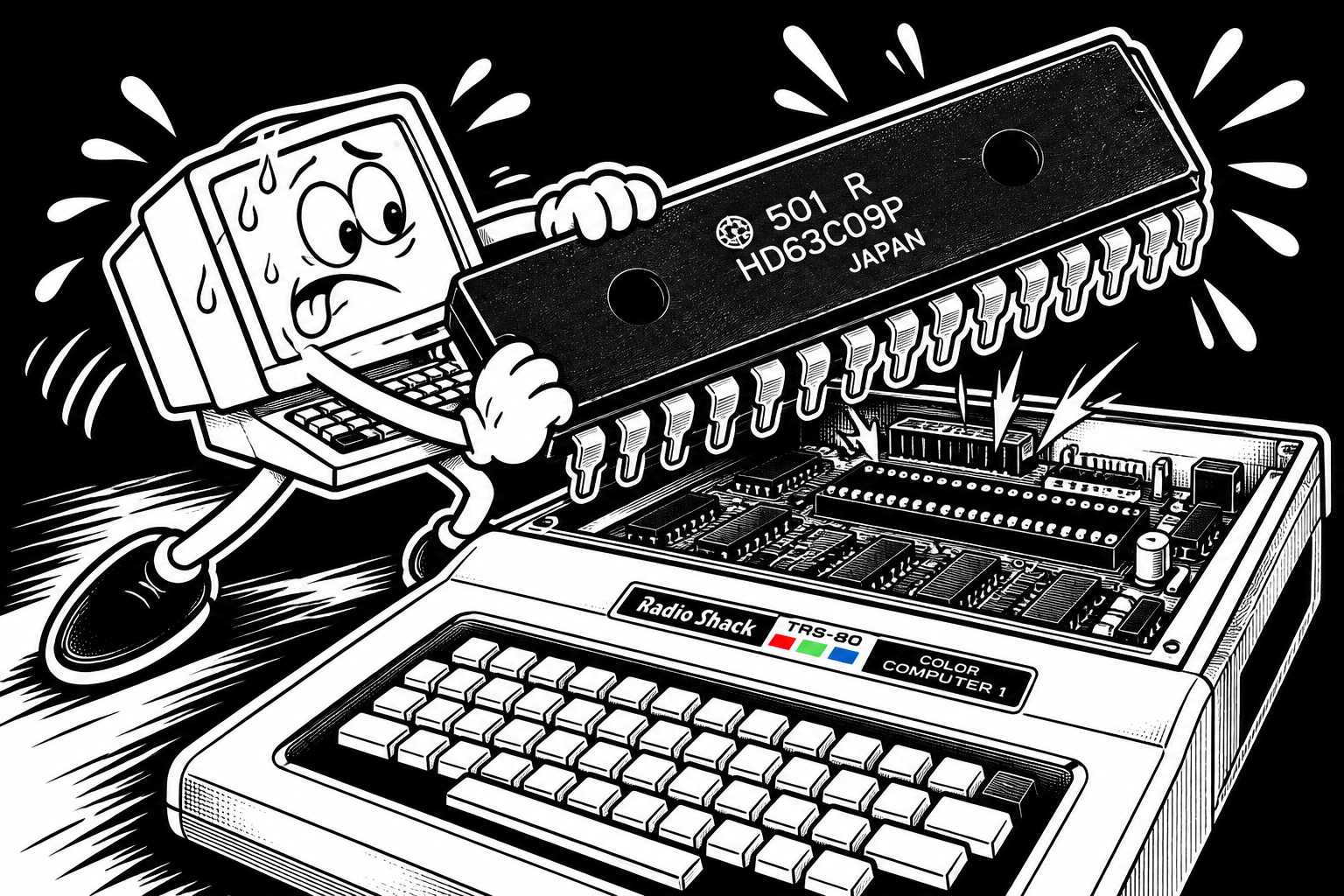
For the entry point into this section, we'll get the Color Computer's only widely adopted CPU replacement out of the way — the Hitachi HD6309, most commonly the externally clocked HD63C09EP.
Unlike a conventional speed upgrade, the 6309 offered something more interesting: an expanded instruction set and additional registers that gave programmers new ways to push the CoCo beyond its original capabilities.
The HC63C09E
Made by Hitachi
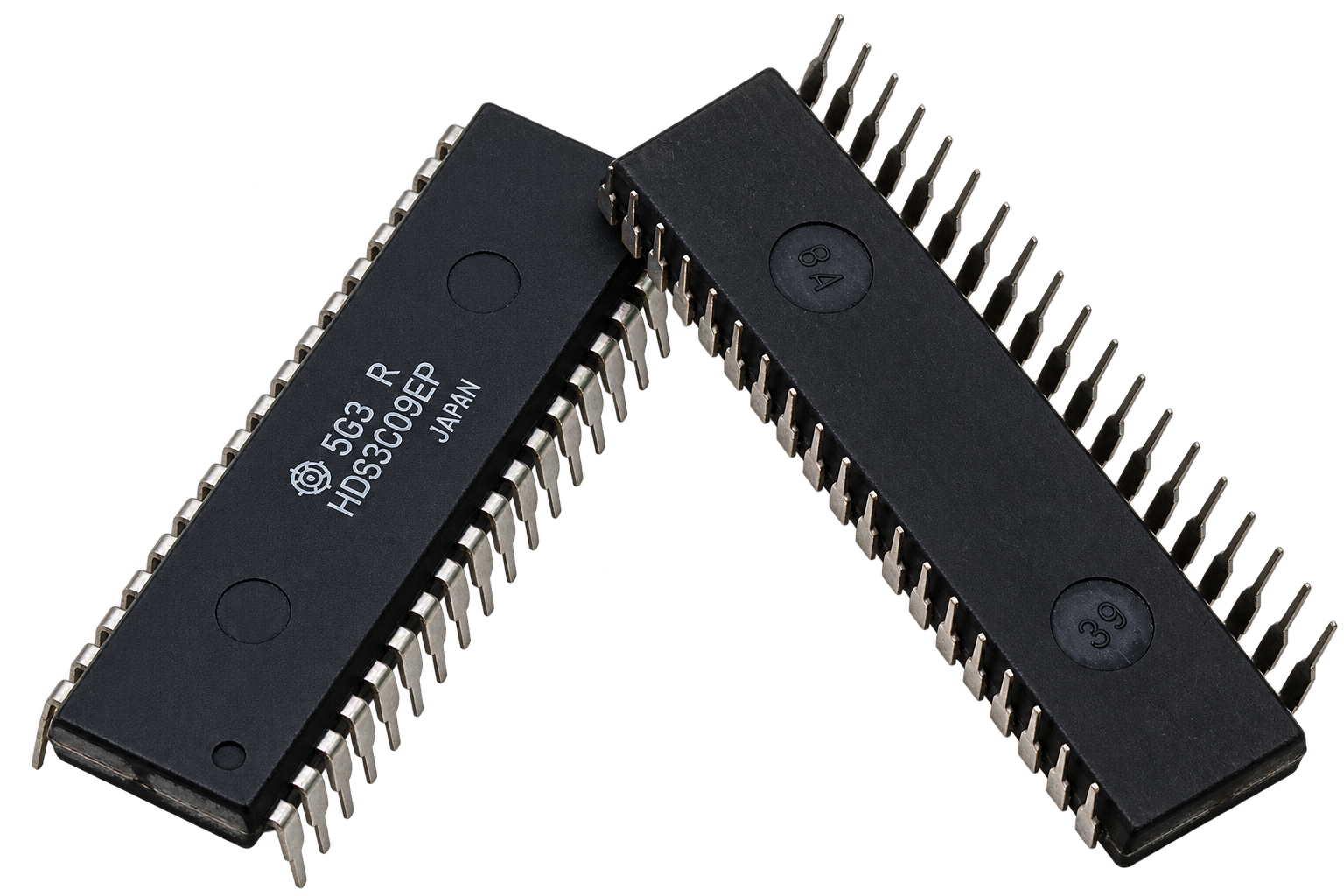
Hitachi HD6309 — The Processor That Gave the CoCo a Second Life
From an energy-efficient Motorola replacement to one of the Color Computer's most significant processor upgrades.
Why Hitachi Developed the 6309
When Motorola introduced the MC6809 microprocessor in 1978, it represented one of the most sophisticated 8-bit processors of its generation. With 16-bit registers, flexible addressing modes, and an instruction set well suited to high-level languages, the 6809 offered capabilities that distinguished it from many contemporary processors.
Motorola's 6809 architecture found a home in computers around the world. In the United States, Radio Shack selected the MC6809E for its TRS-80 Color Computer, introduced in 1980, and retained the processor throughout the CoCo 1, CoCo 2, and CoCo 3 generations.
The Color Computer was far from alone. In Britain, the Dragon 32 and Dragon 64 employed the same processor and a closely related hardware architecture, with the Dragon family later reaching North America through Tano and Spain through Eurohard. Brazil developed its own collection of CoCo-compatible computers, including Prológica's CP-400, the Dynacom MX-1600, and the LZ Color 64. Other relatives appeared in markets such as Mexico and Taiwan.
The 6809's influence extended well beyond CoCo-compatible machines. Japan's Fujitsu FM-7 family, France's Thomson computers, and the Vectrex video game console also employed members of the 6809 family, demonstrating the processor's versatility across different computer architectures and applications.
This international reach helps explain the importance of Hitachi's HD6309. It was not simply an alternative processor for Radio Shack computers, but a compatible, lower-power implementation of an established architecture used across numerous systems. Its subsequently discovered enhancements offered programmers throughout the wider 6809 community capabilities that Motorola's original processor did not provide.
Hitachi, meanwhile, was developing CMOS implementations of established microprocessor architectures. CMOS technology offered significant advantages in electrical power consumption compared with the NMOS manufacturing processes commonly used in earlier microprocessors.
The resulting HD6309 family was intended to provide compatibility with Motorola's 6809 while reducing power requirements. This made it attractive for applications where heat, energy consumption, and battery life were important considerations.
Hitachi offered several versions of the processor, with differences in clocking arrangements and rated operating speeds. For the Color Computer, the externally clocked HD63x09E variants were particularly relevant because the CoCo's motherboard supplied the processor's clock signals.
According to Chris Burke's The 6309 Book, Hitachi's HD63B09E offered substantially lower power consumption than its Motorola counterpart, while maintaining compatibility with existing 6809 software.
At first glance, the 6309 appeared to be a more efficient replacement for an already capable processor.
But Hitachi had included considerably more than a change in manufacturing technology.
More Than a CMOS 6809
Although marketed as a compatible replacement, the HD6309 contained additional internal capabilities that were not part of the standard Motorola 6809 programming model.
Some of these features could be used while the processor operated in its default 6809-compatible mode. Others involved switching to a separate operating mode that changed certain aspects of instruction execution.
These capabilities transformed the 6309 from a low-power substitute into a potentially much more powerful processor.
Additional Registers
The Motorola 6809 provides two 8-bit accumulators, A and B, which can be combined into the 16-bit D register.
The Hitachi 6309 adds two more 8-bit accumulators, E and F, which can be combined into a second 16-bit register called W.
The D and W registers can also be combined into a 32-bit register called Q.
An additional 16-bit V register and a special mode-control register further expand the processor's capabilities.
These additions give programmers more flexibility when performing calculations, manipulating data, and managing memory.
Expanded Instruction Set
The 6309 also includes instructions unavailable on the original Motorola 6809.
Among the most significant are:
- TFM block transfers: Instructions for moving blocks of memory more efficiently.
- Hardware division: Operations that otherwise require software routines on the 6809.
- Enhanced multiplication: Including 16-bit multiplication capabilities.
- Register-to-register arithmetic: Operations that reduce the need to move data through memory.
- Additional bit-manipulation instructions: Providing more efficient control over individual bits.
- 32-bit data operations: Taking advantage of the combined Q register.
These additions are particularly useful in applications involving graphics, data movement, arithmetic, and operating-system functions.
For example, Burke describes circumstances in which the 6309 can move data up to four times as quickly as the 6809.
That does not mean every program runs four times faster. The improvement depends on which instructions are used and how the software is written.
Emulation Mode and Native Mode
One of the most important distinctions is that the 6309 supports two operating modes.
Emulation Mode is the processor's default operating mode. It maintains compatibility with the Motorola 6809, allowing existing software to operate without requiring a complete rewrite.
The additional 6309 instructions and registers are also available in this mode, provided software explicitly uses them.
Native Mode changes certain internal operating characteristics, allowing many instructions to execute more efficiently.
Burke's technical reference describes a typical instruction-execution improvement of approximately 15% in native mode, separate from the additional gains possible through new instructions.
Native mode also changes interrupt handling, meaning software must account for these differences rather than simply assuming complete compatibility with the original processor.
The important distinction is that the 6309's greatest advantages come from software designed to exploit its capabilities.
The Discovery of the Hidden Instructions
One of the most fascinating aspects of the HD6309's history is that its expanded instruction set was not initially promoted as a major product feature.
Hitachi marketed the processor primarily as a compatible member of the 6809 family.
By 1988, however, Japanese computer enthusiasts had discovered that the processor possessed undocumented instructions and registers.
An article published in the April 1988 issue of the Japanese computer magazine Oh!FM described investigations into the HD63C09's unexpected behavior and additional capabilities.
The discoveries showed that the processor could do considerably more than its published compatibility specifications suggested.
For several years, knowledge of these features remained relatively limited outside Japan.
In early 1992, Japanese enthusiast H. Kakugawa circulated information titled “A Memo on the Secret Features of 6309” through the Internet, helping bring the discoveries to a much wider international audience.
This information attracted particular interest among programmers already familiar with the Motorola 6809.
Chris Burke of Burke & Burke subsequently documented the processor's expanded capabilities in The 6309 Book, originally published in 1992 and revised in 1993.
The book provided detailed instruction descriptions, register information, addressing modes, timing considerations, and programming examples.
For Color Computer enthusiasts, it became an important reference for understanding and exploiting the Hitachi processor.
Bringing the 6309 to the Color Computer
The Color Computer's use of the Motorola 6809E made the Hitachi processor a natural candidate for an upgrade.
On compatible CoCo motherboards, an appropriately specified HD6309E-family processor could replace the original Motorola CPU without requiring a complete redesign of the computer.
The physical replacement was relatively straightforward when the existing processor was socketed. Systems with soldered processors required more involved work, including desoldering the original chip and preferably installing a socket.
However, replacing the processor was only the beginning.
A Color Computer equipped with a 6309 could continue running conventional 6809 software, but ordinary programs would not automatically exploit the processor's additional registers, block-transfer instructions, or other enhancements.
To realize the full potential of the upgrade, programmers needed to develop or modify software specifically for the 6309.
This created two important benefits for the CoCo community: existing software compatibility and the opportunity to develop more capable software without abandoning the original computer architecture.
Why the 6309 Matters to the CoCo Ecosystem
The HD6309 became particularly valuable as Color Computer enthusiasts began pushing their machines beyond the capabilities envisioned by Radio Shack.
Its expanded instruction set offered opportunities for faster graphics routines, more efficient memory transfers, improved mathematical calculations, and optimized operating-system code.
The CoCo 3 was an especially attractive platform for these improvements.
Introduced in 1986, the CoCo 3 provided enhanced graphics, additional memory, and more sophisticated memory management through its GIME chip. Combined with a 6309 processor, these capabilities gave programmers a stronger foundation for increasingly ambitious software.
One of the most important developments was NitrOS-9, an enhanced descendant of OS-9 for the Color Computer.
NitrOS-9 includes support for the 6309, allowing suitable builds to take advantage of its expanded instruction set and operating characteristics.
The processor also became useful to assembly-language programmers developing games, utilities, graphics routines, and other performance-sensitive applications.
Its additional registers and specialized instructions allow programmers to accomplish certain tasks with fewer instructions and less processor time than would be required on a conventional 6809.
These benefits extend beyond simply increasing clock speed. A 6309 operating at the same external clock rate as a 6809 can perform some operations more efficiently because of its different internal capabilities.
For a computer family whose hardware remained largely unchanged after the early 1990s, that was a significant opportunity.
A Lasting Upgrade
The Hitachi HD6309 was not originally developed as a performance upgrade for the TRS-80 Color Computer.
It began as a CMOS implementation of the Motorola 6809 architecture, designed to offer compatible operation with substantially reduced power consumption.
The discovery of its additional registers, instructions, and native operating mode revealed a processor with far greater potential than its original marketing suggested.
For Color Computer enthusiasts, the HD6309 offered something particularly valuable: a way to improve the capabilities of existing machines while preserving much of their original software compatibility.
Decades after the Color Computer's commercial production ended, the 6309 remains an important part of the platform's hardware and software development.
Its legacy is not simply that it made some programs faster, but that it gave programmers new tools to continue expanding what the CoCo could accomplish.
Historical References
Hitachi HD6309 processor family — Original manufacturer specifications and device documentation, including externally clocked E-series variants.
April 1988, Oh!FM — Japanese-language article documenting investigations into the HD63C09's undocumented capabilities. An English translation is available through Defining Computers.
H. Kakugawa, 1992 — A Memo on the Secret Features of 6309, an important early source for international awareness of the processor's undocumented features.
Chris Burke, The 6309 Book: Inside the 6309 Microprocessor, Second Edition, Burke & Burke, 1992–1993 — Comprehensive technical reference covering the expanded instruction set, registers, addressing modes, processor modes, and programming techniques. A PDF reconstruction was released by Chris Burke in 2013.

Which RAM Upgrade?
From it's release configuration of a 4k machine, the CoCo (and it's users) were clamoring for an upgrade. Two things stood in the way of that: the skills and memory price/availability. That could be contrused as three things, but oh well.
The first upgrade paths were thru knowledgable usergroup members, and info shared in the early days of computer magazines. It wasn't long before Radio Shack started offering memory upgrades thru their computer centers
Do We Really Need More Memory?
In an article published in the January 1982 issue of The Rainbow, Al Morgan questioned the Color Computer community's seemingly endless appetite for additional RAM, arguing that programmers could accomplish considerably more through efficient, carefully structured code. His argument certainly had merit. Good programming practices were especially important on machines with limited resources.
However, the suggestion that better programming could eliminate the need for additional memory was shortsighted. More RAM wasn't simply an excuse for inefficient programming; it made larger programs, more sophisticated applications, improved graphics, and entirely new capabilities possible.
Consider games such as Donkey King and Time Bandit. Neither could have delivered its gameplay and graphical complexity within the original 4K memory configuration. Nor could more sophisticated operating systems such as OS-9 or FLEX have operated within those constraints. These weren't examples of programmers being wasteful with memory; they were examples of software whose capabilities demanded resources beyond those available in the original machine.
In retrospect, the argument seems remarkably similar to those who once believed nobody would ever need more than 10 megabytes of hard-disk storage. Such predictions tend to overlook a fundamental characteristic of computing: as hardware capabilities expand, software developers discover entirely new things to accomplish with them.
Perhaps the greatest irony is the article's unusual placement in The Rainbow: it began on page 19 and concluded on page 16. An article about making better use of limited memory that apparently traveled backward through the magazine to finish its argument.
Almost a lesson in recursion (yes, I was reading an issue of Rainbow recently, duh!).
Efficient programming is always desirable. But no amount of clever coding can make four kilobytes accommodate software that fundamentally requires substantially more memory.
The Early Days: User Groups, Magazines, and a Soldering Iron
In the Color Computer's earliest days, expanding its memory wasn't necessarily as simple as purchasing an upgrade kit and following the instructions. For many owners, the first source of information wasn't Radio Shack at all. It was the growing community of enthusiasts exchanging discoveries through local computer clubs, user groups, newsletters, and magazines.
These early publications became an invaluable resource. Readers shared circuit modifications, memory-chip substitutions, wiring diagrams, and programming techniques that pushed the Color Computer beyond its original specifications. Some modifications were relatively straightforward; others required considerable electronics knowledge, steady hands, and a willingness to take a soldering iron to a perfectly good computer.
One of the earlier guides for a TRS-80 Color Computer memory upgrades came from the January 1981 issue of '68 Micro Journal, and then updated with 32k info in the May 1981 issue:
"Now for some good points. The TRS80c• can be easily upgraded to 16K by the changing of two Jumpers from the 4K to 16K positions, on the circuit board, end the swapping of the 4K RAM chips for 4116 dynamic RAM chips. That's all there is to It!
Going to 32K Memory. As mentioned In Byte . March Issue, page 124, RAM chips may be piggybacked to get 32K of RAM capacity.
1. Use the 'Diagnostic' pack to do the "Long RAM test on 16K of memory. Note: The "Q"uick and "L"ong diagnostic tests are "dumb" and will only test a maximum of 16K.
2. Then repeat the "L"ong RAM test on a second set of eight 4116 type RAM chips.
3. Now piggyback one set of eight chips on top of the other. Push them together only far enough for one chip pin to contact the other. Observe pin #1 orientation on both chips. With a small soldering Iron quickly tack solder each of the pins together (EXCEPT for pin #4
of the top chip which gets carefully bent out to the side.)
4. Install the eight chip pairs back Into the sockets. Observe orientation.
5. Use some small solid wire (#30 wire wrap) to connect together all of the ^4 pins of the top chips. Use a minute amount of solder or wire wrap.
6. Then use another longer piece of the same type wire to connect this series of #4 pins to pin #35 of the SAM chip (6883). Just push the (uninsulated) end of the wire Into the SAM chip socket. No soldering necessary on the main board Itself.
That's It - you now have a 32K TRS-80C!!"
Another particularly early example appeared in the July 1981 issue of Color Computer News. In an article titled 32K RAM for the Color Computer, Bob Lentz described expanding a 16K machine to 32K by piggybacking eight additional 4116 dynamic RAM chips onto the existing memory devices.
The procedure involved connecting the additional chips through the Color Computer's 6883 Synchronous Address Multiplexer (SAM). Lentz also described optional modifications to the video circuitry that would allow the display to occupy the newly available upper memory bank.
This was more than a simple parts list. The article provided instructions and circuit diagrams, giving technically inclined owners enough information to attempt the modification themselves.
By February 1982, the possibilities had become even more interesting.
In Color Computer News, Frank Hogg published an article titled 32K RAM for FREE!!!, describing how certain 32K Color Computers already contained 64K memory chips, even though the computer could access only half their capacity.
Hogg explained how modifications to the computer's memory-selection circuitry could make the additional RAM available. His article included circuit diagrams, testing procedures, and a discussion of what owners might actually do with the extra memory.
Among the possibilities was running the FLEX operating system, with OS-9 support also under development. These were compelling reasons to expand memory that had little to do with inefficient programming.
The importance of these early articles shouldn't be underestimated. They demonstrated that the Color Computer's limitations weren't necessarily permanent and that knowledgeable enthusiasts could sometimes overcome them without waiting for an official manufacturer-supported solution.
Of course, not everyone possessed the necessary technical skills, equipment, or confidence to perform such modifications. As demand for additional memory grew, an opportunity emerged for companies willing to package these discoveries into installation kits, plug-in expansion boards, and professional upgrade services.
What began as information shared among enthusiasts would soon become a substantial aftermarket industry.
Magazine Upgrade Guides
Commercial Upgrades
Radio Shack's Official Memory Upgrades
When Radio Shack first introduced the TRS-80 Color Computer, its catalog offered two configurations:
-
4K Color Computer (26-3001) — $399.00
-
16K Color Computer with Extended BASIC (26-3002) — $599.00
The $200 difference was substantial, particularly for a home computer marketed toward families and first-time computer owners. For many buyers, the less expensive 4K model offered an affordable entry into computing, with the possibility of expanding its capabilities later.
Owners who initially purchased a 4K Color Computer could upgrade to 16K using Radio Shack's 16K Memory Conversion Add-on (26-3015), priced at $119.00. Extended Color BASIC, which required at least 16K of RAM, was available separately for $99.00.
Together, these upgrades represented an additional $218.00 investment. A customer purchasing the original $399 machine and upgrading it later would have spent $617.00, compared with $599.00 for the factory-equipped 16K Extended BASIC model, excluding any installation charges or other expenses.
Radio Shack expanded its offerings in the 1982 catalog, introducing the 32K Extended BASIC Color Computer (26-3003) for $749.00. The company also offered a 32K RAM Kit (26-3017) for $149.00, providing an upgrade path for existing owners.
By the 1983 catalog, the 16K Color Computer had become the standard entry-level configuration, priced at $399.95. In just a few years, what had originally been a significant memory upgrade was now the starting point for new buyers.
Radio Shack also marketed the Color Computer in several complete system packages. These ranged from the Home Entertainment and Control System, priced at $702.80, to the considerably more ambitious 32K 2-Disk Professional Color System, costing $2,550.95.
These configurations demonstrated how far the Color Computer could be expanded beyond its original home-computing role. They also illustrated the considerable financial investment required to build a fully equipped system using Radio Shack's own hardware.
For many owners, those prices provided another incentive to investigate alternatives. Independent manufacturers began offering less expensive memory upgrades, while others developed installation methods that avoided the soldering and circuit modifications associated with early do-it-yourself projects.
What began as a technical challenge shared among enthusiasts was rapidly becoming a competitive aftermarket industry.
The Micro Works
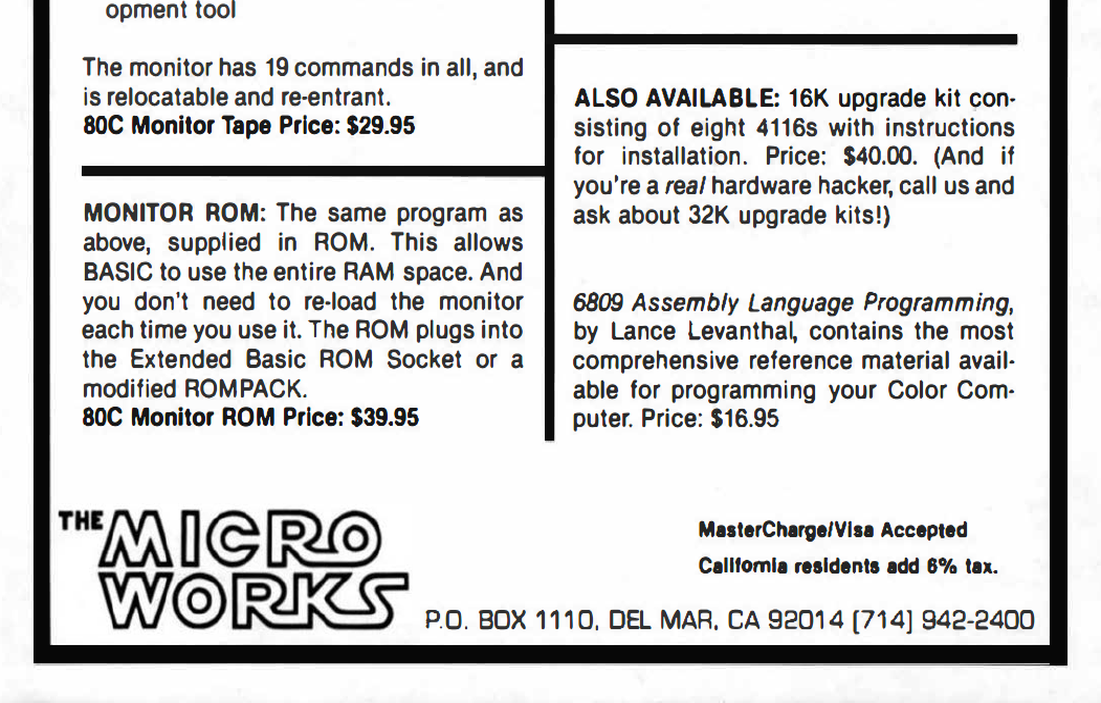
The Micro Works advertised early in the CoCo's life, beginning in January of 1981. This ad, offering 16 & 32k upgrade kits first appeared in the July 1981 issue. One month earlier, was their first RAM upgrade ad for 16k.
The company began advertising in the Rainbow magazine, with the same ad, in September of 1981,with a review on page 19 of the same edition.
Micro Works also advertised in Color Computer News beginning in the January 1982 issue.
DSL Computer Products
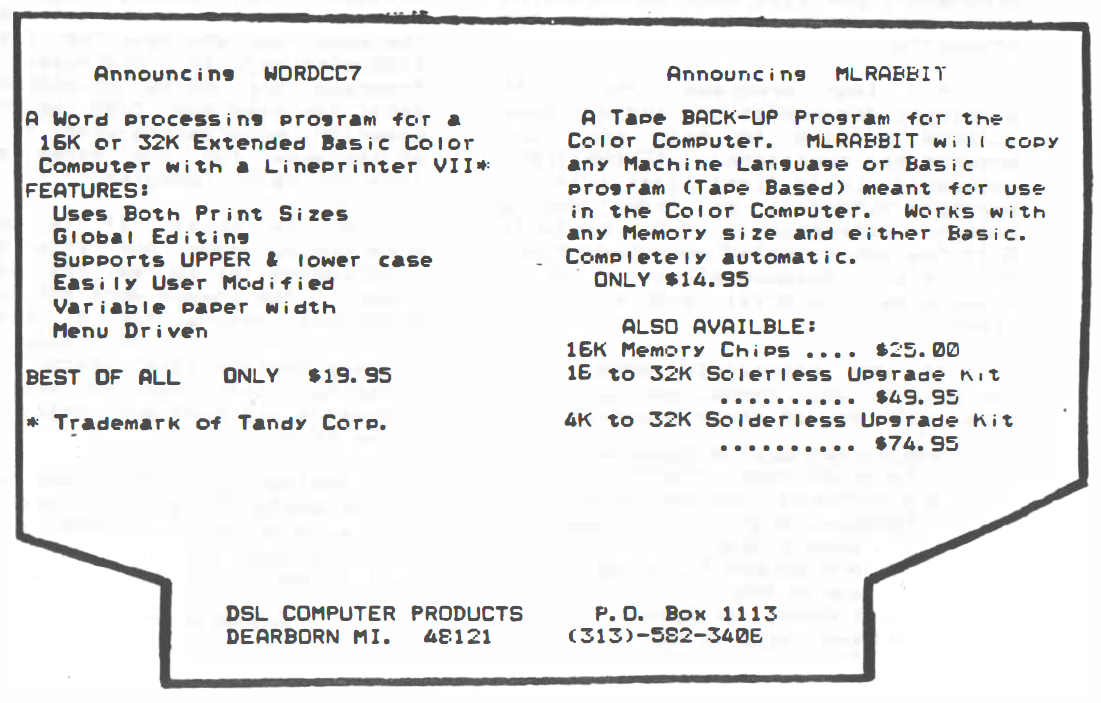
This ad appeared in the January 1982 issue of Rainbow and Color Computer News magazines, and continued for several months A full page ad in April and subsequent of 1982 in Rainbow, and later Hot CoCo, with the memory upgrade section RAM SLAM offered the following:
| Upgrade | Price |
|---|---|
| 4K → 16K | $25.00 |
| 16K → 32K | $49.95 |
| 4K → 32K | $74.95 |
In a January 1985 Rainbow ad, DSL offered a 128k upgrade for 64k CoCo for $99, including the RAM. In the June 1985 issue of Hot CoCo, this expansion kit was reviewed along side a competitive kit by Dynamic Electronics.
Computerware
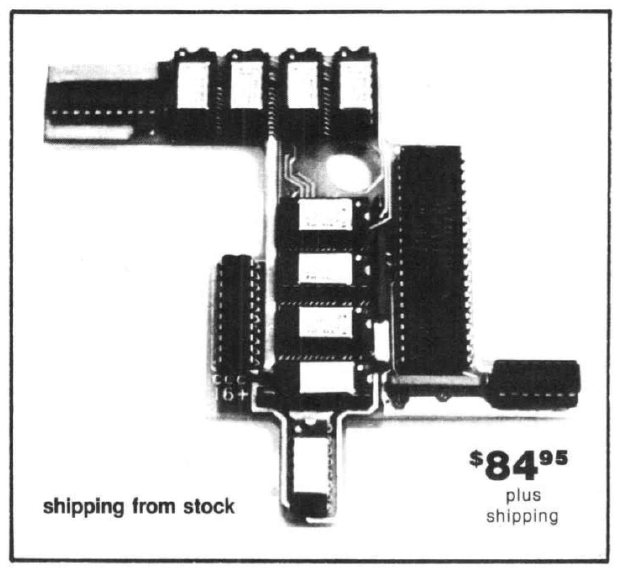
In the January 1982 issue of Color Computer News, Computerware began advertising the first of many memory upgrades for the Color Computer. This would be the 16kPLUS, for memory expansion from 16k to 32k. It featured a custom PCB, and a solderless, easy plug-in install
In the February 1982 issue of Rainbow, Rick Smith reviewed the 16k - 32k kit, and even mention that, at the time, some CoCo 1 boards were too warped to accept the Computerware logic board.
In April of 1982, Computerware began advertising 4k to 64 kupgrades, alongside of their 16k PLUS boards.
JARB - RAM Upgrades
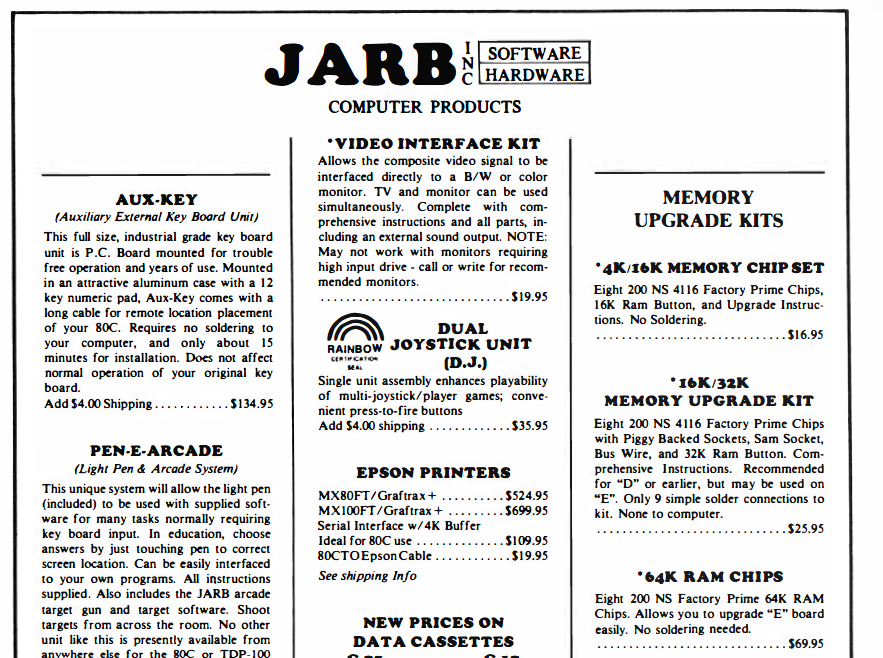
JARB Software & Hardware's 16K-to-32K kit, appears repeatedly, starting in January 1983, in several different magazines; this one was in Rain of that month and year.. The advertisement describes a kit containing eight 200 ns 4116 chips, piggyback sockets, a SAM socket, bus wire, and a 32K RAM button. That makes it more than a simple chip replacement.
JARB's January advertisement also specifies a $49.95 price and says minimal soldering is required, with an estimated 30-minute installation.
Spectral Associates
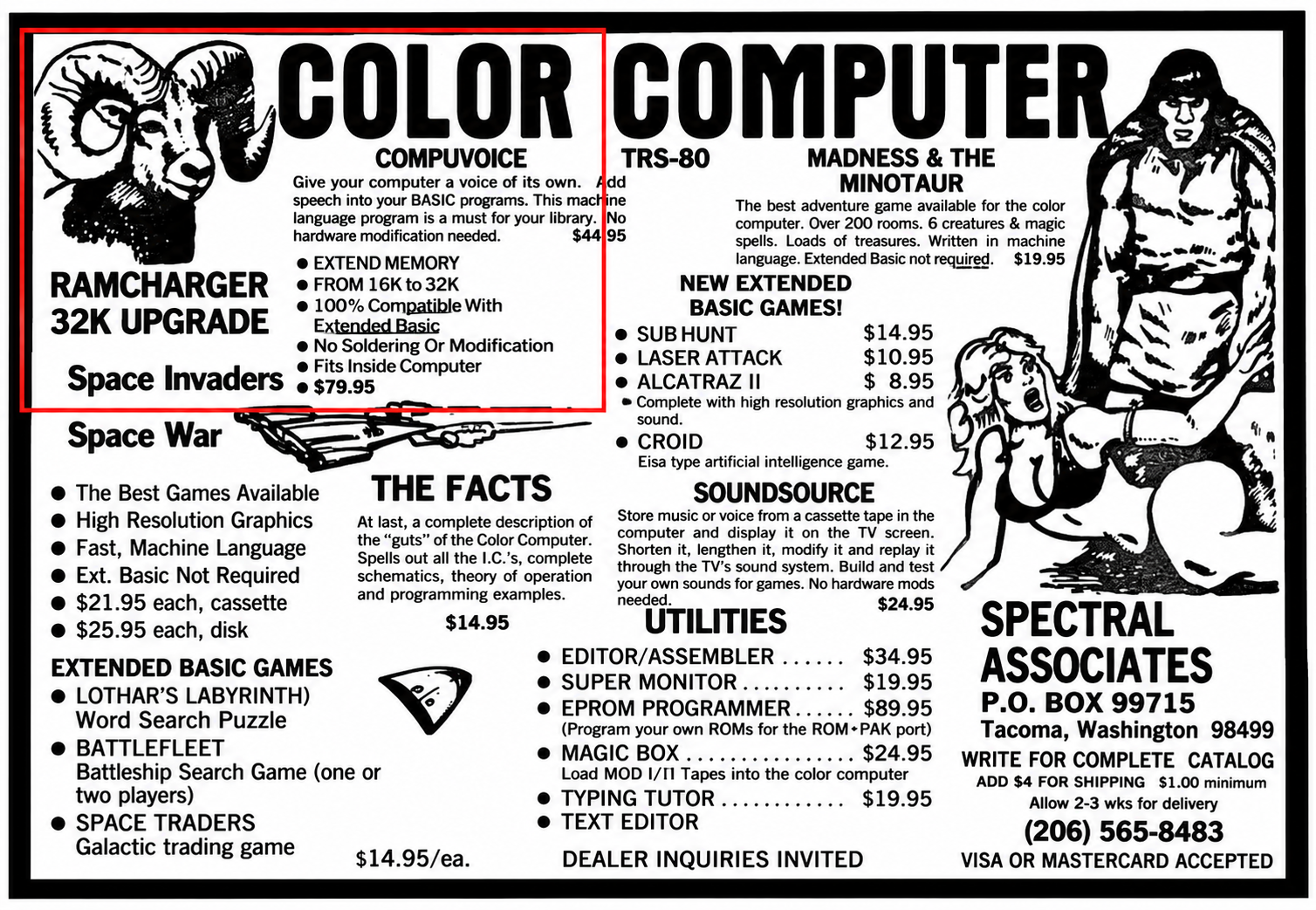
Spectral Associates – RAMCharger (1981)
Spectral Associates of Tacoma, Washington, marketed the RAMCharger, a commercial memory expansion for the TRS-80 Color Computer, advertised as early as December 1981.
Priced at $79.95, the RAMCharger expanded a 16K Color Computer to 32K using a small circuit board containing an additional 16K of RAM. Unlike many early memory upgrades, it required no soldering or permanent modifications and was installed inside the computer.
Appearing when 32K expansion frequently involved soldering additional memory chips or modifying the motherboard, the RAMCharger represented an early effort to make memory upgrades accessible to ordinary Color Computer owners. Its removable, plug-in design offered a simpler alternative to more technically demanding upgrades and helped establish a market for user-installable expansion hardware.
References
-
The Rainbow, December 1981, p. 3 — Spectral Associates RAMCharger advertisement, including its $79.95 price and 16K-to-32K expansion.
-
Color Computer Secrets Revealed, Disk ’n Data, Chapter 13 — Describes the RAMCharger circuit board, its additional 16K RAM, and its use with early Color Computer motherboard revisions
Spectral Associates
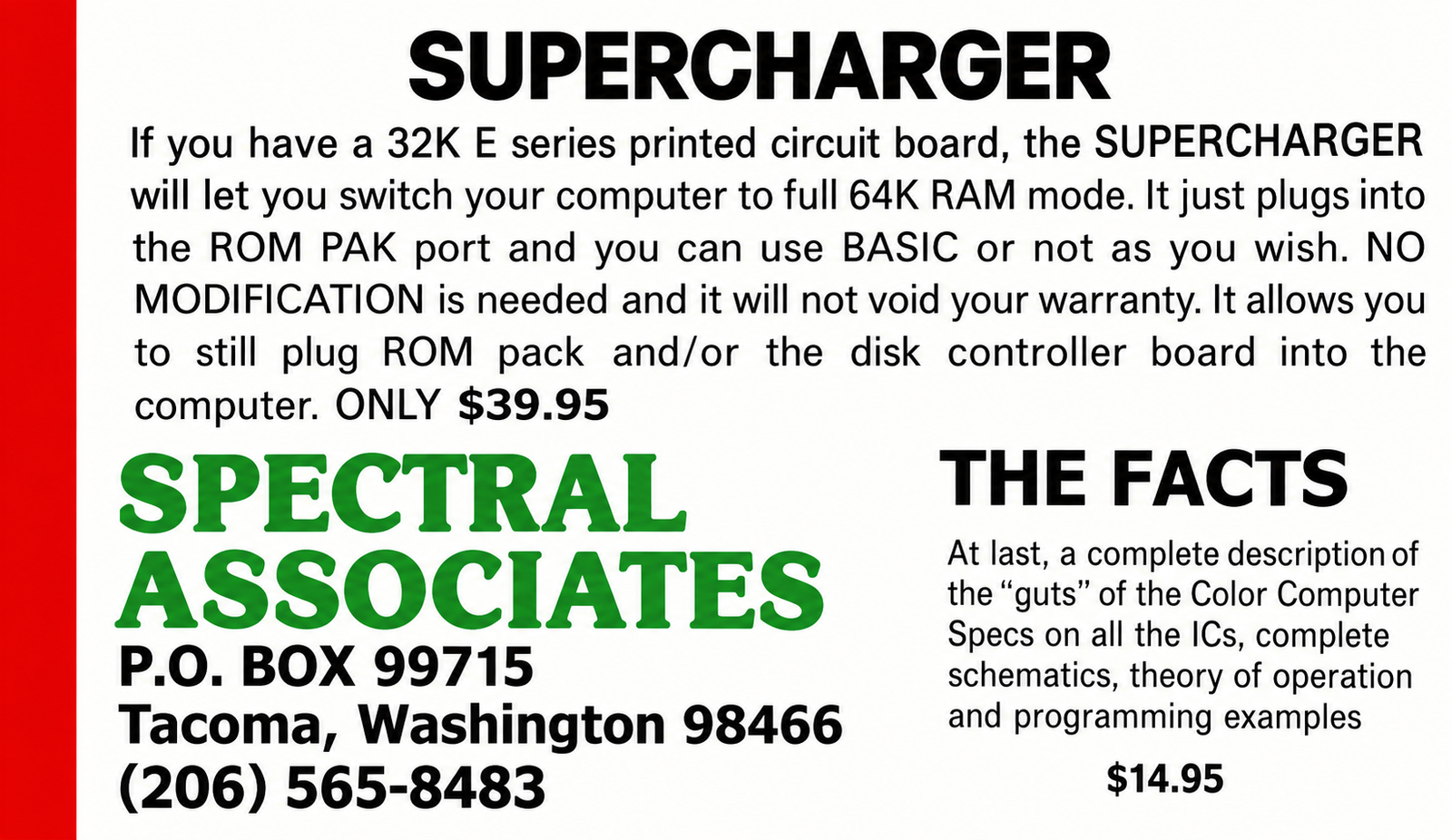
Spectral Associates – Supercharger (1982)
Spectral Associates of Tacoma, Washington, offered the Supercharger, advertised as early as August 1982 for $39.95, as a way to access the TRS-80 Color Computer's full 64K RAM capacity without modifying the motherboard.
The Supercharger was specifically designed for 32K Color Computers equipped with Revision E motherboards. Unlike earlier motherboard revisions, Revision E machines used 64K memory chips configured to operate as 32K. If all 64K of the installed memory was functional, the Supercharger could enable access to the otherwise unused upper 32K. It could not repair defective memory or provide additional RAM.
The device plugged into the cartridge port and included a pass-through connector for ROM cartridges and disk controllers. Although it eliminated the need for permanent hardware modifications, a September 1983 review in Color Computer News documented compatibility problems with certain 64K programs, including Telewriter 64.
The Supercharger represented an innovative early approach to memory expansion, allowing owners of compatible Revision E machines to unlock memory already present in their computers.
References:
-
The Rainbow, August 1982 — Spectral Associates Supercharger advertisement.
-
William F. Estep, “Supercharger,” Color Computer News, September 1983, pp. 70–72. View PDF
Spectrum Projects
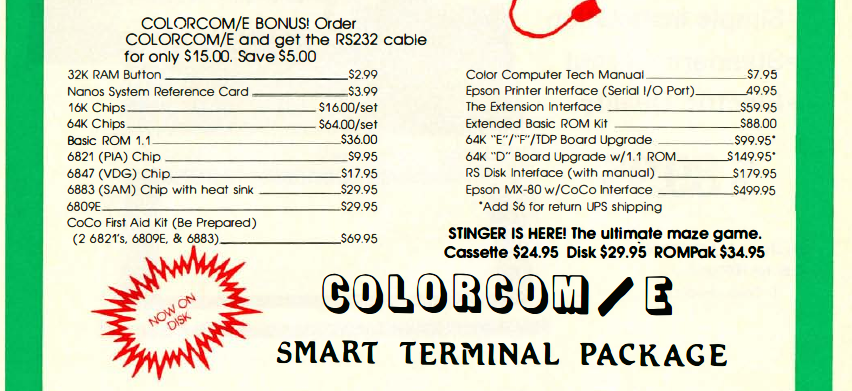
Spectrum Projects advertised a selection of memory upgrades for the TRS-80 Color Computer in the February 1983 issue of The Rainbow. This is the earliest appearance of the company's memory-upgrade advertising we've located so far.
The company offered replacement RAM chips and upgrade kits for several Color Computer motherboard revisions, including the original D board and the later E/F and TDP configurations.
| Product | Price |
|---|---|
| 16K RAM chip set | $12.00 |
| 64K RAM chip set | $49.95 |
| 64K upgrade kit — E/F/TDP boards | $99.95 |
| 64K upgrade kit — D board, including BASIC 1.1 ROM | $149.95 |
The separate D-board offering is particularly noteworthy because it included the BASIC 1.1 ROM, reflecting the additional requirements of upgrading earlier Color Computers, in order to be able to recognize and use the additional RAM. Upgrading a CoCo wasn't always as simple as slamming some RAM into the motherboard...
Dynamic Electronics
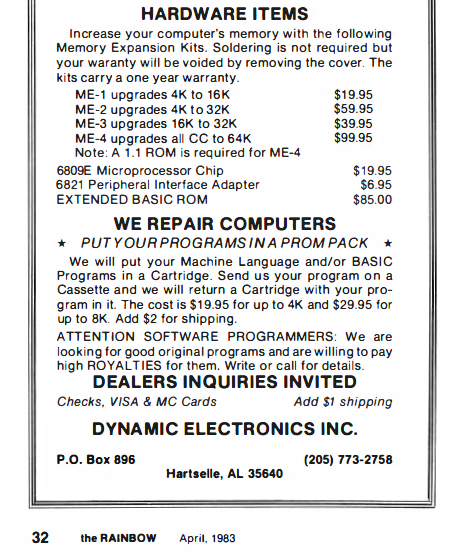
Dynamic Electronics first appeared (advertising RAM upgrades, anyway) in the April 1983 issue of Rainbow:
| Kit | Upgrade | Price |
|---|---|---|
| ME-1 | 4K → 16K | $19.95 |
| ME-2 | 4K → 32K | $59.95 |
| ME-3 | 16K → 32K | $39.95 |
| ME-4 | All CoCo configurations → 64K | $99.95 |
Dynamic offered a complete range of solderless RAM upgrades, through 64k rather than just IC chips. Their RAM upgrades even received a new product announcement in Color Computer New in the December 1983 issue, on page 139.
Quasar Animations
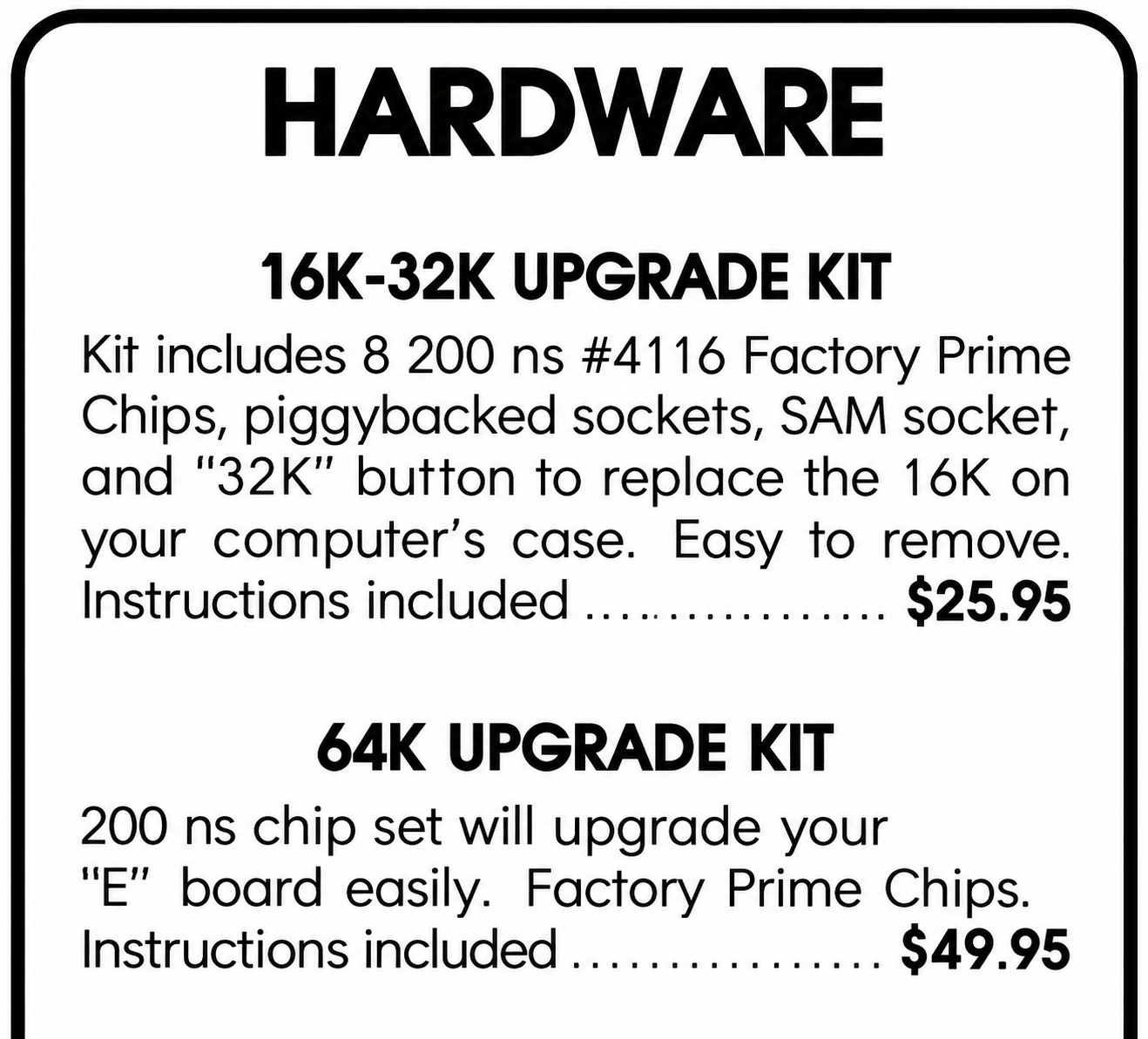
Quasar began advertising in both Hot CoCo and Rainbow in 1983. While hey were primarily a software distributor, they did offer a few hardware items, including Color Computer memory upgrade kits.
- 16K–32K Upgrade Kit ($25.95): Included eight 200 ns #4116 prime chips, piggybacked sockets, a SAM (Synchronous Address Multiplexer) socket, and a "32K" physical button to stick onto the CoCo's case.
- 64K Upgrade Kit ($49.95): Packaged a 200 ns #4164 chip set specifically designed to upgrade early CoCo "E" boards
During the 1982–1983 RAM upgrade boom, magazine columns in The Rainbow, Color Computer Magazine and Hot CoCo frequently evaluated RAM expansions as a broad category rather than reviewing individual suppliers. Since Quasar Animations was repackaging industry-standard factory-prime RAM chips (like the #4116 and #4164) with basic socket configurations, community consensus treated these mail-order kits more like commodity utility parts rather than proprietary hardware innovations
Green Mountain Micro
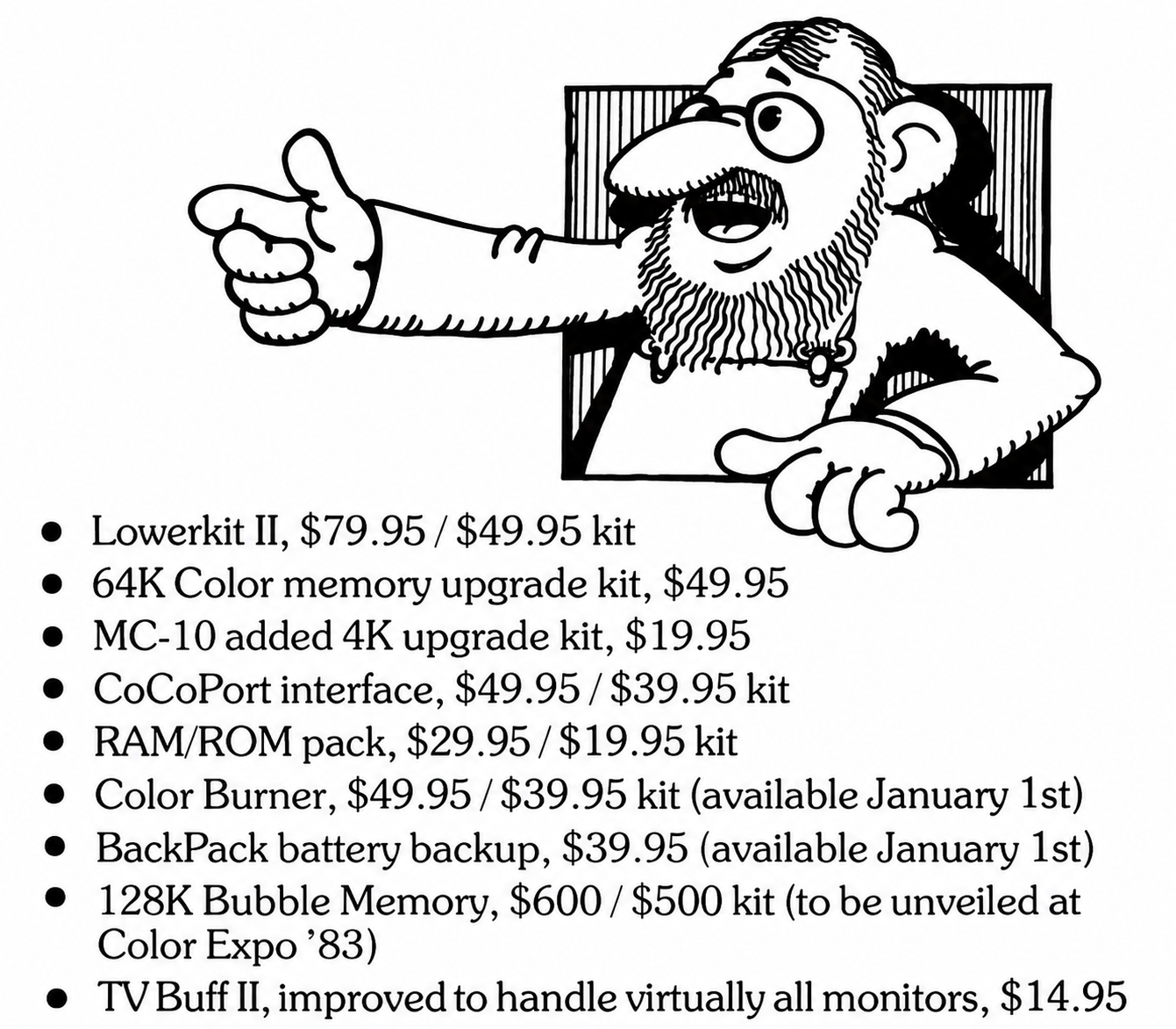
Green Mountain Micro, operated by Dennis Bathory Kitsz in Roxbury, Vermont, offered a variety of hardware upgrades and expansion products for the TRS-80 Color Computer during the early 1980s.
Among its offerings was a 64K memory upgrade kit priced at $49.95, allowing owners to expand their existing Color Computers. The company also marketed a RAM/ROM Pack, available assembled for $29.95 or as a kit for $19.95, providing additional memory capabilities through the cartridge interface.
Green Mountain Micro continued advertising its 64K upgrade kits into 1985. By October of that year, the price had dropped to $25, or $30 with an optional memory tester.
The company's products provided Color Computer owners with affordable alternatives to factory memory upgrades, while its selection of assembled hardware and do-it-yourself kits appealed to users with different levels of technical experience.
(The bubble memory will not be covered here, as the original CCN article is above.)
Selected Software
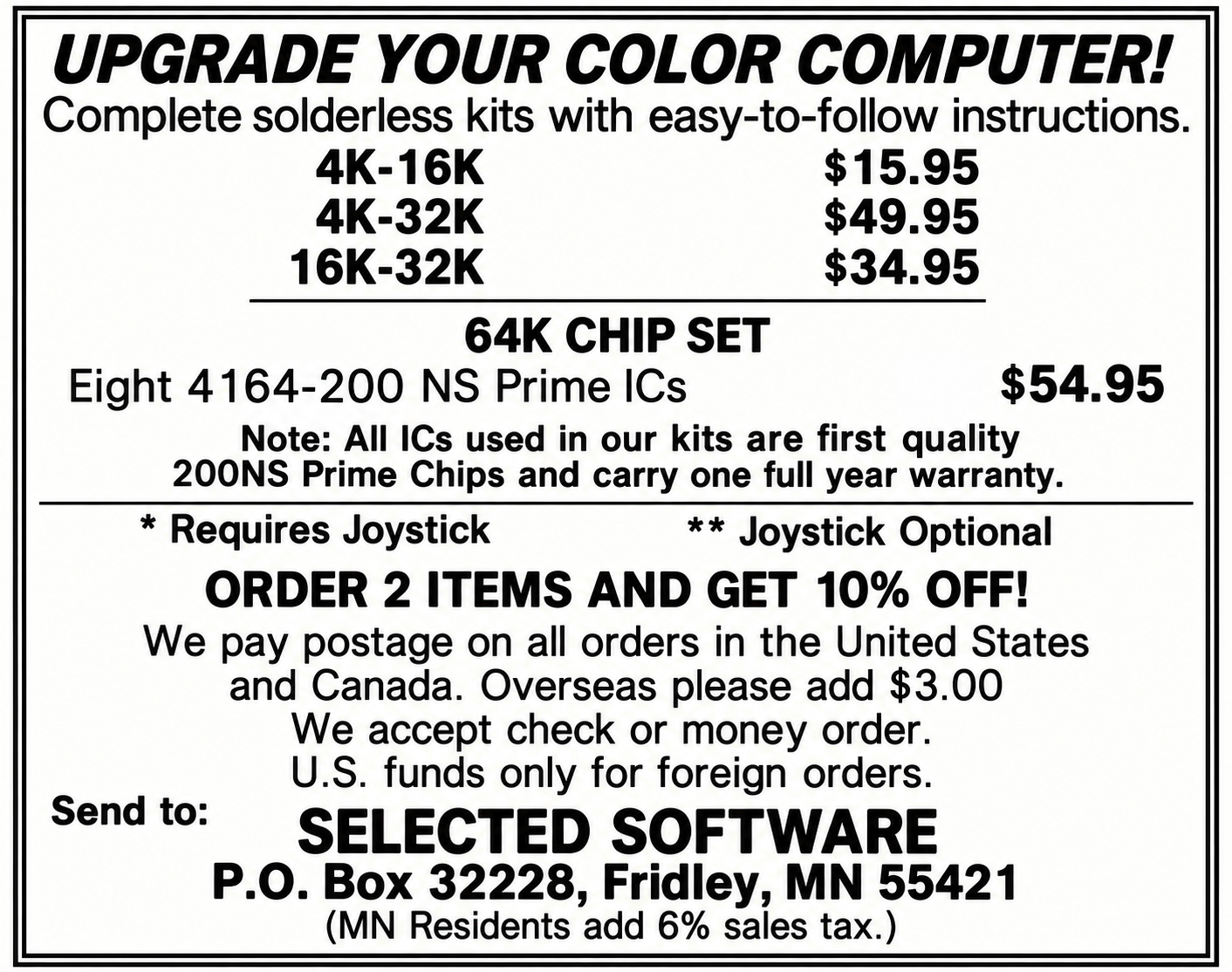
Selected Software – Memory Upgrade Kits (1983)
Selected Software of Fridley, Minnesota, began advertising memory upgrades for the TRS-80 Color Computer by early 1983, initially offering 4K-to-16K and 16K-to-32K upgrade kits.
By late 1983, the company had expanded its offerings to include 4K-to-32K and 64K upgrades, providing owners with a range of options for increasing their computers' memory. The kits were advertised as solderless, with installation instructions, 200ns memory chips, and a one-year warranty.
The 64K upgrade was specifically intended for Revision E and F motherboards, while the lower-capacity upgrades supported earlier board revisions. Customers were instructed to specify their motherboard revision when ordering.
Selected Software's expanded lineup reflected the growing availability of affordable, owner-installable memory upgrades as the Color Computer platform matured.
References:
-
The Rainbow, February 1983 — Early 4K-to-16K and 16K-to-32K kit advertisements.
-
The Rainbow, December 1983 — Expanded memory-upgrade lineup and motherboard compatibility details.
RGS Micro 128K
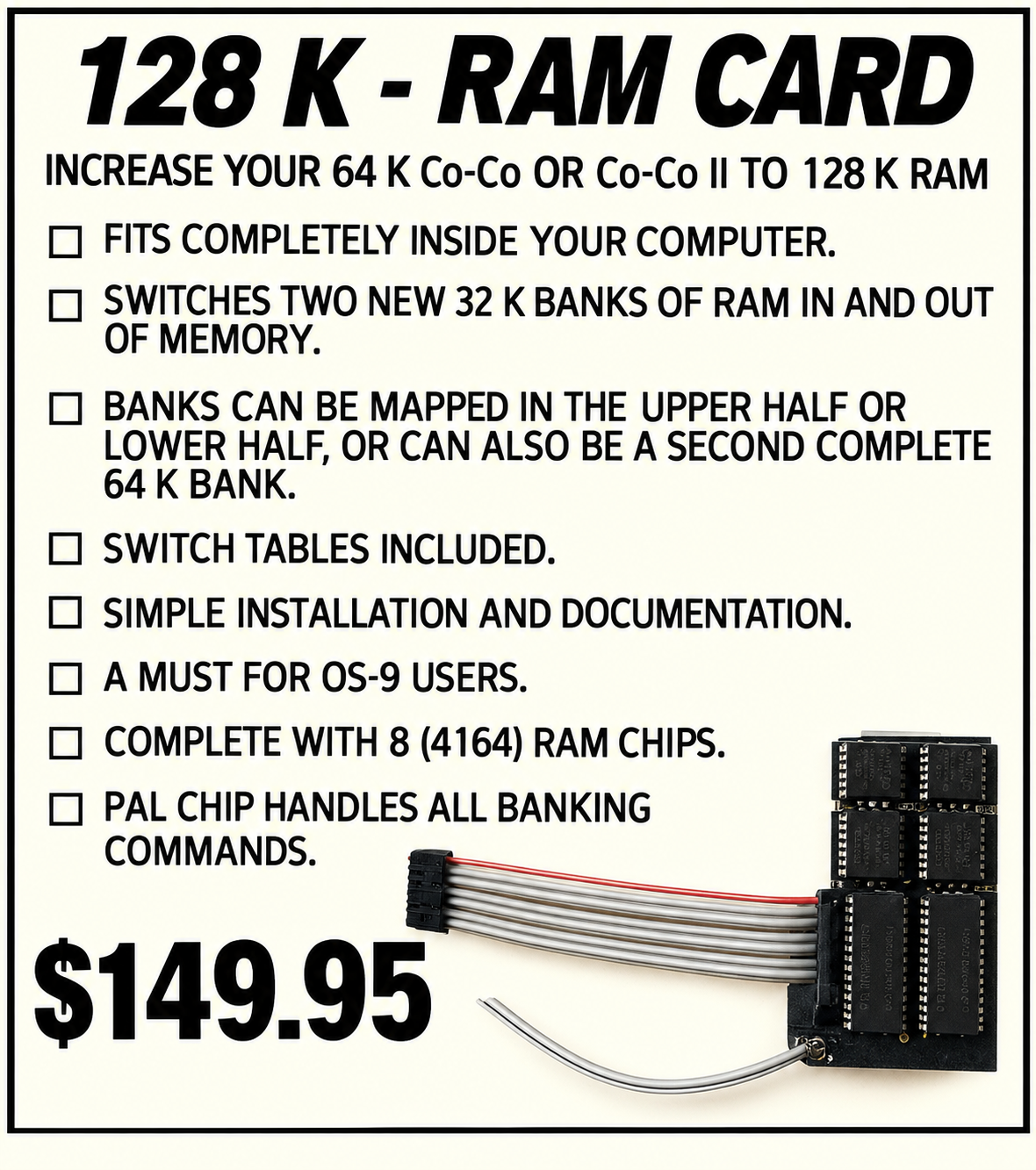
RGS Micro Inc. – 128K RAM Card (1984)
RGS Micro Inc. offered a 128K RAM Card for the TRS-80 Color Computer and Color Computer 2, advertised in the October 1984 issue of The Rainbow for $149.95.
Designed for existing 64K machines, the internally mounted expansion board added another 64K of memory using eight 4164 RAM chips. A programmable array logic (PAL) chip controlled memory banking, allowing the additional memory to be accessed as two 32K banks or as an alternate 64K bank. The card was promoted particularly for OS-9 users.
Although advertised as easy to install, a December 1984 discussion in The Rainbow documented installation difficulties involving soldered motherboard components and physical clearance in certain CoCo 2 models.
The RGS card was an early commercial attempt to expand the Color Computer beyond its standard 64K memory limit, providing additional bank-switched RAM for applications that could take advantage of it.
References:
-
The Rainbow, October 1984 — RGS Micro 128K RAM Card advertisement.
-
The Rainbow, December 1984, p. 288 — Contemporary discussion of the RGS expansion board and installation considerations.
-
The Rainbow, March 1985 — Later advertisement mentioning bundled Kdos software.
Spectrum Projects
Thunder RAM
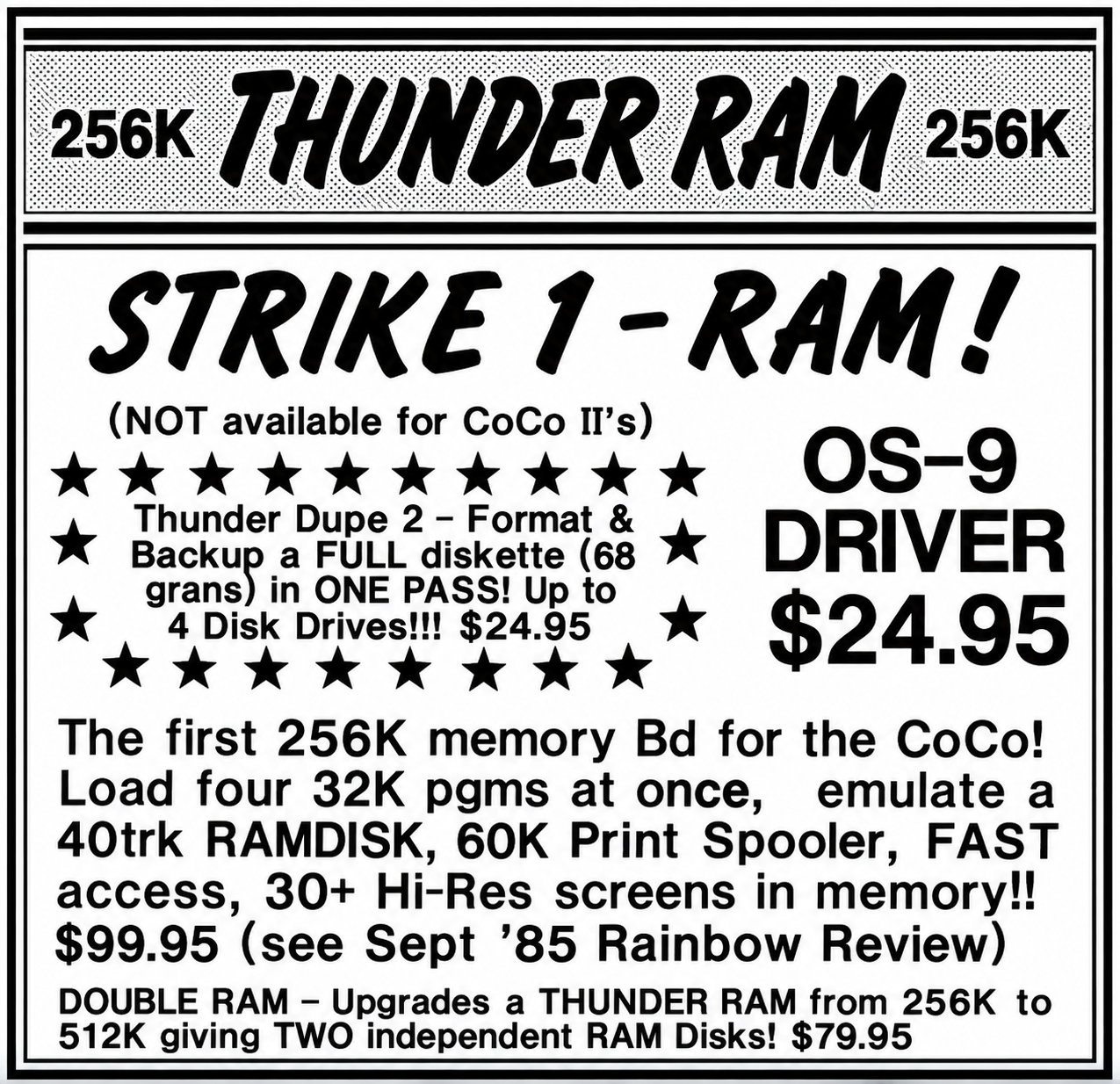
Spectrum Projects – Thunder RAM (1985)
Spectrum Projects, operated by Bob Rosen of Woodhaven, New York, introduced Thunder RAM, a 256K memory upgrade for the original TRS-80 Color Computer, in 1985. The internally installed expansion was reviewed in the September 1985 issue of The Rainbow and subsequently advertised for $99.95. Thunder RAM was not compatible with the Color Computer 2.
The upgrade provided bank-switched memory beyond the CoCo's normal 64K limit. Spectrum Projects promoted its ability to hold multiple 32K programs, store more than 30 high-resolution graphics screens, support a 60K print spooler, or emulate a 40-track floppy disk entirely in RAM.
Thunder RAM also attracted third-party software support. Brian Lantz developed an OS-9 RAM disk driver, sold for $24.95, while Marty Goodman's ThunderDupe 2 ($24.95) used the additional memory to copy entire floppy disks in a single pass.
By 1986, Spectrum Projects offered Double RAM, a $79.95 upgrade that expanded an existing Thunder RAM installation to 512K. Rather than providing one continuous memory space, Double RAM created two independent 256K banks selected by a physical switch.
Thunder RAM was among the early commercial expansions that demonstrated how the original Color Computer could make practical use of substantially more than 64K of memory, particularly through RAM disks and specialized software.
References:
-
The Rainbow, September 1985 — Thunder RAM review.
-
The Rainbow, October 1985 — Rainbowfest report introducing Thunder RAM.
-
The Rainbow, November 1985 — OS-9 RAM disk discussion.
-
The Rainbow, December 1985 — Review of OS-9 RAM disk driver and ThunderDupe 2.
-
The Rainbow, May 1986 — Double RAM hardware review.
Spectrum Projects
Super RAM
Spectrum Projects – Super RAM (1986)
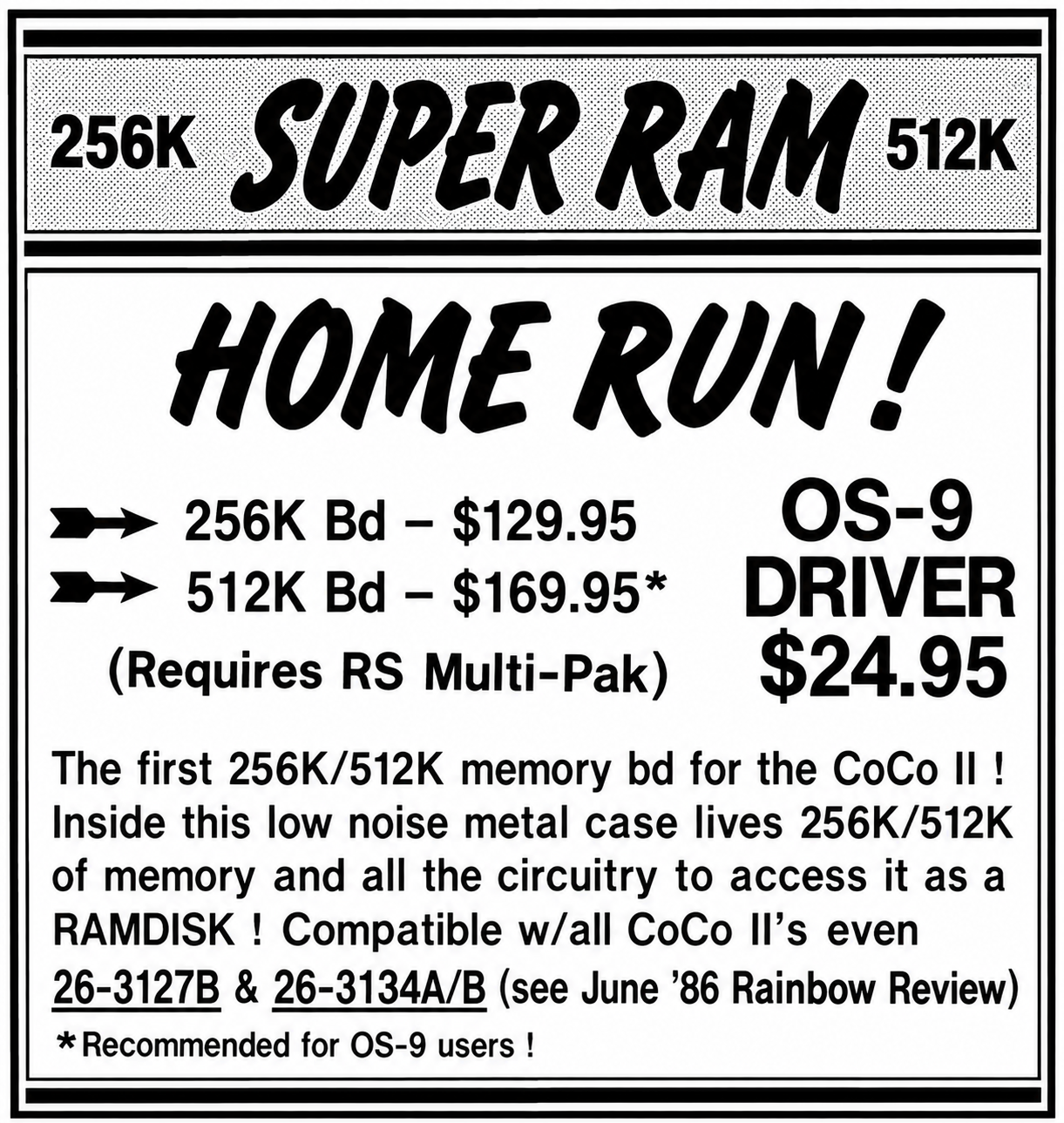
Introduced in 1986, Super RAM was Spectrum Projects' answer to the memory-expansion limitations of the TRS-80 Color Computer 2. Unlike the company's earlier Thunder RAM, which required internal installation and was incompatible with the CoCo 2, Super RAM housed its additional memory and supporting circuitry in an external, shielded metal enclosure.
Super RAM was manufactured by Disto and distributed by Spectrum Projects, as confirmed by the June 1986 review in The Rainbow.
Designed to operate through a Radio Shack Multi-Pak Interface, Super RAM was offered in 256K and 512K versions, priced at $129.95 and $169.95, respectively. Its primary purpose was to provide a high-speed RAM disk, allowing programs and data to be accessed without the delays associated with floppy drives. An optional OS-9 driver was available for $24.95, with the 512K version particularly recommended for OS-9 users.
Spectrum Projects advertised compatibility with all CoCo 2 models, including the later 26-3127B and 26-3134A/B revisions. The company promoted Super RAM at the 1986 Palo Alto Rainbowfest and referenced an independent review in the June 1986 issue of The Rainbow.
Super RAM offered CoCo 2 owners a practical way to add substantial working storage without modifying the computer's motherboard, distinguishing it from conventional internal RAM upgrades.
References:
-
The Rainbow, May 1986 — Spectrum Projects advertisement introducing Super RAM.
-
The Rainbow, June 1986 — Super RAM review, identifying Disto as manufacturer.
-
The Rainbow, July 1986 — Spectrum Projects advertisement detailing pricing, compatibility, and OS-9 support.
-
The Rainbow, September 1986 — Spectrum Projects advertisement confirming specifications.
J&R Electronics
Banker I
J&R Electronics — The Banker (1985)
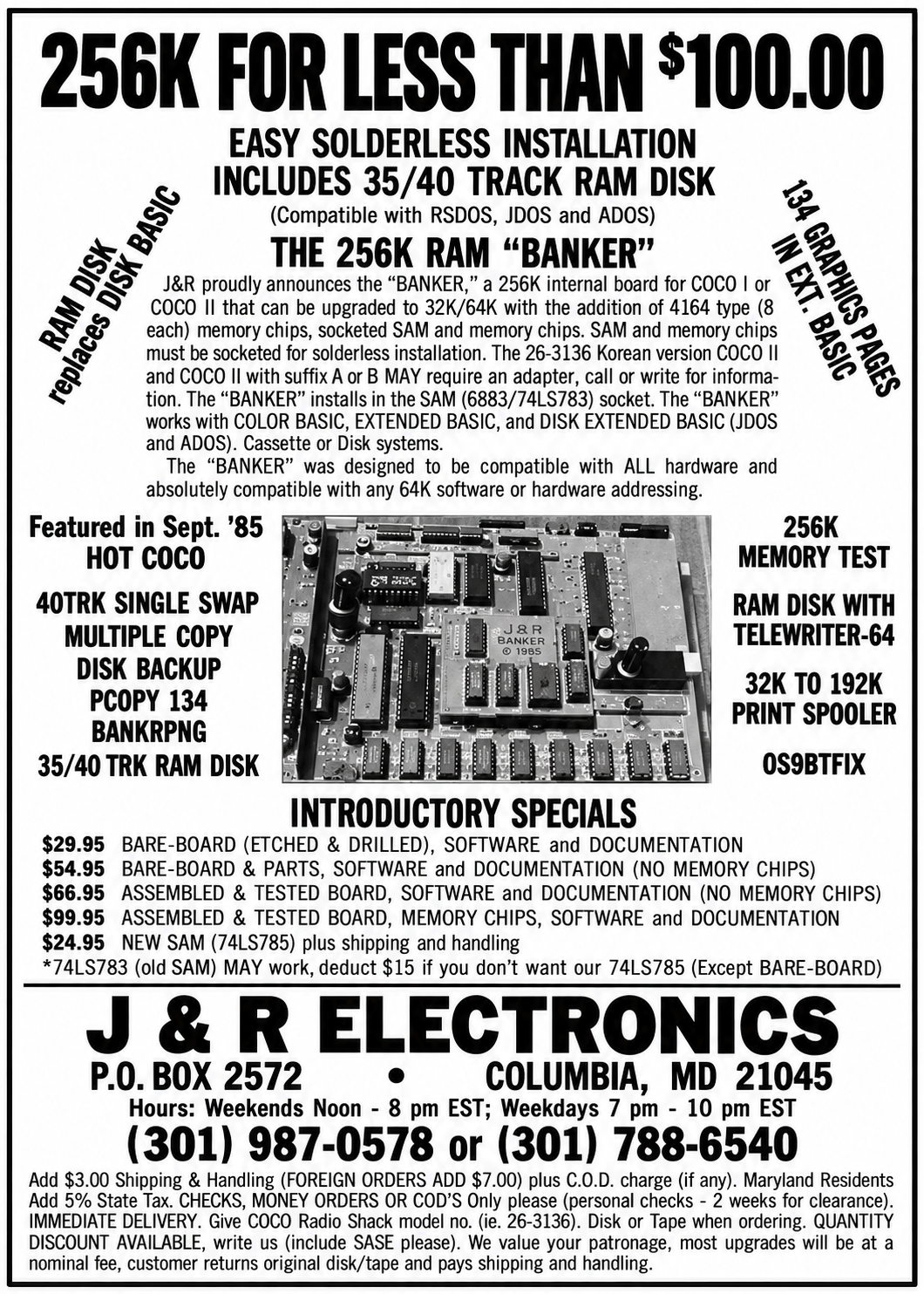
Introduced in 1985 by J&R Electronics of Columbia, Maryland, The Banker was an internal 256K memory-expansion system for the TRS-80 Color Computer 1 and 2. Developed by Jesse Jackson and Raymond Rowe, the board plugged into the computer's SAM socket, with the original SAM relocated onto the Banker board. Installation could be solderless on suitably socketed machines, although certain motherboard revisions and memory configurations required additional work.
Rather than simply increasing the memory available to BASIC, the Banker provided bank-switched RAM for specialized applications. Its accompanying software supported 35- and 40-track RAM disks, rapid floppy-disk copying, printer spooling, and expanded graphics storage. The system was designed to retain compatibility with existing 64K software and supported Color BASIC, Extended BASIC, Disk BASIC, and OS-9 applications.
J&R offered several configurations, from a $29.95 bare circuit board to a $99.95 assembled and tested 256K system complete with memory chips, software, and documentation. Although initially advertised as a 128K expansion, the original Banker also supported 256K configurations, as documented in J&R Electronics' 1986 assembly and user's manuals. The company subsequently introduced the separate Banker II memory-expansion system for larger banks.
The Banker provided CoCo owners with substantial additional memory at a comparatively accessible price, while demonstrating the practical benefits of bank switching on machines originally limited to a 64K address space.
References:
- HOT CoCo, September 1985 — Banker article (See 'The FAT COCO above).
- J&R Electronics — Banker User's Manual, March 1, 1986.
- J&R Electronics — Banker Assembly Manual, May 1, 1986.
- J&R Electronics — Contemporary 256K Banker advertisement.
J&R Electronics
Banker II
J&R Electronics – Banker II (1986)
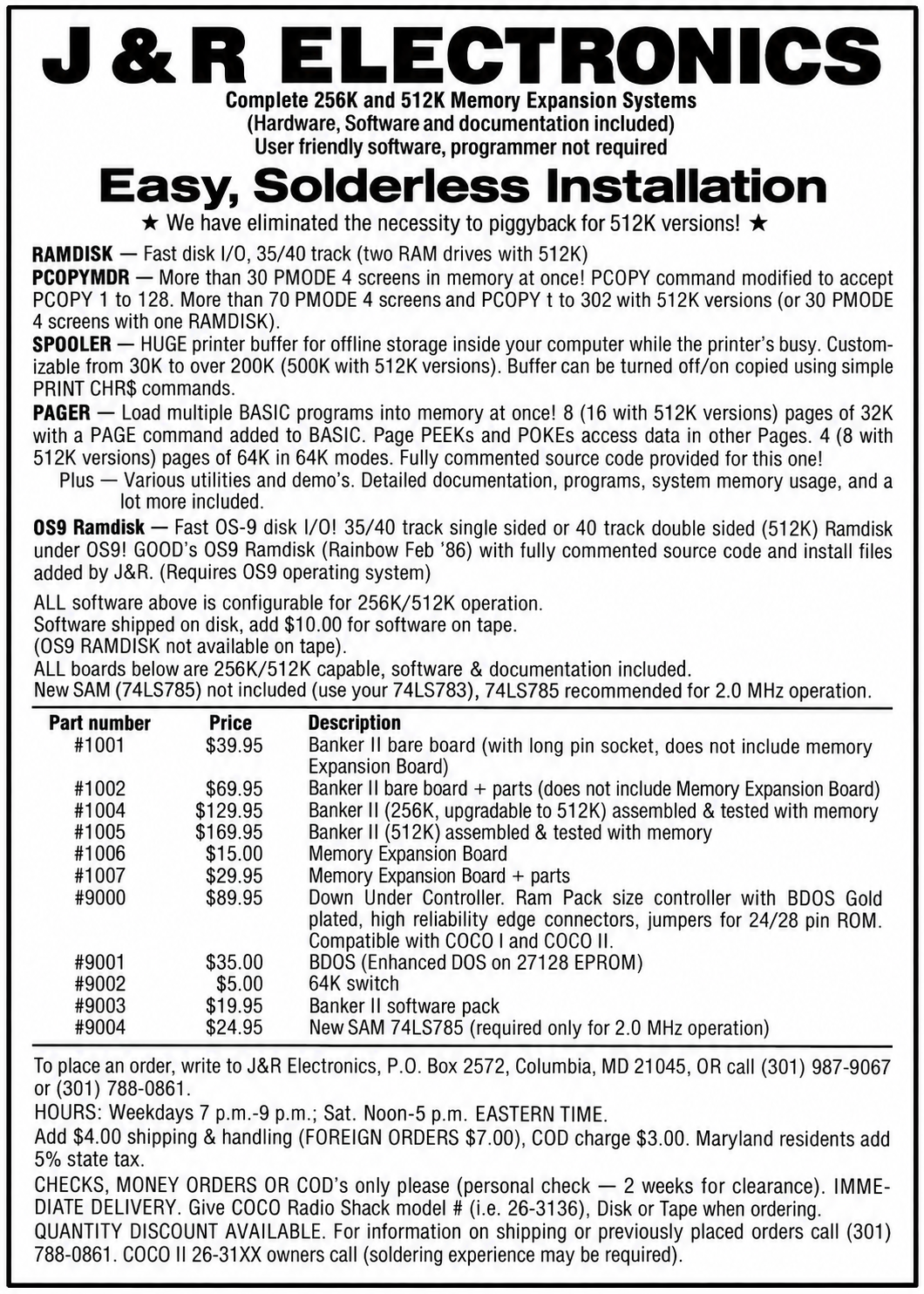
Introduced in 1986, Banker II was J&R Electronics' follow-up to its original Banker memory expansion for the TRS-80 Color Computer 1 and 2. Developed by Jesse Jackson and Raymond Rowe of Columbia, Maryland, the system combined a revised memory-management board with a separate RAM expansion board, providing either 256K or 512K of bank-switched memory.
Banker II was designed for internal installation, with the memory-management board occupying the computer's SAM socket and the expansion board fitting beneath the keyboard. Installation was generally solderless, although certain CoCo 2 motherboard revisions required additional modifications. Both kit and fully assembled versions were offered.
Like its predecessor, Banker II included software to make practical use of memory beyond the CoCo's normal 64K address space. Applications included high-speed RAM disks, floppy-disk copying, printer spooling, memory testing, and expanded graphics storage. Programmable memory banking also allowed users to develop applications that accessed multiple 32K or 64K memory segments.
Banker II was reviewed by Jeffrey S. Parker in the April 1988 issue of The Rainbow. Parker tested the assembled 512K version, praising its flexibility, documentation, and software support, although he reported occasional operating problems that could not be consistently reproduced. The review listed prices of $39.95 for the kit and $169.95 for the fully assembled system.
Arriving during the transition to the CoCo 3, Banker II offered owners of earlier Color Computers a way to obtain substantial additional memory without replacing their existing machines.
References:
-
The Rainbow, August 1986 — J&R Electronics advertisement.
-
The Rainbow, October 1986 — J&R Electronics advertisement.
-
The Rainbow, April 1988, pp. 133–134 — Jeffrey S. Parker, “Banker II — Expand and Manage CoCo 2 Memory.”
A New Generation: Memory Expansion and the Color Computer 3
When Radio Shack introduced the Tandy Color Computer 3 in 1986, it brought a fundamental change to memory expansion. The earlier Color Computers had been designed around a 4K - 64K address space, leaving third-party manufacturers to develop increasingly elaborate methods of providing additional RAM. Bank-switching circuits, replacement memory boards, modified SAM connections, and specialized software allowed these machines to reach capacities of 128K, 256K, and eventually 512K.
The CoCo 3 approached the problem differently.
Equipped with 128K of RAM as standard, the new machine incorporated a memory-management unit within its GIME chip. This allowed the computer's 6809 processor to access different portions of a larger memory space through hardware-supported memory mapping. More importantly, Radio Shack designed the CoCo 3 with provisions for expansion to 512K, making additional memory a supported feature rather than an aftermarket workaround.
Radio Shack offered its own 512K upgrade, but the opportunity was not lost on independent manufacturers. Companies including Disto, PBJ, and others developed competing expansion boards, often emphasizing easier installation, lower prices, or additional capabilities. As OS-9 Level II and increasingly sophisticated graphics applications emerged, demand for larger memory configurations continued to grow.
The following section examines the commercial memory upgrades developed specifically for the Color Computer 3, beginning with the original 128K-to-512K expansions and continuing into the larger memory systems that followed.

Radio Shack
512K Upgrade
Radio Shack — Color Computer 3 512K Memory Upgrade (1986)
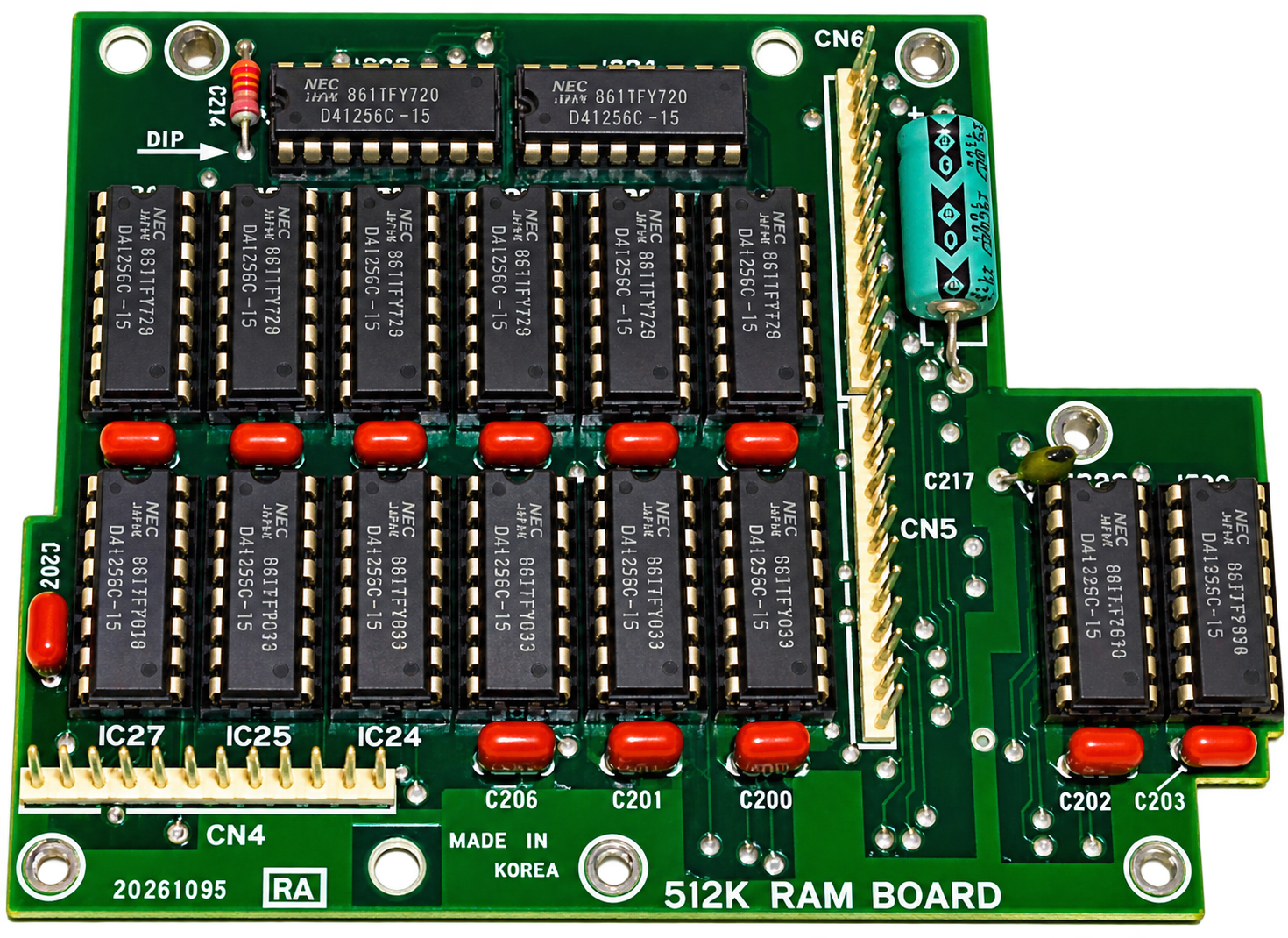
Introduced alongside the Color Computer 3 in 1986, Radio Shack's 512K Memory Upgrade Kit, catalog number 26-3335, provided the manufacturer's official means of expanding the computer's standard 128K of RAM to 512K. The upgrade was originally advertised for $149.95, in addition to the computer's $219.95 purchase price.
The expansion used an internal daughterboard populated with dynamic RAM chips. Installation required opening the computer, removing its original memory chips, and fitting the new board to the motherboard's expansion connections. Unlike many earlier CoCo memory upgrades, the board worked with the CoCo 3's built-in GIME memory-management hardware rather than requiring a separate bank-switching system.
With 512K installed, the CoCo 3 could accommodate larger programs, additional graphics data, and memory-intensive applications. The expanded memory was particularly useful under OS-9 Level II, which could take advantage of the larger memory configuration for multitasking and more demanding software. Programs written specifically for the expanded CoCo 3 could also make use of the additional RAM, although ordinary Color BASIC programs did not automatically gain access to the full 512K.
Radio Shack's upgrade established the standard 512K configuration for the Color Computer 3. It also provided a reference point for the competing expansion boards that soon appeared from independent manufacturers, many offering the same capacity at lower prices or with different installation arrangements.
References:
-
Radio Shack — 1987 Tandy Computer Catalog, RSC-17B, p. 37; Color Computer 3 and 512K Upgrade Kit, catalog no. 26-3335.
-
Martin H. Goodman — “Upgrading CoCo's Memory,” The Rainbow, March 1989.
-
Radio Shack — Original 512K RAM expansion board, marked “512K RAM BOARD,” PCB no. 20261095.
PBJ Systems
512K RAM Upgrade
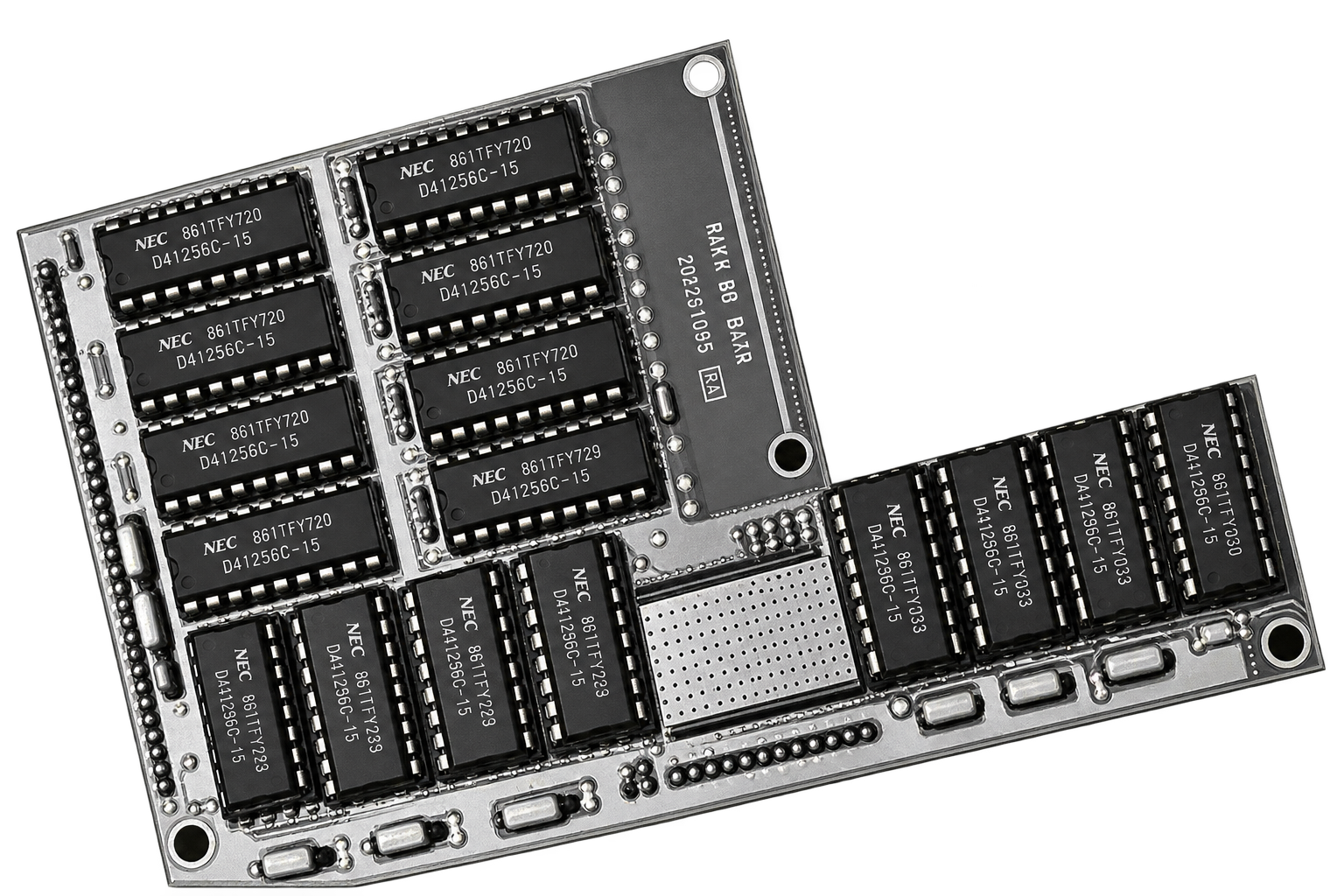
PBJ Inc. — 512K Memory Upgrade / 512CE (1987)
By early 1987, PBJ Inc. was manufacturing a 512K memory expansion for the Tandy Color Computer 3, offering an alternative to Radio Shack's official upgrade. The board expanded the computer's standard 128K of RAM to 512K and was marketed through several companies, including Spectrum Projects and Speech Systems, in addition to PBJ's own involvement with the product.
The expansion used sixteen socketed 41256 dynamic RAM chips, rated at 120 nanoseconds, mounted on an L-shaped, double-sided glass-epoxy circuit board. Measuring approximately 4½ by 2⅞ inches, the board connected to the CoCo 3's existing memory expansion sockets and used the computer's built-in GIME memory-management hardware.
The PBJ upgrade was reviewed by Jerry Semones in the March 1987 issue of The Rainbow, under the title “CoCo III 512K Upgrade: Money-Saving Modification.” The review identified PBJ as the manufacturer and Spectrum Projects of Howard Beach, New York, as the distributor. Spectrum offered the board for $139.95 with memory chips or $99.95 without chips, plus $3 shipping and handling.
During the same period, Speech Systems of Batavia, Illinois, marketed a 512K expansion under the name 512K Turbo RAM. Its accompanying installation documentation specifically identified the hardware as the PBJ 512CE Memory Upgrade Board, establishing the connection between Speech Systems' product and PBJ's design.
Speech Systems advertised Turbo RAM in March 1987 at an introductory price of $119.95, reduced from $149.95, while an unpopulated board was available for $69.95. Its package included a memory-test program, GIME technical information, and MUSICA RAM Disk software. Speech Systems also advertised a two-year warranty.
References:
-
Jerry Semones — “CoCo III 512K Upgrade: Money-Saving Modification,” The Rainbow, March 1987, p. 145.
-
Speech Systems — “Turbo Charge Your CoCo 3,” advertisement, The Rainbow, March 1987.
-
Speech Systems — 512K Turbo RAM documentation, incorporating PBJ 512CE installation instructions.
-
PBJ Inc. — 512CE Memory Upgrade Board installation documentation.
J&R Electronics
JramR 512K Upgrade
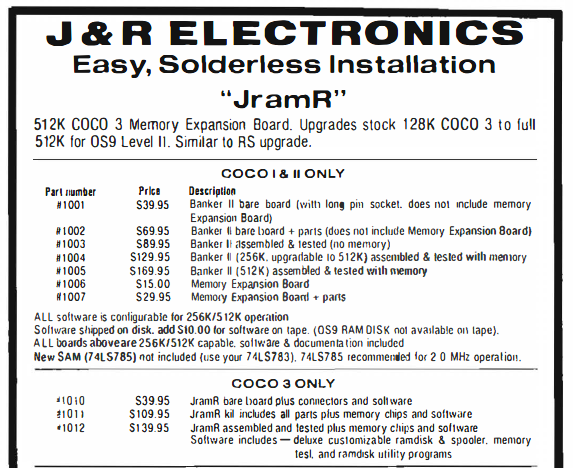
J&R Electronics — JramR 512K Memory Upgrade (1987)
By April 1987, J&R Electronics of Columbia, Maryland, had extended its Color Computer memory expansion products to the new CoCo 3 with the introduction of JramR, an internal upgrade that expanded the machine's standard 128K of RAM to 512K. Having already developed the Banker and Banker II memory systems for the earlier Color Computers, J&R was now offering a solution designed specifically for the CoCo 3's expanded memory capabilities.
JramR was offered in three configurations, allowing customers to choose between assembling the hardware themselves or purchasing a completed expansion. An April 1987 advertisement in The Rainbow listed the bare board with connectors and software for $39.95, a kit including memory chips for $109.95, and a fully assembled and tested board for $139.95.
The expansion used sixteen 41256 dynamic RAM chips, rated at 120 to 150 nanoseconds, installed in sockets on a double-sided glass-epoxy circuit board measuring approximately 4¾ by 2 5/16 inches. Installation required removing the CoCo 3's four original RAM chips and disconnecting capacitor C65. J&R incorporated special header pins with integrated spacers to prevent the expansion board from being inserted too deeply into the motherboard connectors, protecting the components beneath it.
One of JramR's distinguishing features was its accompanying software. Both the kit and assembled versions included an 18-page manual and a disk containing four utilities:
- JRAMRDSK — A customizable RAM disk that integrated with Disk BASIC and could emulate one or two FAST disk drives.
- JRAMRSPL — A machine-language printer spooler that allowed the computer to continue processing while documents were printed.
- JRAMRTST — A memory-testing utility for checking the expanded 512K configuration.
- RAMDSKUT — A BASIC utility for managing RAM disk assignments and transferring data between RAM disks and physical drives.
The JramR received a favorable review from Jerry Semones in the June 1987 issue of The Rainbow. Semones praised the board's construction and installation arrangements, reporting no noticeable radio-frequency interference despite its lack of a ground-plane shield. He was particularly impressed by the RAM disk software, which provided nearly instantaneous directory access and rapid program loading.
JramR represented a continuation of J&R Electronics' involvement in expanded-memory systems, carrying the company's experience with the Banker products into the CoCo 3 generation. Its combination of multiple purchasing options, thoughtful hardware construction, and bundled utilities made it a competitive offering in the growing market for 512K upgrades.
References:
- J&R Electronics — Advertisement, The Rainbow, April 1987, p. 134.
- Jerry Semones — “JramR: 512K Upgrade for the CoCo 3,” The Rainbow, June 1987, p. 134.
Performance Peripherals
512K Upgrade
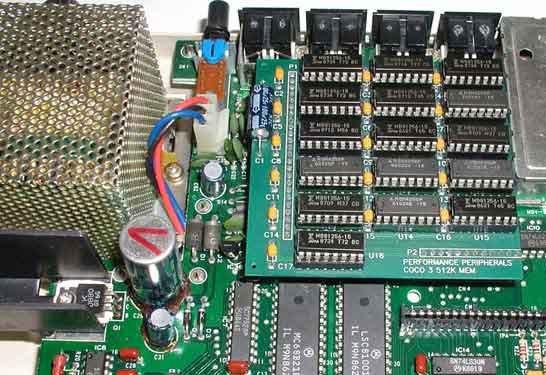
Performance Peripherals — CoCo 3 512K Turbo RAM Board (1987)
By late 1987, Performance Peripherals of Mira Loma, California, was offering its own 512K memory expansion for the TRS-80 Color Computer 3. Marketed as the CoCo 3 Turbo RAM Board, the upgrade expanded the computer's original 128K of RAM to 512K, providing an economical alternative to Radio Shack's factory expansion kit.
The board appeared in the November 1987 issue of The Rainbow, where it was listed at $79.95, including a memory-test program. A February 1988 advertisement offered the fully populated board for the same price, while an unpopulated version was available for $29.95. This allowed owners to purchase the circuit board separately and install their own memory chips.
The Performance Peripherals expansion used sixteen socketed 256K × 1-bit dynamic RAM chips, with the company specifying 120-nanosecond memory. Installation involved removing the CoCo 3's four original RAM chips and connecting the expansion board to the motherboard's existing memory connections. The supplied instructions also required modifying two motherboard capacitors, C65 and C66, by disconnecting one lead or removing them entirely. Although advertised as a solderless installation, this capacitor modification made the procedure somewhat more involved than simply plugging in a replacement board.
Performance Peripherals emphasized the quality of its construction, using double-wipe IC sockets and individual decoupling capacitors for the memory chips. The company advertised its boards as individually tested and burned in before shipment, and backed them with a one-year warranty and a 30-day money-back guarantee.
Additional software was available to take advantage of the expanded memory, including RAM-disk and print-spooler utilities. A dedicated 512K memory-test program could exercise the expanded RAM and help identify defective memory chips.
The Performance Peripherals board received favorable attention in Martin H. Goodman's article “Upgrading CoCo's Memory,” published in the March 1989 issue of The Rainbow. Goodman examined the board's construction, including its sixteen 0.33 µF decoupling capacitors and double-wipe sockets, and reported successfully using one in his own development system. The complete article is available in our Magazine Upgrade Articles section.
With its competitive pricing, socketed memory, and supporting utilities, the Performance Peripherals Turbo RAM Board represented another practical route to the CoCo 3's supported 512K configuration.
References:
-
The Rainbow, November 1987 — “Received and Certified,” Performance Peripherals CoCo 3 Turbo RAM Board listing.
-
The Rainbow, February 1988, p. 95 — Performance Peripherals advertisement.
-
Performance Peripherals — RAM Board Installation, two-page installation guide.
-
Martin H. Goodman — “Upgrading CoCo's Memory,” The Rainbow, March 1989.
-
Performance Peripherals — 512K CoCo 3 Memory Test and 512K utility software.
CRC Disto
Super RAM 512K Upgrade
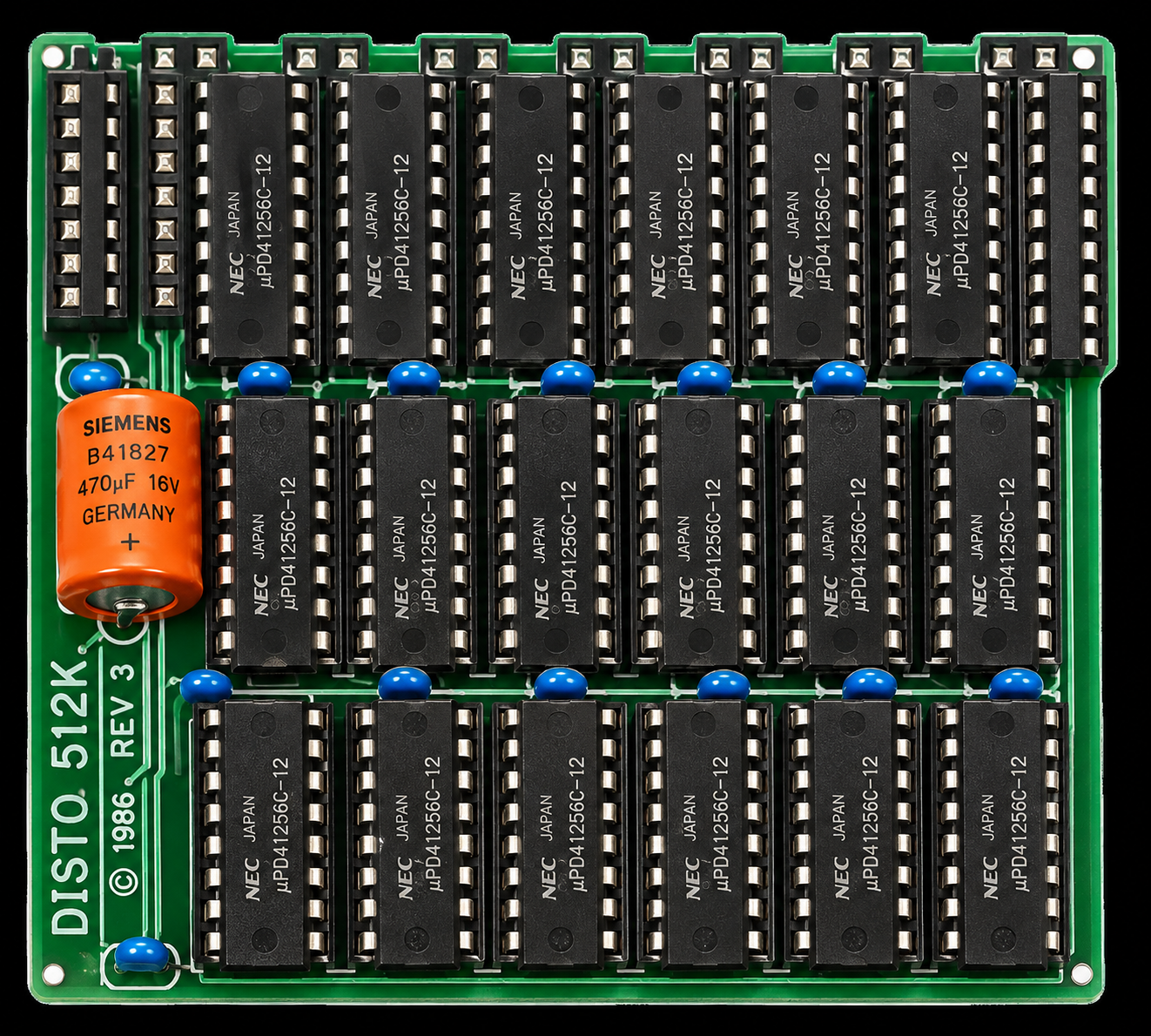
DISTO Super RAM 3 — 512K Memory Upgrade (1987)
The DISTO Super RAM 3 was an internal memory expansion board designed to upgrade the Tandy Color Computer 3 from its original 128K of RAM to 512K. Unlike DISTO's earlier external Super RAMDisk, which required a Multi-Pak Interface, the Super RAM 3 installed directly onto the CoCo 3 motherboard, providing additional system memory without occupying a cartridge slot.
The Super RAM 3 was among the more compact 512K upgrades available at the time. In his May 1987 Rainbow review, Jerry Semones described a double-sided glass-epoxy circuit board measuring just 2¾ × 2⅞ inches. The board carried sixteen socketed NEC 41256 120-nanosecond DRAM chips, arranged with the components facing upward to improve ventilation.
Installation was relatively straightforward, although it involved more than simply plugging in the new board. The four original 128K RAM chips at IC16 through IC19 had to be removed, along with two small capacitors, C65 and C66, which were clipped from the motherboard. The expansion board then plugged into two existing white header sockets on the CoCo 3 motherboard. Semones reported completing the installation in approximately 20 minutes.
The board did not incorporate a ground plane, but the reviewer reported no noticeable radio-frequency interference during testing with his shortwave equipment. A thin sheet of anti-static foam was also supplied to insulate the underside of the expansion board from components on the motherboard.
DISTO included a software disk containing a 512K memory test, utilities for creating one or two RAMdisks, and a printer spooler. The spooler could also be used with DISTO's PPRINT printer interface, allowing printing to continue while the computer performed other tasks.
The Super RAM 3 was distributed through CRC Computers in Montreal, Quebec, and Spectrum Projects in New York. The May 1987 review listed a price of $124.95, while a June 1987 CRC Computers advertisement offered the complete 512K upgrade for $99.95 or an unpopulated board for $34.95.
The DISTO Super RAM 3 offered CoCo 3 owners a compact alternative to other internal 512K upgrades, with socketed memory chips, a relatively quick installation procedure, and bundled utilities that made practical use of the expanded memory.
Sources: The Rainbow, May 1987, p. 144, Jerry Semones, review of the DISTO Super RAM 3; The Rainbow, June 1987, CRC Computers advertisement.
Microcom Software
Memory Upgrades

Microcom Software — 512K and 1MB Memory Upgrades (1987–1988)
Microcom Software, located in Fairport, New York, was among the companies advertising memory expansion products for the Tandy Color Computer 3 during the late 1980s. By November 1987, the company was offering a 512K memory upgrade, and advertisements appearing in the February 1988 issue of The Rainbow promoted both a 512K expansion board and a more ambitious upgrade capable of increasing the CoCo 3's memory to 1MB.
The 512K Memory & 1MB Upgrades
Microcom's 512K upgrade was advertised as a fully assembled and tested expansion board using 120-nanosecond DRAM chips. The company emphasized its solderless installation and claimed that the board's design provided firm electrical contact while positioning the memory chips on top to minimize potential heat-related problems.
The February 1988 advertising described installation as taking approximately two minutes, with illustrated instructions supplied. One advertisement listed the complete upgrade at $79.95, with an unpopulated board available for $44.95. Another advertised a complete, tested upgrade for $99, with a bare board priced at $39.95..
The February 1988 Microcom included a 1MB memory expansion for the CoCo 3, offering twice the capacity of the more conventional 512K upgrades. Unlike the solderless 512K board, the 1MB expansion required an existing 512K CoCo 3 and some soldering experience. The advertisement stated that the kit included the additional 512K of memory and the necessary hardware, along with OS-9 drivers written by Kevin Darling.
Two configurations were offered:
- Zero-K kit — $119: Hardware kit without the additional memory chips.
- Complete 1MB kit — $159: Hardware and memory required for the expansion.
Sources and references:
- The Rainbow, November 1987 — Microcom Software 512K upgrade advertisement.
- The Rainbow, February 1988 — Microcom Software 512K upgrade and 1MB expansion advertisements.
- Microcom Software, P.O. Box 214, Fairport, New York 14450.
CRC/Disto
1 Megabyte Upgrade
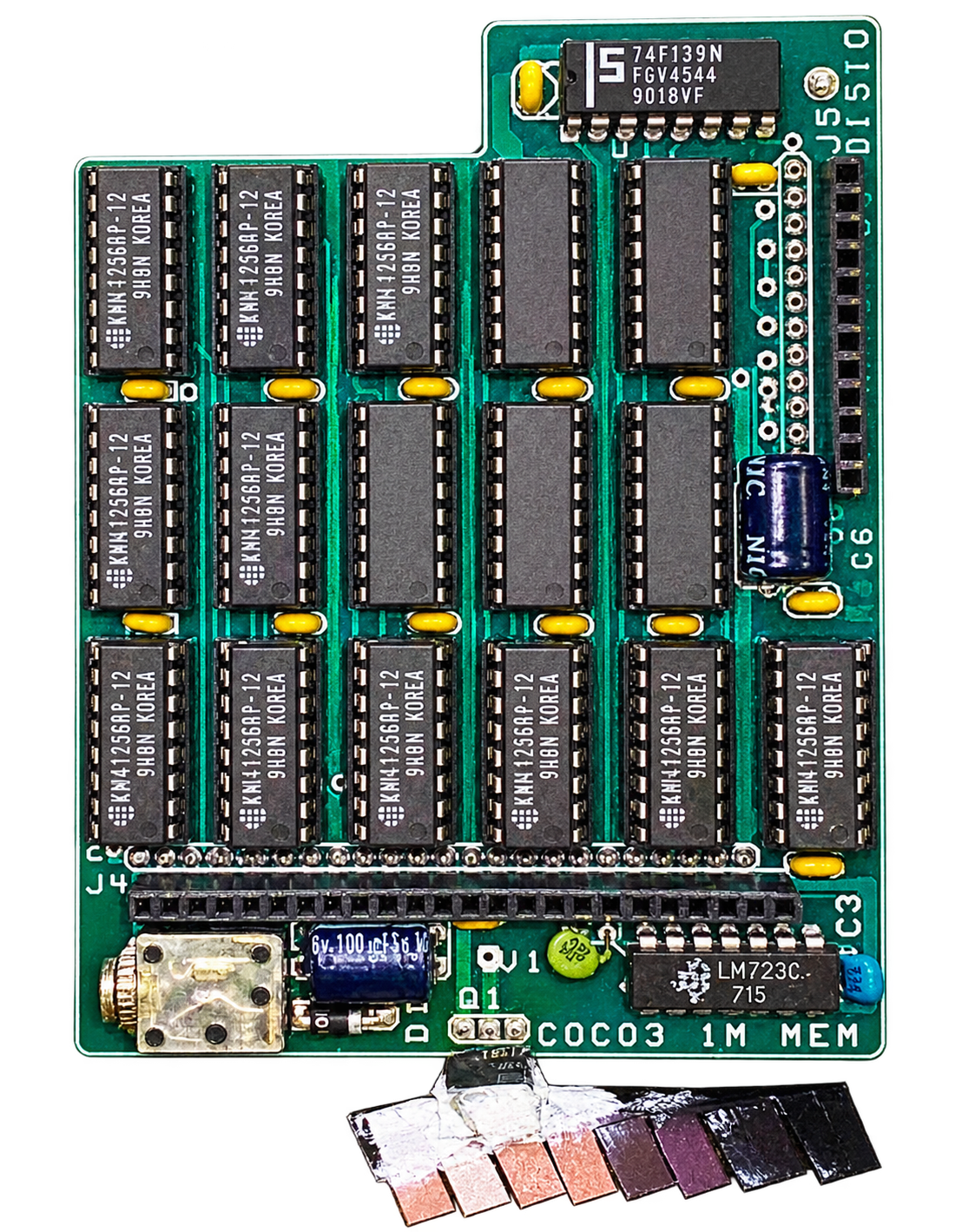
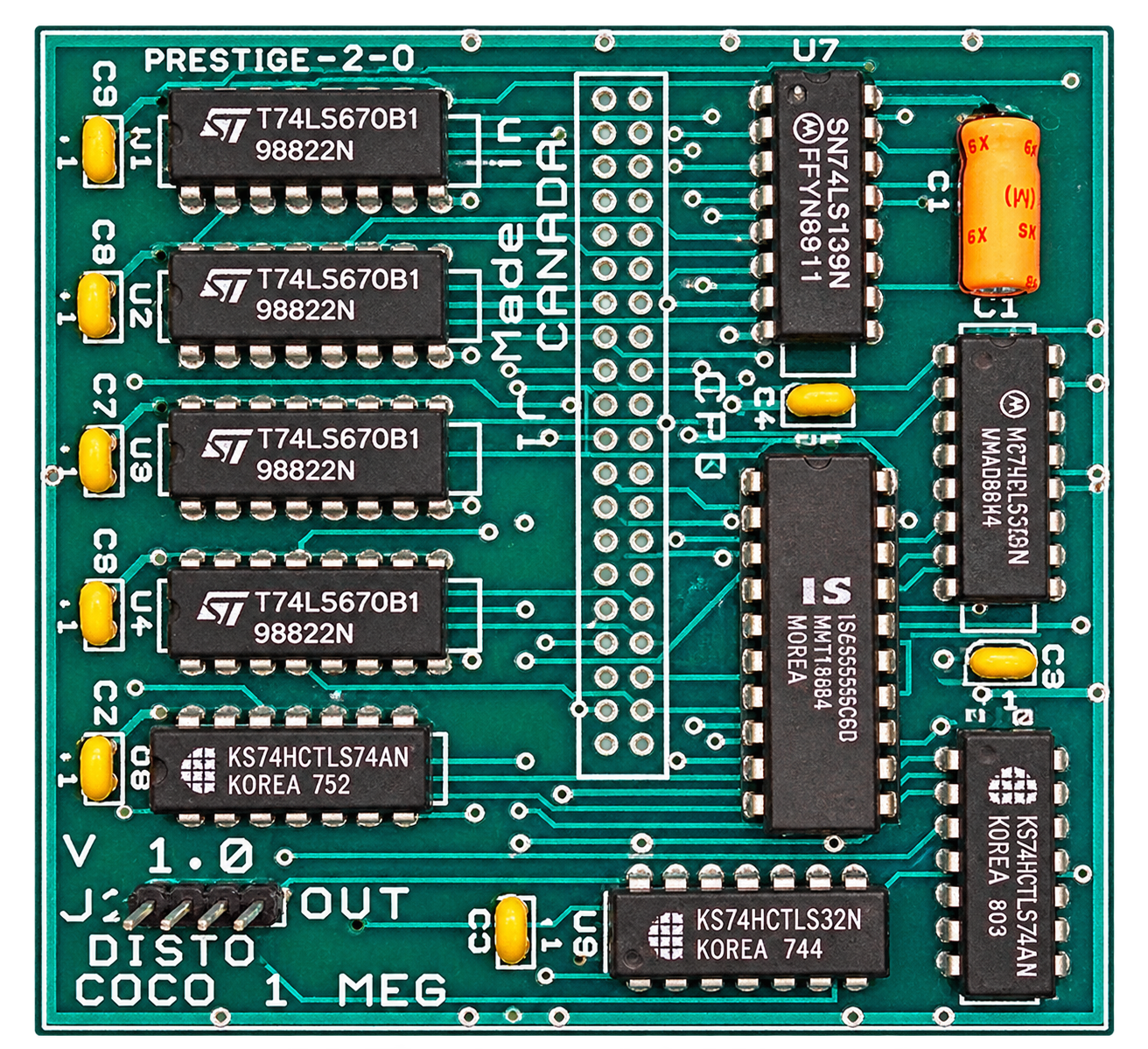
DISTO 1MB Memory Upgrade — 1989–1990
By the late 1980s, the Tandy Color Computer 3's 512K memory ceiling was becoming increasingly restrictive, particularly for users running OS-9 Level II and other memory-intensive applications. Although numerous manufacturers had introduced upgrades to expand the CoCo 3 from its original 128K to 512K, moving beyond that limit presented a considerably more difficult engineering challenge.
DISTO Super Products, developed by Tony DiStefano and distributed through CRC Computers in Quebec, Canada, was among the companies tackling this limitation. Its 1MB Memory Upgrade extended the CoCo 3's memory capacity to a full megabyte while allowing owners to retain their existing 512K expansion boards.
A prototype was reportedly demonstrated at the Somerset RainbowFest in October 1989, and the upgrade was described as a new product in early 1990. The original DISTO installation manual provides additional chronological evidence, with schematics dated September 29, 1989.
A Different Approach to Memory Expansion
Unlike conventional 512K upgrades, which simply replaced or supplemented the CoCo 3's original RAM, the DISTO 1MB system required additional circuitry to extend the computer's memory-addressing capabilities.
The upgrade consisted of two principal components: a special 512K memory expansion board and a separate Data Address Translation (DAT) control board.
The memory board installed into the CoCo 3's existing RAM expansion connectors after the original memory chips had been removed. Female headers on its upper surface allowed the owner's existing 512K expansion board to be installed directly above it, creating a stacked arrangement providing a total of 1MB of RAM.
This design offered an important advantage: owners who had already invested in a 512K upgrade did not have to discard their existing hardware. DISTO's installation manual specifically described compatibility with existing 512K memory cards.
The additional memory board contained sixteen 256K × 1 DRAM chips, providing another 512K of physical memory. It also incorporated supporting circuitry, including memory-decoding logic and voltage regulation.
The DAT Control Board
The second component was a separate DAT board, responsible for extending the CoCo 3's memory-addressing capabilities beyond the GIME chip's normal 512K limit.
The CoCo 3's memory-management hardware normally provided sixteen DAT registers, each selecting an 8K physical memory block from a total of 64 blocks. This arrangement allowed access to 512K of physical RAM.
DISTO extended this arrangement to 128 physical blocks, permitting the processor to access 1MB of memory through the existing 64K address space.
The DAT board employed additional digital logic, including four 74LS670 register chips, to provide the expanded address selection. The original manual also describes a mechanism associated with address $FF9B that allowed the system to select which 512K region supplied video memory.
This additional circuitry was essential. Simply installing more RAM would not have allowed the original GIME to address memory beyond its intended range.
Installation and Hardware Modifications
Installing the DISTO 1MB upgrade was considerably more involved than fitting a conventional 512K memory board.
The special memory board was installed first, followed by the owner's existing 512K expansion board. Additional wiring connected the memory expansion hardware to the DAT circuitry and the GIME.
The DAT board interfaced directly with the CoCo 3's 6809 processor through a specially formed 40-pin adapter. Rather than using a conventional replacement CPU socket, the adapter's pins were soldered directly to the processor's legs.
The installation instructions called for soldering all 40 connections and checking continuity before proceeding. This made the installation a more demanding undertaking, requiring careful workmanship to avoid shorts or damaged components.
The resulting assembly was distinctive: two memory boards stacked above the motherboard, a separate CPU-connected DAT board, and additional interconnecting wiring.
Although complex by later standards, the arrangement allowed the CoCo 3 to retain much of its original architecture while accessing twice the memory previously available through conventional 512K upgrades.
Software Support and Practical Benefits
Expanded hardware addressing was only part of the challenge. Operating systems and applications also needed software capable of recognizing and using the additional memory.
The DISTO installation manual credits Kevin Darling with developing OS-9 drivers and patches for the 1MB expansion.
OS-9 Level II was particularly well suited to taking advantage of additional physical memory because its memory-management architecture could allocate and manage multiple processes within the expanded address space.
For BASIC and other software designed around the original CoCo 3 memory configuration, the benefits depended on whether the software had been written or modified to recognize the additional memory.
The upgrade therefore represented more than a simple increase in RAM capacity. It combined hardware address expansion with operating-system support to make memory beyond 512K practically usable.
Surviving Hardware and Documentation
Original DISTO 1MB hardware survives, including examples of both the memory expansion board and the separate DAT control board.
The photographed memory board carries the marking COCO3 1M MEM, while the reverse identifies the PCB as PRESTIGE-2-0. The accompanying control board is marked DISTO, COCO 1 MEG, V 1.0, Made in Canada, and PRESTIGE-2-0.
The significance of the PRESTIGE-2-0 marking has not been independently established. It may represent a board designation or production revision, but the available evidence does not justify identifying it as a separate manufacturer.
The surviving installation manual provides unusually detailed documentation, including installation procedures, a theory of operation, and schematics dated September 29, 1989.
Together, the original documentation and surviving hardware provide a valuable record of one of the more ambitious commercial memory expansions developed for the Color Computer 3.
Historical Significance
The DISTO 1MB Memory Upgrade represented an important step beyond the CoCo 3's original memory architecture.
Tony DiStefano's design demonstrated how additional memory-addressing circuitry could extend the machine beyond the GIME's conventional 512K limit, while preserving compatibility with existing 512K memory expansion hardware.
Its installation was undeniably complicated, involving stacked memory boards, additional control logic, soldered CPU connections, and interconnecting wiring. Nevertheless, the design helped demonstrate that the CoCo 3's memory capacity was not necessarily limited to what Radio Shack had originally provided.
Later memory expansions would offer larger capacities and more compact hardware arrangements, but DISTO's 1MB upgrade remains a notable example of the ingenuity employed by third-party developers to extend the useful life and capabilities of the Color Computer.
Sources and references
-
DISTO 1 Meg Memory Upgrade Kit, original installation and technical manual, DISTO Super Products / CRC Computers Inc.; schematics dated September 29, 1989.
-
Tandy's Little Wonder, historical references to the October 1989 prototype demonstration and early 1990 product introduction.
-
Surviving DISTO 1MB memory expansion and DAT boards, photographed front and rear, including installation hardware.
CRC/Disto
2 Megabyte Upgrade
DISTO 2MB Memory Upgrade — 1993
Following the development of its 1MB memory expansion in 1989–1990, DISTO Super Products introduced an even more ambitious upgrade for the Tandy Color Computer 3. Announced in 1993, the DISTO 2MB Memory Upgrade quadrupled the capacity of a conventionally expanded 512K CoCo 3 and represented a substantial redesign of Tony DiStefano's earlier memory-expansion hardware.
The new design abandoned the stacked memory boards used by the original 1MB upgrade in favor of two 1MB SIMM modules and a redesigned Data Address Translation (DAT) interface. Although the new hardware was considerably more compact, extending the CoCo 3's memory capacity to 2MB still required sophisticated additional circuitry to overcome the limitations of the machine's GIME chip.
The exact commercial introduction date has not been established. Contemporary historical references place DISTO's announcement in 1993, the same year The Rainbow ceased publication in May. Whether the upgrade became available before or after the magazine's final issue remains uncertain.
A New SIMM-Based Design
The DISTO 2MB upgrade consisted of two internal circuit boards: a memory expansion board and a separate DAT control board.
Unlike the earlier DISTO 1MB system, which accommodated an existing 512K expansion board, the 2MB upgrade replaced the computer's previous memory expansion hardware entirely.
The new memory board plugged into the CoCo 3's standard memory expansion connectors and carried two sockets for 1MB SIMMs. These modules provided the full 2MB of system memory without requiring an existing 512K upgrade.
The original installation manual specified 1MB × 8-bit DRAM SIMMs using 100-nanosecond or faster memory, and also supported compatible 1MB × 9-bit modules. In his technical paper, Inside DISTO's 2-Meg Kit, Tony DiStefano described testing several SIMM configurations, including two-, three-, eight-, and nine-chip modules.
Using readily available SIMM memory represented a significant improvement over the earlier arrangement of individual DRAM chips and stacked expansion boards. The new design also fit entirely inside the original CoCo 3 enclosure.
Extending the GIME's Memory Addressing
The CoCo 3's GIME chip normally provided sixteen DAT registers, allowing the processor to select 8K memory blocks from a maximum of 512K of physical RAM.
DISTO's 2MB upgrade extended this arrangement by adding two additional address-selection bits to each DAT entry. Instead of selecting among 64 physical memory blocks, the expanded circuitry permitted selection among 256 blocks of 8K, providing access to the full 2MB.
The additional address bits were maintained by circuitry on the DAT board, which interfaced with the CoCo 3's processor and memory-management signals.
Because the GIME itself could not read back these additional bits, software using the expanded memory had to maintain its own record of their settings. The original installation manual specifically cautioned programmers about this limitation.
Video memory required separate handling. DISTO provided an additional register at address $FF9B that allowed software to select one of four 512K regions for video display.
Although this permitted graphics and text screens to be placed within any of the four memory regions, the GIME could not automatically cross a 512K boundary during video access. Software therefore had to ensure that a display buffer remained within the selected region.
Solving the DRAM Refresh Problem
Memory addressing was only one of the challenges involved in expanding the CoCo 3 to 2MB.
The larger DRAM devices used by the SIMMs required different addressing and refresh behavior from the 256K DRAM chips originally supported by the GIME.
In Inside DISTO's 2-Meg Kit, Tony DiStefano explained that the design required additional circuitry to supply the higher memory-address bits and accommodate the SIMMs' refresh requirements.
The memory board therefore performed more than a simple electrical connection between the SIMMs and the motherboard. It incorporated logic to multiplex the additional address signals, generate the necessary timing, and provide suitable refresh cycles.
DiStefano's technical discussion describes the use of CAS-before-RAS refresh and additional circuitry to distinguish processor memory accesses from video accesses.
Much of the engineering effort involved reconstructing the timing relationships required by the GIME, particularly because several useful internal signals were not available directly from the chip's external pins.
This work illustrates why expanding the CoCo 3 beyond 512K was considerably more complicated than installing larger memory devices.
Installation and Hardware Requirements
Although the DISTO 2MB upgrade was physically neater than the earlier 1MB design, installation still required opening the computer and making electrical modifications.
The DAT board interfaced directly with the CoCo 3's 6809 processor.
For computers with a socketed CPU, the processor could be removed and installed in the socket on the DAT board. The DAT assembly was then connected to the original CPU socket using the supplied adapter.
For machines with a soldered CPU, the installation instructions described fitting a 40-pin socket over the existing processor and soldering each socket connection to the corresponding CPU leg.
Additional connections were required on the motherboard, including a jumper across resistor R22 and two signal wires connected to specified circuit points.
The memory board was installed in the original expansion connectors and linked to the DAT board through a six-pin cable.
Once installed, the supplied memory-test software could be used to verify operation and confirm that the full 2MB was accessible.
DISTO described the installation as an evening's work, although the original manual emphasized that good soldering experience was necessary.
OS-9 Support and Software Compatibility
As with DISTO's earlier 1MB expansion, OS-9 Level II was a principal beneficiary of the additional memory.
The upgrade included OS-9 drivers and patches that allowed the operating system to recognize and manage the full 2MB. The installation manual credited Kevin Darling with writing the supplied OS-9 software unless otherwise noted.
For users running multiple processes, RAMdisks, or memory-intensive applications, the additional capacity offered possibilities far beyond the CoCo 3's original configuration.
Software written for the standard 128K or 512K memory arrangement could continue operating, but it would not automatically take advantage of the additional memory. Applications required appropriate support to access physical memory beyond the original GIME addressing range.
The upgrade was therefore particularly attractive to OS-9 users and programmers interested in extending the CoCo 3's capabilities.
Documentation and Historical Significance
The DISTO 2MB upgrade is unusually well documented compared with many late-period Color Computer expansion products.
Its surviving installation manual provides hardware installation instructions, memory requirements, software considerations, and an explanation of the extended addressing arrangement.
Even more valuable is Tony DiStefano's technical paper, Inside DISTO's 2-Meg Kit, which documents the design's internal operation in considerable detail. The paper includes schematics, programmable logic information, and explanations of the memory-addressing and refresh circuitry.
These documents establish that the 2MB upgrade was not merely a larger version of DISTO's earlier 1MB product. It represented a substantial redesign, combining SIMM-based memory with new circuitry for addressing, timing, and refresh control.
The upgrade also demonstrated how far the CoCo 3 could be extended beyond Radio Shack's original specifications. A computer introduced with 128K of RAM could now accommodate sixteen times that amount, while retaining its original processor and GIME chip.
Although later memory expansions would provide still greater capacities and more compact implementations, the DISTO 2MB upgrade remains an important example of the technical ingenuity of the Color Computer's independent hardware developers.
It also stands as a fitting continuation of Tony DiStefano's work on memory and bus-addressing circuitry, extending the practical capabilities of the CoCo 3 well beyond its original design.
Sources and references
-
DISTO Super Products, 2-Meg Memory Upgrade Kit, original installation and technical manual.
-
Tony DiStefano, Inside DISTO's 2-Meg Kit, technical description, schematics, and programmable logic documentation.
-
Tandy's Little Wonder, historical reference to DISTO's 1993 announcement of the 2MB upgrade.
Cloud 9
512k SIMM Upgrade
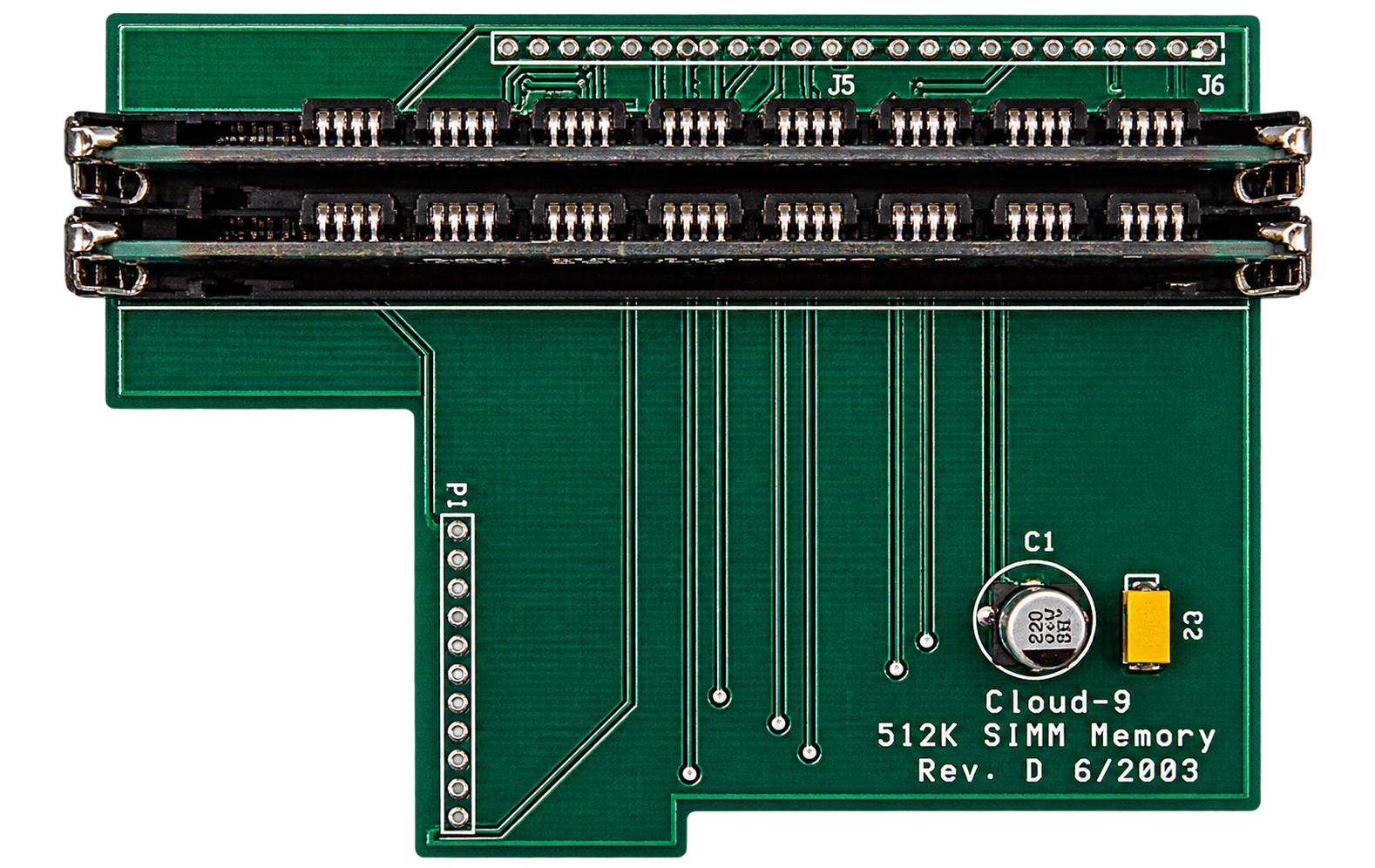
Cloud-9 512K SIMM Memory Upgrade — Available by 2002
As the Color Computer entered the twenty-first century, owners continued to seek reliable ways to maintain and expand their aging machines. Although 512K memory upgrades had been available for the CoCo 3 since the late 1980s, many of the earlier expansion boards relied on individual 41256 DRAM chips that were becoming increasingly difficult to obtain.
Cloud-9, a company established in 1994 and associated with CoCo developers Mark Marlette and Boisy Pitre, offered a practical alternative with its 512K SIMM Memory Upgrade. Rather than using a collection of individual DRAM chips, the board employed two removable SIMM memory modules, making it easier to source replacement memory and maintain the upgrade.
The product was advertised on Cloud-9's website by 2002, although its original introduction date has not been established. Surviving examples include a board marked Rev. D 6/2003, while the original installation manual, Revision 1.2, is dated April 30, 2004.
Design and Features
The Cloud-9 upgrade expanded a standard 128K Color Computer 3 to 512K using two 256K SIMM modules.
Its distinctive stepped circuit board carried two SIMM sockets arranged side by side, along with the necessary connections to the CoCo 3 motherboard. The board installed directly into the computer's existing memory expansion connectors, eliminating the need for a separate external interface or extensive additional wiring.
Cloud-9 specified 120-nanosecond or faster SIMMs using eight or nine memory chips per module. Three-chip SIMMs were explicitly unsupported because their refresh requirements exceeded those provided by the original CoCo 3 hardware.
The use of removable SIMMs offered a practical advantage over conventional expansion boards populated with individual DRAM chips. Compatible memory modules could be replaced without desoldering individual devices, and the upgrade could be maintained using memory components that remained relatively common in the personal computer surplus market.
Cloud-9 promoted the board as a quality, cool-running memory upgrade, although the surviving documentation does not provide comparative power-consumption or temperature measurements.
Installation
Installation followed the general procedure used by many conventional CoCo 3 memory upgrades.
The computer's four original DRAM chips, identified as IC16 through IC19, were removed from the motherboard. Two small capacitors, C65 and C66, were also removed as specified in Cloud-9's instructions.
The new memory board was then installed into the existing expansion connectors, with J4, J5, and J6 aligning with CN4, CN5, and CN6 on the motherboard.
Because of the board's position above the keyboard connector, Cloud-9 recommended temporarily moving the keyboard forward while leaving its cable attached. This provided additional cable clearance during installation.
Once the board was seated and the keyboard reinstalled, the computer could be reassembled and tested.
The upgrade did not require additional CPU-mounted address-translation hardware, since its 512K capacity remained within the standard addressing capabilities of the CoCo 3's GIME chip.
Testing and Software Compatibility
Cloud-9 supplied a BASIC memory-testing utility named MTEST512, distributed on a 5¼-inch disk.
The utility could be launched with the command RUN "MTEST512" and performed repeated tests of the expanded memory until interrupted by the user.
Because the upgrade retained the CoCo 3's standard 512K memory organization, it was compatible with software designed to use conventional 512K expansion hardware.
This included applications and operating systems such as OS-9 Level II and NitrOS-9, which could benefit from the additional memory without requiring the specialized address-translation hardware associated with larger 1MB and 2MB expansions.
Pricing and Availability
Cloud-9 offered the upgrade both as an assembled product and as a kit for users comfortable assembling their own hardware.
A surviving 2002 website listing advertised the completed 512K SIMM upgrade for $35 plus shipping, while the kit version, supplied without memory, was priced at $20 plus shipping.
The kit included the printed circuit board and components needed to assemble the upgrade, with the purchaser providing the SIMM modules and assembly labor.
By 2007, an advertisement listed the assembled and tested version at $40, with the kit without memory priced at $25.
These prices made the Cloud-9 board an affordable option for enthusiasts maintaining or restoring Color Computer 3 systems many years after Radio Shack had discontinued the computer.
Surviving Hardware and Documentation
Original examples of the Cloud-9 SIMM upgrade can be identified by their distinctive stepped circuit board and two SIMM sockets.
One surviving board carries the silkscreen markings Cloud-9, 512K SIMM Memory, and Rev. D 6/2003, establishing a documented hardware revision from June 2003.
The original user manual, Revision 1.2, dated April 30, 2004, provides installation instructions, SIMM compatibility requirements, and information about the supplied memory-testing utility.
Together with Cloud-9's surviving website material and later advertising, these sources provide a useful record of the upgrade's design, pricing, and continued availability during the 2000s.
Historical Significance
Cloud-9's 512K SIMM upgrade was not intended to exceed the CoCo 3's established 512K memory limit. Instead, it addressed a different problem: keeping conventional memory expansion practical and affordable as the original hardware aged.
By replacing increasingly scarce individual DRAM chips with removable SIMM modules, Cloud-9 offered owners a convenient way to maintain and expand their machines without adopting the more complicated circuitry required by larger memory upgrades.
The product also reflected the changing nature of the Color Computer aftermarket. By the early 2000s, expansion hardware was no longer primarily about competing with new commercial computers. It was increasingly about preserving existing systems, improving reliability, and making replacement components easier to obtain.
Cloud-9 would later introduce its TRIAD 512K SRAM upgrade, which took a different approach by replacing conventional DRAM with lower-power static memory.
The earlier SIMM-based board remains a noteworthy example of how independent developers continued supporting and improving the Color Computer long after its commercial production had ended.
Sources and references
-
Cloud-9, 512K SIMM Upgrade product webpage, 2002 archival capture.
-
Cloud-9, 512K SIMM Upgrade User Manual, Revision 1.2, April 30, 2004.
-
Cloud-9, 512K SIMM Upgrade product webpage, 2007 archival capture.
-
Surviving Cloud-9 512K SIMM Memory circuit board, Revision D, June 2003.
-
Tandy's Little Wonder, second edition, historical discussion of Cloud-9 hardware and CoCo expansion products.
Cloud 9 TRIAD
512k SRAM Upgrade
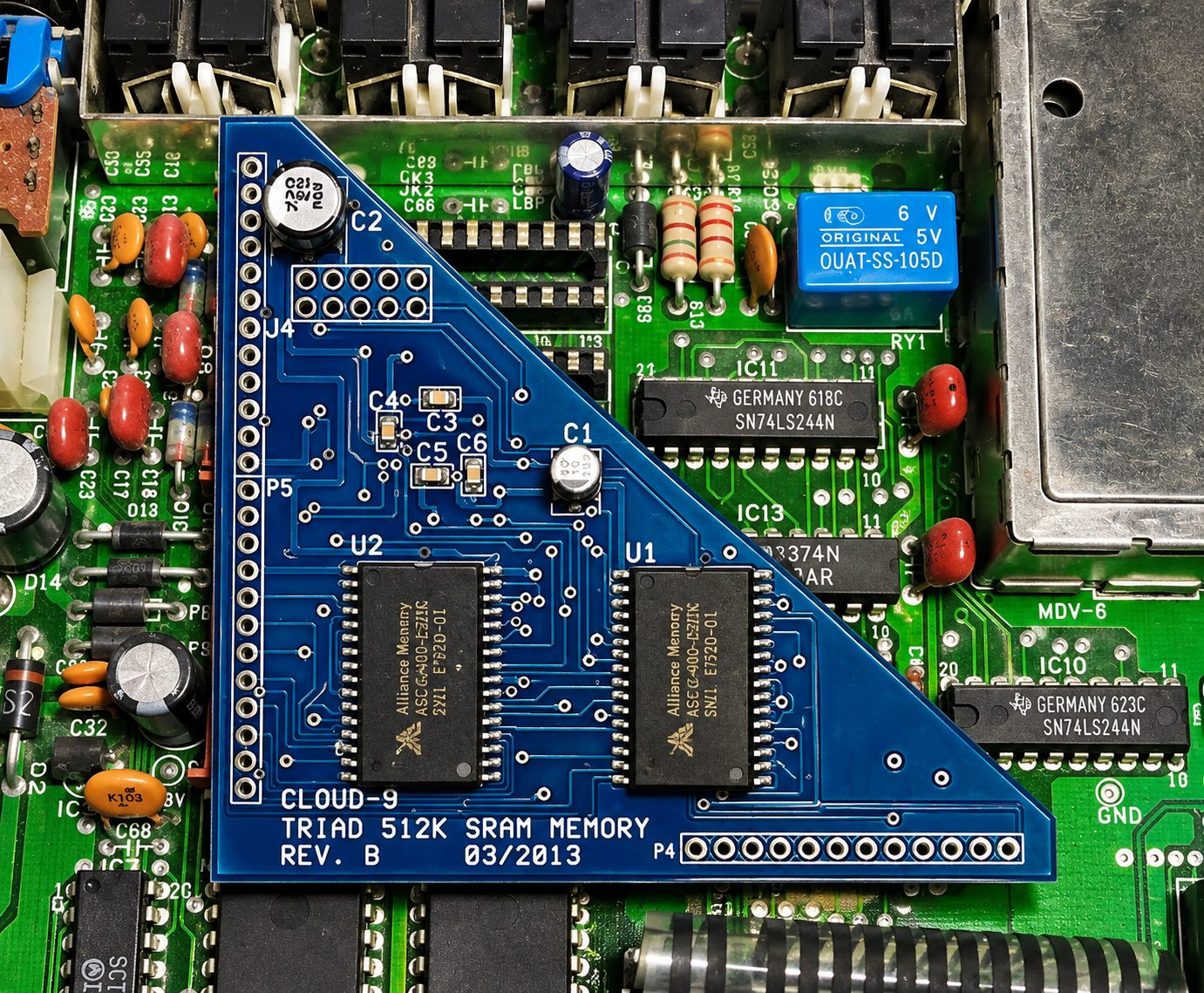
Cloud-9 TRIAD 512K SRAM Memory Upgrade — 2013
In 2013, Cloud-9 introduced the TRIAD 512K SRAM Memory Upgrade for the Tandy Color Computer 3, offering a modern alternative to the conventional DRAM-based expansion boards that had been available since the late 1980s.
Unlike traditional 512K upgrades, including Cloud-9's own SIMM-based expansion introduced in 1997, TRIAD employed static RAM (SRAM) rather than dynamic RAM (DRAM). This eliminated the need for memory-refresh circuitry and substantially reduced the electrical power consumed by the expansion hardware.
Cloud-9 promoted TRIAD as a cooler-running, lower-power replacement for its earlier memory boards, emphasizing its compact dimensions and reduced demands on the CoCo 3's aging power supply.
The original TRIAD was designed to provide a conventional 512K memory configuration. It did not require additional memory-management hardware or modifications to the GIME's standard addressing capabilities.
A New Approach to Memory Expansion
The TRIAD's most recognizable feature was its distinctive triangular blue printed circuit board, substantially smaller than conventional CoCo 3 memory expansion cards.
Rather than employing sixteen individual DRAM chips or removable SIMM modules, the board incorporated two surface-mounted SRAM devices. Its unusual shape allowed the necessary circuitry to occupy considerably less space inside the computer.
Because SRAM retains its contents without periodic refresh cycles while power is applied, TRIAD avoided the refresh requirements associated with the original DRAM-based designs.
The board also reduced the electrical load placed on the CoCo 3's internal power supply, an increasingly attractive feature as the computers approached three decades of age.
The surviving Revision B board carries the markings CLOUD-9, TRIAD 512K SRAM MEMORY, and REV. B 03/2013, establishing a documented hardware revision from March 2013.
Cloud-9's installation manual, Revision 1.2, was dated April 5, 2013, and an archived advertisement from June 1, 2013, offered the upgrade for $50 plus shipping and handling.
Power Consumption and Heat Reduction
One of TRIAD's principal selling points was its substantially reduced power consumption compared with conventional DRAM memory expansions.
Cloud-9 published comparative measurements in the original installation manual, testing TRIAD against its earlier 512K SIMM upgrade.
Both boards were evaluated in a standard CoCo 3 equipped with a 6809 processor, running the MTEST512 memory-testing program for approximately two hours. Ambient temperature was recorded at 78°F.
The TRIAD memory devices reached 87.4°F, compared with 166.8°F for the earlier SIMM expansion. The voltage regulator heatsink measured 150.8°F with TRIAD installed, versus 171.6°F with the SIMM board.
The difference in current consumption was particularly substantial. Cloud-9 measured an average of 21.82 milliamperes at CN6 pin 2 for TRIAD, compared with 543 milliamperes for the SIMM upgrade.
According to Cloud-9's published calculations, these results represented approximately a 96% reduction in current consumption, while the new board occupied roughly half the circuit-board area of its predecessor.
Cloud-9 advertised TRIAD as producing approximately 90% less heat and using one-twentieth of the power of conventional 512K upgrades. These figures were based on the manufacturer's own testing, rather than independent laboratory measurements.
Nevertheless, the documented difference in current draw and operating temperature demonstrated the practical advantages of replacing older DRAM technology with modern SRAM.
Installation and Compatibility
Despite its substantially different memory technology, TRIAD retained the straightforward installation procedure used by conventional CoCo 3 memory expansions.
The original four DRAM chips, identified as IC16 through IC19, were removed from the motherboard. Two capacitors, C65 and C66, were also removed according to Cloud-9's instructions.
The TRIAD board then plugged directly into the existing memory expansion connectors, with J4, J5, and J6 aligned with CN4, CN5, and CN6 on the motherbo
Cloud 9 TRIAD+
512k - 2048k SRAM Upgrade
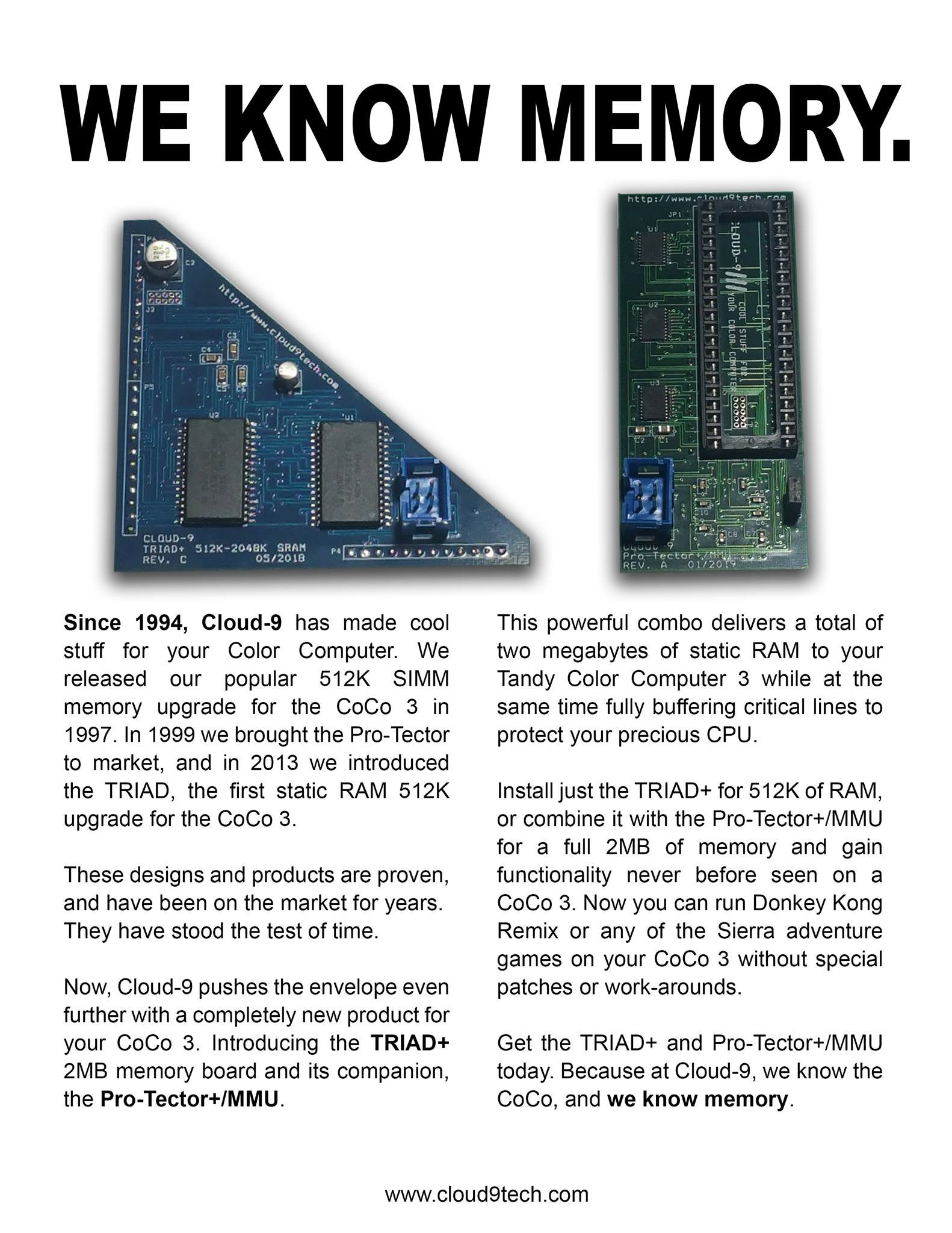
Cloud-9 TRIAD+ 2MB SRAM Upgrade and Pro-Tector+/MMU — 2018–2019
In April 2018, Cloud-9 announced the next generation of its Color Computer 3 memory expansion hardware: the TRIAD+ SRAM Memory Upgrade and its companion Pro-Tector+/MMU. Together, the two products provided a modern, compact solution for expanding the CoCo 3 to 2MB of memory while retaining the low power consumption and reduced heat output that had distinguished Cloud-9's original TRIAD design.
The new hardware represented the culmination of more than two decades of Cloud-9 memory expansion development. The company had introduced its original 512K SIMM upgrade in 1997, followed by the Pro-Tector CPU protection interface in 1999 and the TRIAD 512K SRAM upgrade in 2013.
Unlike the original TRIAD, which provided a conventional 512K memory configuration, TRIAD+ incorporated a full 2MB of static RAM. However, the CoCo 3's original GIME memory-management hardware could access only 512K of that capacity. To utilize the remaining memory, Cloud-9 developed the Pro-Tector+/MMU, combining processor protection circuitry with expanded memory-addressing capabilities.
The resulting system offered CoCo 3 owners a substantial increase in memory without the complicated stacked expansion boards, extensive wiring, or older DRAM technology associated with some earlier 1MB and 2MB upgrades.
Development and Introduction
The TRIAD+ development history is unusually well documented through contemporary announcements by Cloud-9 developer Mark Marlette.
On April 22, 2018, Marlette announced that TRIAD+ and Pro-Tector+/MMU would replace the company's existing TRIAD and Pro-Tector products. The announcement included photographs of a TRIAD+ circuit board marked Revision A, March 2018, establishing that working hardware existed by that time.
Marlette explained that TRIAD+ could operate as a conventional 512K memory upgrade when installed alone, while the addition of Pro-Tector+/MMU would make the full 2MB of SRAM available.
The initial announcement listed target prices of $45 for TRIAD+ and $30 for Pro-Tector+/MMU. These were projected prices rather than confirmed retail prices.
Development continued through subsequent hardware revisions. A later TRIAD+ board was marked Revision C, May 2018, while a surviving Pro-Tector+/MMU board carried a Revision A, January 2019 designation.
By April 27, 2019, Cloud-9 was publicly advertising the complete combination, describing it as a new generation of memory expansion hardware for the CoCo 3.
The precise date of the first customer shipment has not been established, but the contemporary announcements document the product's development and promotion well before its appearance in later archived website captures.
TRIAD+ — 2MB of Static RAM
The TRIAD+ retained the distinctive triangular circuit-board arrangement introduced with the original 2013 TRIAD.
The new design incorporated 2MB of SRAM, replacing the older DRAM-based memory expansion technology with static memory that did not require periodic refresh cycles.
This approach reduced electrical power consumption and heat generation while eliminating the need for conventional DRAM refresh circuitry.
The compact board installed inside the CoCo 3 using the computer's existing memory expansion connections. Its relatively small footprint helped preserve internal space and reduced the amount of additional hardware required.
Unlike conventional 512K memory upgrades, TRIAD+ contained substantially more physical memory than the original GIME could address.
When installed by itself, the board operated as a standard 512K expansion, providing compatibility with the CoCo 3's existing memory-management system.
The remaining 1.5MB was physically present but could not be accessed through the original GIME addressing arrangement.
To unlock the full capacity, the system required Cloud-9's companion Pro-Tector+/MMU.
Pro-Tector+/MMU — Expanded Memory Addressing
The Pro-Tector+/MMU combined two functions in a single interface: protection of the CoCo 3's processor and additional memory-management circuitry.
Cloud-9's original Pro-Tector, introduced in 1999, was designed to buffer critical processor signals and help protect the CPU from electrical conditions associated with external hardware and expansion devices.
The newer Pro-Tector+/MMU extended that concept by incorporating the additional address-management functionality required for the TRIAD+ memory board.
The CoCo 3's GIME normally provides access to 512K of physical memory through sixteen Data Address Translation (DAT) registers. Each register selects an 8K memory block, allowing the processor's 64K address space to be mapped into different regions of the installed RAM.
Accessing 2MB requires additional physical address-selection capability beyond the GIME's original configuration.
The Pro-Tector+/MMU supplied the necessary expanded memory-management functionality, allowing software designed to support the extended configuration to access the full 2MB installed on TRIAD+.
The combination therefore provided a substantial increase in available memory while preserving the CoCo 3's original processor and GIME.
Two Operating Configurations
Cloud-9 offered TRIAD+ in two configurations, allowing owners to select the memory capacity appropriate for their systems.
TRIAD+ alone — 512K accessible
With only the TRIAD+ board installed, the CoCo 3 operated as a conventional 512K machine. Although the board contained 2MB of SRAM, the original GIME could address only the first 512K.
This configuration provided the advantages of modern SRAM technology without requiring the companion memory-management hardware.
TRIAD+ with Pro-Tector+/MMU — 2MB accessible
Adding the Pro-Tector+/MMU enabled the full 2MB of physical SRAM to be addressed.
Owners could therefore begin with the TRIAD+ memory board and later expand their systems to 2MB by adding the companion interface, rather than replacing the memory expansion board.
This modular approach distinguished TRIAD+ from earlier memory upgrades that required separate, dedicated hardware configurations for different capacities.
Power Consumption and Reliability
Like its predecessor, TRIAD+ was promoted as a cooler-running, lower-power alternative to conventional DRAM memory expansion boards.
Cloud-9's advertising described the SRAM design as operating approximately 90% cooler and consuming one-twentieth of the power of older 512K upgrades, while occupying roughly half the circuit-board area.
These claims reflected the advantages Cloud-9 had previously documented for its original TRIAD design. They should be understood as manufacturer-reported comparisons rather than independently verified measurements specific to every TRIAD+ configuration.
The reduced electrical load was particularly significant for aging CoCo 3 systems, whose original power supplies and internal components had already accumulated decades of service.
The Pro-Tector+/MMU added another element of hardware protection by buffering critical processor signals, extending the protective concept introduced with Cloud-9's earlier Pro-Tector interface.
Software Compatibility and Applications
Expanding the CoCo 3 beyond 512K provided additional opportunities for operating systems and applications capable of using the larger physical memory configuration.
NitrOS-9 was particularly well suited to systems with expanded memory, allowing additional RAM to support multitasking, larger applications, and memory-intensive operations.
Cloud-9 also promoted the TRIAD+ and Pro-Tector+/MMU combination as providing improved compatibility with certain software titles that had previously required special patches or workarounds.
In its April 2019 advertisement, the company specifically mentioned Donkey Kong Remix and Sierra adventure games as examples of software that could benefit from the new hardware configuration.
These compatibility improvements were presented as features of the complete TRIAD+ and Pro-Tector+/MMU combination, rather than the standalone 512K memory board.
Pricing and Availability
Cloud-9's April 2018 development announcement proposed target prices of $45 for TRIAD+ and $30 for Pro-Tector+/MMU.
A later Cloud-9 product listing advertised two configurations:
-
TRIAD+ 512K: $55 plus shipping and handling, including a Tandy 512K case badge.
-
TRIAD+ 2048K: $115 plus shipping and handling, including the Pro-Tector+/MMU and a Tandy 2048K case badge.
The product listing also advertised an installation manual and an RS-DOS memory-testing program supplied or available with the upgrade.
The exact date of this later pricing has not been established. However, the April 2018 development announcement and April 2019 advertisement confirm that the product was being publicly promoted several years before the surviving mid-2024 website capture.
Surviving Hardware and Documentation
Several documented hardware revisions help establish the development history of the TRIAD+ system.
The earliest identified TRIAD+ board is Revision A, dated March 2018, photographed in Mark Marlette's April 22, 2018 development announcement.
A subsequent TRIAD+ Revision C board is dated May 2018 and appears in Cloud-9's April 2019 advertising.
The companion Pro-Tector+/MMU board pictured in that advertisement carries a Revision A date of January 2019.
These photographs establish a progression from the original 2018 TRIAD+ development hardware to the complete two-board combination advertised in 2019.
They also provide useful identifying details for collectors attempting to distinguish the later TRIAD+ from Cloud-9's original 2013 TRIAD 512K SRAM upgrade.
Historical Significance
The TRIAD+ and Pro-Tector+/MMU combination represented a significant refinement of the large-memory upgrades developed for the Color Computer 3.
Earlier designs, including DISTO's 1MB and 2MB expansions, had demonstrated that the CoCo 3 could operate with substantially more memory than Radio Shack originally intended. However, these systems often required complicated additional circuitry, multiple interconnected boards, or extensive installation modifications.
Cloud-9 approached the same challenge using modern SRAM technology and a compact, modular hardware arrangement.
The TRIAD+ board provided the complete 2MB of physical memory, while the Pro-Tector+/MMU supplied the additional addressing capability needed to utilize it. This separation allowed the memory board to function independently as a conventional 512K upgrade or as part of a fully expanded 2MB system.
The design also combined increased memory capacity with lower power consumption, reduced heat generation, and processor signal protection.
Introduced more than thirty years after the CoCo 3 first appeared in 1986, the TRIAD+ demonstrated the continued technical development of the Color Computer platform by independent hardware designers.
Together with the original TRIAD, it stands as an important example of Cloud-9's efforts to modernize, preserve, and extend the capabilities of Tandy's final Color Computer.
Sources and references
-
Mark Marlette, Facebook announcement of TRIAD+ and Pro-Tector+/MMU development, April 22, 2018.
-
Cloud-9, We Know Memory, TRIAD+ and Pro-Tector+/MMU advertisement, Facebook publication dated April 27, 2019.
-
Cloud-9, TRIAD+ 512K–2048K SRAM Upgrade, archived product webpage and pricing.
-
Cloud-9 TRIAD+ Revision A circuit board, March 2018.
-
Cloud-9 TRIAD+ Revision C circuit board, May 2018.
-
Cloud-9 Pro-Tector+/MMU Revision A circuit board, January 2019.
-
Cloud-9, TRIAD 512K SRAM Upgrade User's Manual, Revision 1.2, April 5, 2013, for background on the preceding TRIAD design.