
EXPANDING THE COLOR COMPUTER
THE COMPUTER THAT REFUSED TO STAY STOCK
HOW MUCH DATA?!
When the Color Computer arrived in 1980, data storage could hardly have been simpler: connect an ordinary cassette recorder, insert a tape, and wait. For many early CoCo owners, the familiar squeal of a program being saved to cassette was simply part of using the computer.
It didn't stay that way for long.
Floppy disk systems transformed the CoCo into a much more capable machine, and an active third-party market quickly expanded the possibilities beyond Radio Shack's own drives and controllers. Larger-capacity floppy systems appeared, followed by hard drives and other mass-storage solutions. Some manufacturers explored considerably less conventional technologies—including bubble memory—while later generations of hardware brought solid-state storage and virtual disk systems to machines designed decades before such technologies existed.
Storage for the Color Computer therefore became much more than a choice between cassette and floppy disk. Over its lifetime, the CoCo used an unusually broad collection of storage technologies, ranging from magnetic tape and removable disks to hard drives, nonvolatile memory, networked storage and modern flash media.
ENDLESS (ALMOST) STORAGE POSSIBILITES
MAGNETIC STORAGE MEDIA

Magnetism is the basis of cassette tape, floppy disk and hard disk storage. A thin coating of magnetic material is divided into tiny regions whose magnetic orientation can be changed to represent data. When information is written, the drive's recording head creates a magnetic field that changes those regions. When the data is read, the magnetic patterns are detected and converted back into electrical signals the computer can understand.
The same basic principle applies whether the medium is a cassette tape, a floppy disk or the rigid platters inside a hard drive. The physical construction, recording methods and capacity may differ considerably, but all store information by changing and later detecting magnetic patterns on the recording surface.
And yes — this is why magnets and floppy disks were never particularly good friends.
Tape/Disk Systems
- Cassette
- JPC TC-8C
- Exatron ESR
- Exatron CCI
- 26-3022
- Cer-Comp
- 26-3029
- AMDISK III
- FD-500
- J&M & JDOS
- FD-501
- FD-502
Floppy Controllers
- Sardis DMC
- HDS Controller
- Disto Super
- Mav FD-502
- Mav Disto Mini 1
HDD Controllers
Cassette Tape Data Storage
Radio Shack and others
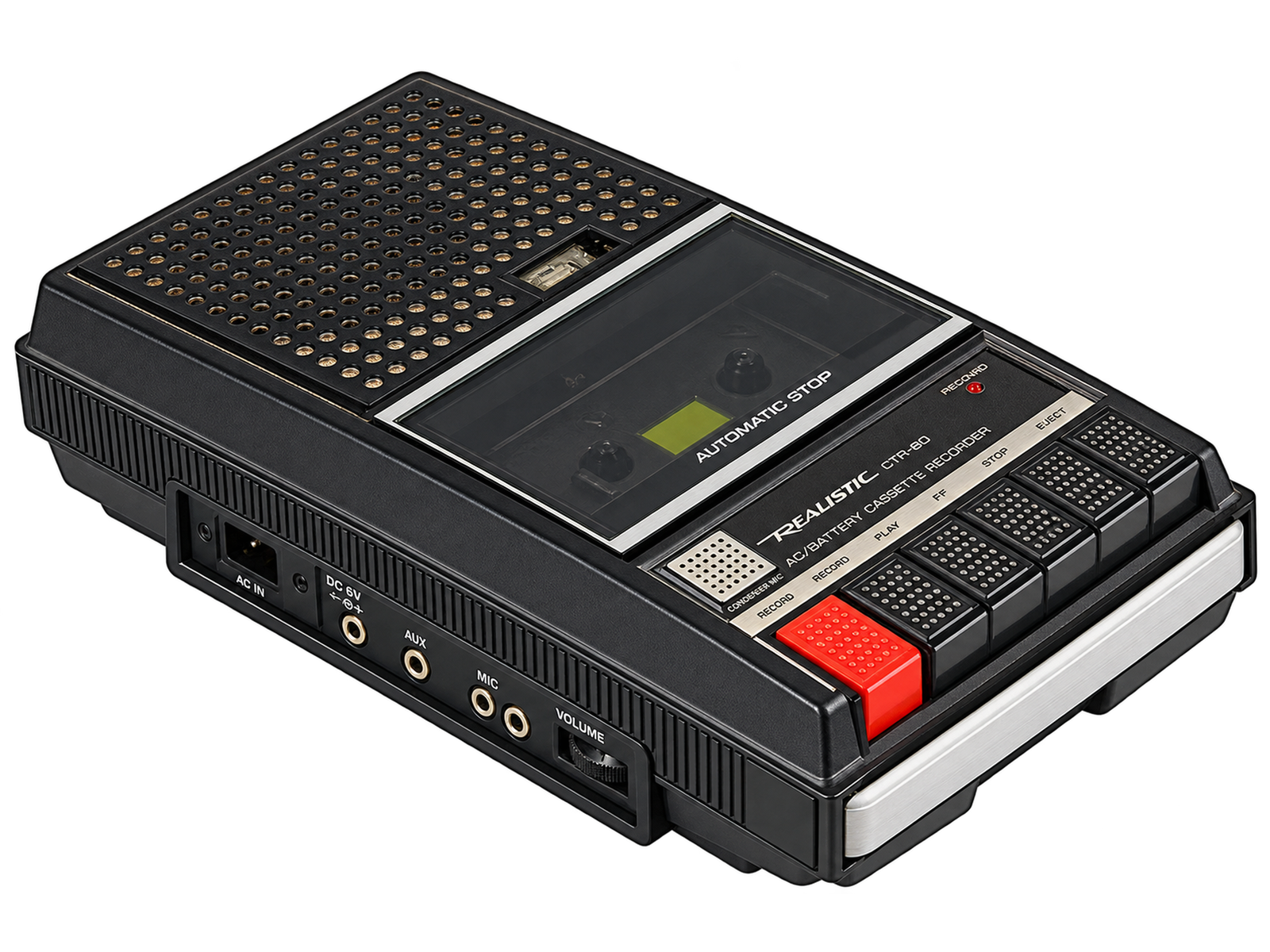
Cassette tape was the Color Computer's original mass-storage system. Rather than requiring an elaborate external controller, the CoCo handled much of the process of converting digital information into audio — and back again — itself. This allowed an inexpensive, ordinary cassette recorder to become a practical storage device.
The CoCo recorded data using Frequency Shift Keying (FSK), representing binary information with audio frequencies of approximately 1200 Hz and 2400 Hz. Data was transferred at roughly 1500 baud. When loading a program, the process was reversed: the CoCo interpreted the recorded tones and reconstructed the original digital data.
Color BASIC made cassette operation straightforward with commands such as CLOAD and CSAVE. Recordings contained a leader used for synchronization, followed by structured blocks containing information such as the filename, file type, program or data, and error-checking information.
Radio Shack offered cassette recorders intended for computer use, including models such as the CTR-80A, CCR-81 and CCR-82. However, owners weren't necessarily limited to Radio Shack hardware. Other cassette recorders could be used provided they had the necessary audio input and output connections.
A particularly useful feature of the CoCo cassette interface was remote motor control. The cassette cable carried the audio signals as well as a connection to the recorder's remote jack, allowing the computer to start and stop a compatible recorder automatically while loading or saving data.
Ordinary Type I ferric-oxide cassettes were commonly used. Shorter tapes, such as C30 cassettes, were well suited to computer storage because their shorter length made finding programs quicker and their thicker tape stock was generally more durable. Longer C60 and C90 tapes provided more recording time and could hold collections of programs, at the expense of longer searches, more rewinding, and thinner tape.
Cassette storage was inexpensive, readily available and surprisingly capable. Its biggest disadvantage was inherent in the medium itself: tape was sequential. Finding a program could mean rewinding, fast-forwarding, watching the counter and listening for the familiar sound of CoCo data.
For early Color Computer owners, though, that was simply part of using the machine — at least until a floppy disk drive entered the picture.
Radio Shack's Computer-Specific Cassettes
Ordinary audio cassettes typically used a non-recording leader at the beginning of the tape. For computer storage this could be inconvenient: if recording began while the leader was still passing over the tape head, the beginning of the data could be lost.
Radio Shack addressed the problem with Certified Computer Cassettes designed specifically for data storage. These were advertised as leaderless, allowing recording to begin immediately without first advancing the tape past a conventional leader.
Radio Shack offered several short-duration cassettes particularly well suited to computer use:
- C10 — 10 minutes total, 5 minutes per side: A convenient length for individual programs and small collections of files.
- C20 — 20 minutes total, 10 minutes per side: Offered considerably more recording time while remaining much shorter than a typical music cassette. Radio Shack sold the C20 as Catalog No. 26-301 for use with its TRS-80 computers.
Short computer cassettes also had a practical advantage beyond the missing leader: less tape meant less time spent rewinding, fast-forwarding and searching for a program.
High Speed Cassette
JPC TC-8C
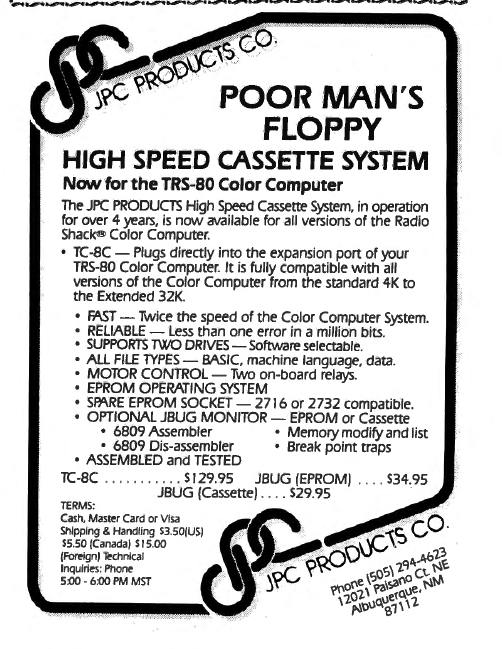
Not every attempt to improve the Color Computer's storage involved replacing the cassette recorder.
JPC Products Company took a different approach. Rather than asking CoCo owners to purchase a floppy drive, the company attempted to make the inexpensive cassette hardware they already owned faster, more reliable and considerably more capable.
The result was the TC-8C Cassette Interface, advertised with the wonderfully appropriate nickname:
“The Poor Man's Floppy.”
The TC-8C was supplied as a ROM Pak that plugged directly into the Color Computer's cartridge port. Inside was JPC's cassette operating system, called CCCOS, along with the circuitry necessary to independently control two external cassette recorders.
Unlike a conventional cassette interface, however, the TC-8C did not replace the Color Computer's built-in cassette system.
It supplemented it.
Two Cassette “Drives” — And Maybe Three
The TC-8C provided two cassette connectors and two independently controlled motor relays. CCCOS could therefore treat the attached recorders somewhat like separate storage drives, allowing the user to select which recorder was being accessed.
Even more interestingly, the Color Computer's original cassette port remained completely functional.
James G. Kriz, reviewing the TC-8C for Color Computer News in May 1983, pointed out that it was therefore possible to operate three cassette recorders concurrently — two through the TC-8C and another through the CoCo's standard cassette interface.
That arrangement allowed operations that were considerably more sophisticated than normal cassette use. A data file could be read from one recorder, modified, and written to another without requiring the entire file to fit into available memory.
For a cassette-based storage system, that was an impressive trick.
Twice the Speed
The other major attraction was speed.
JPC advertised the TC-8C as operating at approximately twice the speed of the standard Color Computer cassette interface. Kriz's testing found it operating at approximately 3600 baud.
He offered a particularly useful real-world comparison: a program that normally required about 45 seconds to load through the standard cassette interface took only about 20 seconds using the TC-8C.
That increased speed came with a catch.
Standard Color Computer tapes were not compatible with the TC-8C's higher-speed recording format. This wasn't an especially serious problem, however, because the original cassette interface remained available. Existing programs could simply be loaded normally and then saved again using the TC-8C.
Recorder quality also became much more important at the higher data rate.
Kriz tested three different cassette recorders: a Radio Shack model, a Panasonic and the recommended Radio Shack CTR-80A. The Panasonic would not load at all, while the other Radio Shack recorder worked only sporadically and produced too many I/O errors to be considered acceptable. The CTR-80A, however, operated reliably.
The TC-8C could therefore deliver considerably better cassette performance, but only if the recorder itself was capable of reliably handling the increased data rate.
CCCOS — A Cassette Operating System
What really separated the TC-8C from a simple high-speed cassette interface was CCCOS.
The operating system resided in ROM and was activated with:
EXEC 53248
Once running, it occupied only 594 bytes at the top of memory, leaving most of the Color Computer's RAM available to BASIC and applications. Color Computer News #20 May 1983
CCCOS provided 13 commands and five BASIC statements, many deliberately resembling familiar Color BASIC cassette commands.
Among them were:
@SAVE and @LOAD for BASIC programs;
@SAVEM and @LOADM for machine-language programs;
@VERIFY and @VERIFYM for checking recorded programs;
@DIR for displaying filenames stored on a cassette;
@GO for executing machine-language programs;
@RUN and @RUNM for automatically loading and executing programs;
and @ON and @OFF for controlling the cassette motors.
The @DIR command was particularly useful for cassette storage. It could list all filenames encountered on a tape or stop when a specified filename was found.
CCCOS also supplied BASIC statements corresponding to familiar file operations, including @OPEN, @CLOSE, @INPUT, @PRINT and @EOF. Device numbers could be specified, allowing Tape 1 to be opened for input while Tape 2 was simultaneously opened for output.
It wasn't random-access storage, of course.
The cassette still had to physically move past everything preceding the requested data.
But CCCOS made sequential tape storage behave considerably more like a managed storage system than the ordinary Color Computer cassette interface.
Not Quite Perfect
The contemporary review also reveals some of the TC-8C's shortcomings.
Kriz considered the absence of a @LINEINPUT instruction the system's biggest fault. Without it, data created by text editors or word processors could be difficult to handle because spaces and colons were treated as delimiters by @INPUT and lines containing them could be truncated.
He also noted a limitation in @OPEN: a filename had to be explicitly specified rather than supplied through a variable during program execution.
These weren't fatal problems, and JPC apparently agreed that improvements were warranted.
According to Kriz, JPC president Gerry Williams explained that registered owners would receive announcements of major revisions and could obtain updated firmware for the cost of the change. Some of the reviewer's suggestions were reportedly expected to be implemented within four or five months.
A ROM Socket With Another Purpose
JPC also included a spare ROM socket inside the TC-8C.
The socket could accept either a 2716 or 2732 EPROM, selected through DIP switches, allowing additional firmware to reside directly inside the cartridge.
JPC naturally had something of its own to put there.
The company offered JBUG, a 6809 machine-language monitor, and recommended its ROM version for installation in the TC-8C's spare socket. The contemporary material describes JBUG as providing a 6809 assembler and disassembler along with facilities for examining and modifying memory and setting breakpoint traps.
JPC advertised JBUG for $29.95 on cassette or $34.95 in EPROM.
This gave the TC-8C a useful secondary purpose: the same cartridge used to improve cassette storage could also carry a machine-language development monitor.
$129.95 Instead of a Disk Drive
The assembled and tested TC-8C sold for $129.95.
That was the real point behind JPC's “Poor Man's Floppy” advertising.
The TC-8C obviously couldn't make magnetic tape into a floppy disk. Access remained sequential, tapes still had to be rewound and positioned, and the reliability of the system depended heavily upon the quality and condition of the cassette recorder and tape.
But it addressed several of cassette storage's most irritating shortcomings without requiring the owner to purchase an actual disk system.
It was faster.
It could control multiple recorders.
It provided directory-like functions.
It supported BASIC, machine-language and data files.
And its operating system was instantly available from ROM.
Kriz ultimately described the TC-8C as an “exceptional product” for the Color Computer and concluded that, even with the additional cost of another cassette recorder, it represented a reasonable alternative to a disk system.
Stringy Floppy
Exatron

Most Likey Never Made for the Color Computer
The CoCo Device That Never Was: The Color Computer Exatron Stringy Floppy
The Exatron Stringy Floppy (ESF) is celebrated in retro-computing history as a high-speed, budget-friendly savior for the TRS-80 Model I and III. Operating at 7,200 baud, it loaded programs roughly 14 times faster than standard audio cassettes, bridging the financial gap before expensive 5.25-inch floppy disks became mainstream. Naturally, when Radio Shack released the Motorola 6809-based TRS-80 Color Computer (CoCo) in late 1980, Exatron aimed to capture that burgeoning market too. However, its implementation on the Color Computer went from a highly anticipated upgrade to an obscure footnote.
Planned Use: Speeding Up the CoCo
Exatron’s planned use for the Color Computer was exactly the same as its predecessor: to kill the painfully slow cassette "loading blues" for budget-conscious users. Because the CoCo utilized an entirely separate architecture from the Z80-driven Model I, a standard ESF could not be plugged in directly. Exatron designed a custom interface cartridge that inserted directly into the CoCo’s 40-pin expansion slot (the program pak port). This cartridge contained custom ROM firmware designed to patch into Tandy’s Color BASIC, allowing users to load and save data onto the miniature, continuous-loop Mylar "wafer" tapes at blazing speeds.
Actual Availability: A Market Ghost
While Exatron extensively prototyped, engineered, and even generated preliminary documentation for the Color Computer stringy floppy system, its actual retail availability was virtually non-existent.
Two major market forces killed the CoCo Stringy Floppy before it could get off the ground:
The Price Drop of True Floppy Disks: By 1981 and 1982, the cost of true random-access 5.25-inch floppy disk drives began to plummet across the industry.
The "Tandy/Radio Shack Disc Controller": Tandy swiftly introduced its own Color Computer Floppy Disk System paired with Disk Extended Color BASIC.
Faced with the choice of buying a sequential, loop-tape system or saving up just a little more for a true, reliable, random-access floppy disk drive, CoCo users overwhelmingly chose the latter.
Exatron ultimately shifted its focus away from the CoCo to pursue other microcomputer contracts (and eventually rebranded as Entrepo). While the ESF remains a staple of standard TRS-80 collections, a working Exatron Stringy Floppy setup manufactured specifically for the Color Computer is one of the rarest, most elusive prototype hardware items in the CoCo community today.
Exatron Not So Stringy
Disk Controller (CCI)
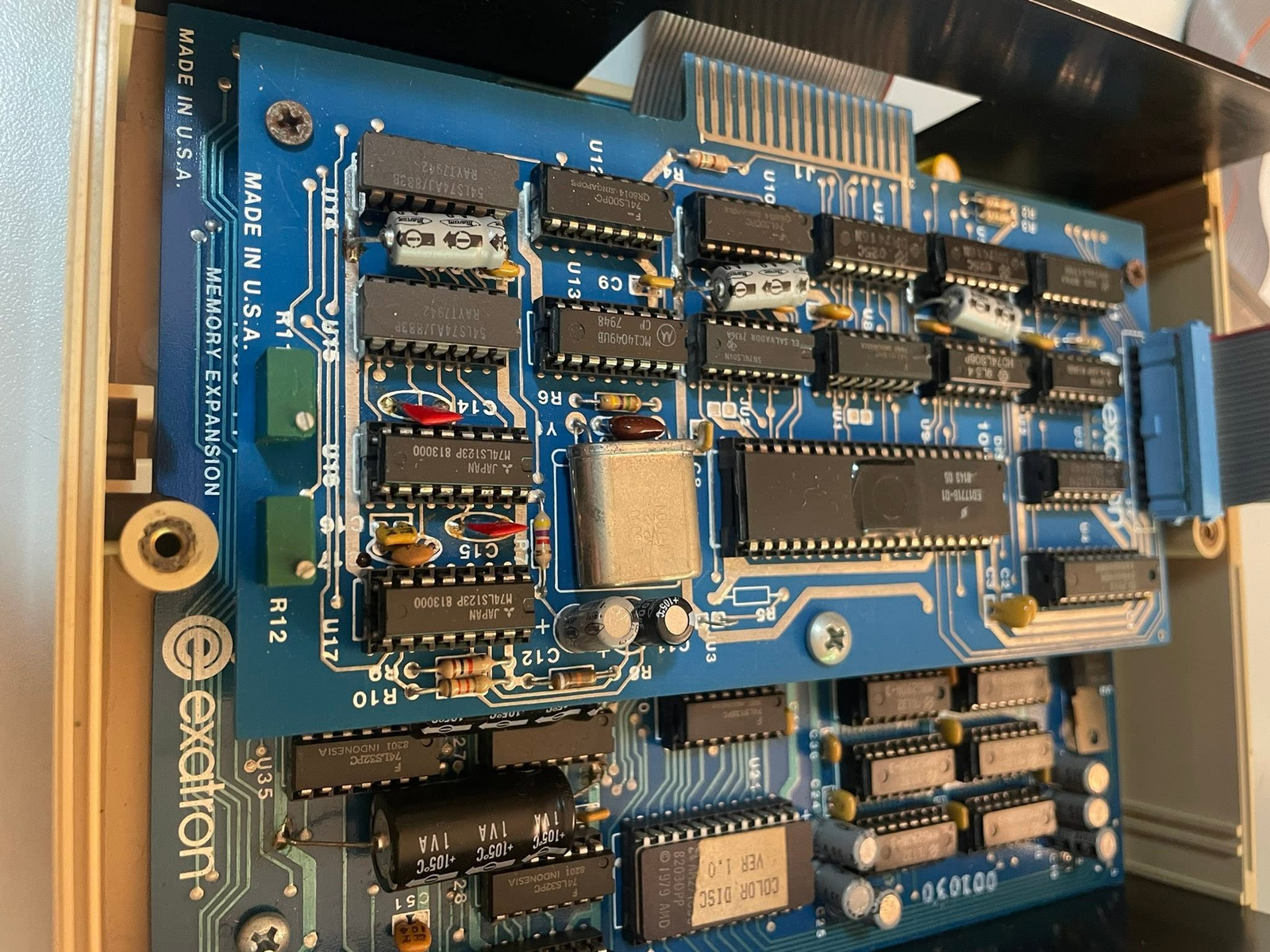
Image Supplied by Brian Wieseler
While Exatron is best remembered by many early TRS-80 users for its unusual Stringy Floppy, the company's production disk solution for the Color Computer took a considerably more conventional—and surprisingly ambitious—approach. The Exatron Color Computer Interface (CCI) combined a floppy disk controller, a substantial memory expansion, a machine-language monitor, and Exatron's own disk operating system into a single expansion unit.
By January 1982, 80-U.S. Journal described the Exatron CCI as one of only two disk systems then available for the Color Computer, the other being Radio Shack's own system. This placed Exatron among the very earliest companies to offer a practical floppy disk alternative for the CoCo.
More Than a Disk Controller
Unlike Radio Shack's cartridge-based controller, the CCI was a larger external expansion unit connected to the Color Computer's Program Cartridge port by a short ribbon cable. The review described the electronics as two high-quality, wave-soldered circuit boards housed in an approximately 6½ × 6½ × 2⅝-inch turquoise plastic enclosure.
One board provided the CCI's memory and ROM circuitry, while the second contained the floppy disk controller.
At the heart of the disk interface was a Western Digital WD1771 floppy disk controller, limiting the system to single-density operation. The drive connection was electrically compatible with the arrangement used by the TRS-80 Model I, allowing the CCI to use readily available Model I-type 5¼-inch floppy drives rather than requiring a proprietary Exatron drive mechanism.
The system supported up to four floppy drives.
32K Memory Expansion
The CCI also provided 32K of additional RAM, a significant amount of memory for an early Color Computer.
The memory was divided into two 16K banks. One expanded the Color Computer's normal user memory, while the second occupied the upper address space normally associated with ROM and cartridge hardware. This arrangement allowed Exatron to make additional memory available for its operating system and other software without consuming the CoCo's normal BASIC workspace.
The CCI also contained a 2K machine-language monitor called CCMON, providing facilities for examining and changing memory, setting breakpoints, moving memory and performing other operations useful to machine-language programmers.
The January 1982 evaluation even documents one of the system's quirks. Initialization could occasionally fail if the CCI and Color Computer were powered in the wrong sequence. When everything initialized properly, CCMON performed a memory check and displayed:
TOP BANK PASSED
CCDOS
Exatron supplied its own operating system, CCDOS, rather than attempting to duplicate Radio Shack's Disk BASIC.
CCDOS was stored in the CCI's upper RAM area, leaving the Color Computer's normal user RAM available to programs. Its commands were designed to resemble the syntax already familiar to TRS-80 disk users.
The system supported 35-track, single-density disks with a formatted capacity of approximately 87,040 bytes per disk.
CCDOS provided a fairly comprehensive collection of disk-management commands, including formatting, disk copying, file copying and deletion, renaming files, changing the default drive, examining free disk space and displaying disk directories. BASIC and machine-language programs could be loaded and saved directly to disk.
The operating system also supported both sequential and random-access files, making the CCI useful for more than simply storing BASIC programs. Up to 15 file buffers were available, with as many as five random-access files open simultaneously.
TRS-80 Model I Compatibility
One of Exatron's more interesting selling points was its attempt to bridge the large existing TRS-80 Model I software library with the new Color Computer.
The CCI used the same general type of floppy drives as the Model I, and CCDOS included facilities intended to assist in transferring software between the two machines. The LOAIT command could load compatible Model I BASIC programs from 35-track, single-density disks into the Color Computer.
This did not make the two machines completely disk-compatible—their operating systems and disk directory structures differed—but it provided a migration path for BASIC software that few other early CoCo disk systems attempted.
Exatron also offered an optional ROM Backup Adapter. This allowed ROM cartridge contents to be copied to cassette and subsequently transferred to disk. The software could then be loaded into the CCI's upper memory and executed without the original cartridge installed.
Pricing
Exatron marketed the system in modular form, allowing a Color Computer owner to purchase the memory interface first and add disk capability later:
- Color Computer Interface with 32K RAM — $199
- CCI Disk Card — $99
- CCDOS and manual — $29.95
- ROM Backup Adapter — $19.95
Thus, an owner who already had suitable Model I-style disk hardware could add the complete Exatron floppy interface and operating system without purchasing another proprietary drive system.
An Early Alternative to Radio Shack
The CCI is particularly interesting because of when it appeared. Exatron had previously discussed developing its Stringy Floppy technology for the Color Computer, but by the beginning of 1982 the company's documented commercial CoCo disk product was a conventional floppy system built around the CCI.
It was also much more than a simple third-party clone of Radio Shack's controller. The combination of 32K RAM expansion, CCMON, CCDOS, a WD1771 disk interface, four-drive support, Model I-style drive compatibility, and software-transfer facilities made the CCI an unusually comprehensive expansion system for the early CoCo.
Its limitations were equally characteristic of the period. The WD1771 restricted it to single density, CCDOS was its own environment rather than Radio Shack Disk BASIC, and the hardware required somewhat more attention from the user than Tandy's integrated system.
Nevertheless, at a time when disk storage for the Color Computer was only beginning to emerge, the Exatron CCI represented one of the first serious alternatives to Radio Shack's own Mini Disk System—and one of the more ambitious attempts to turn the early CoCo into a substantially expanded disk-based computer.
From Stringy Floppy to Real Floppy
Exatron's plans for Color Computer mass storage changed remarkably quickly. In 1981 the company was promoting a CoCo version of its Stringy Floppy, but by early 1982 its documented Color Computer storage product had become the Color Computer Interface (CCI) — a much more ambitious system combining 32K of RAM, a Western Digital WD1771 floppy-disk controller, the CCMON machine-language monitor and Exatron's CCDOS operating system.
The change brought another problem with it: radio-frequency interference.
Later historical accounts describe significant RFI problems with Exatron's early Color Computer disk hardware. This isn't particularly surprising considering the design. The CCI connected to the Color Computer through the cartridge expansion port using a ribbon cable, while the external interface contained the floppy-controller electronics and associated circuitry. In an era when home computers were commonly connected to televisions through RF modulators, electrically noisy external hardware could produce very visible interference.
The problem was reportedly severe enough that some early systems produced so much interference that the television display became difficult to use. Exatron worked to improve shielding and eventually brought the interference under control.
What makes the episode particularly interesting is the speed with which Exatron's plans changed. Within roughly a year, the company's Color Computer storage effort had moved from an advertised $298 continuous-loop tape system to a conventional floppy controller with memory expansion and its own disk operating environment.
The CoCo's First Disk
RS Catalog 26-3022
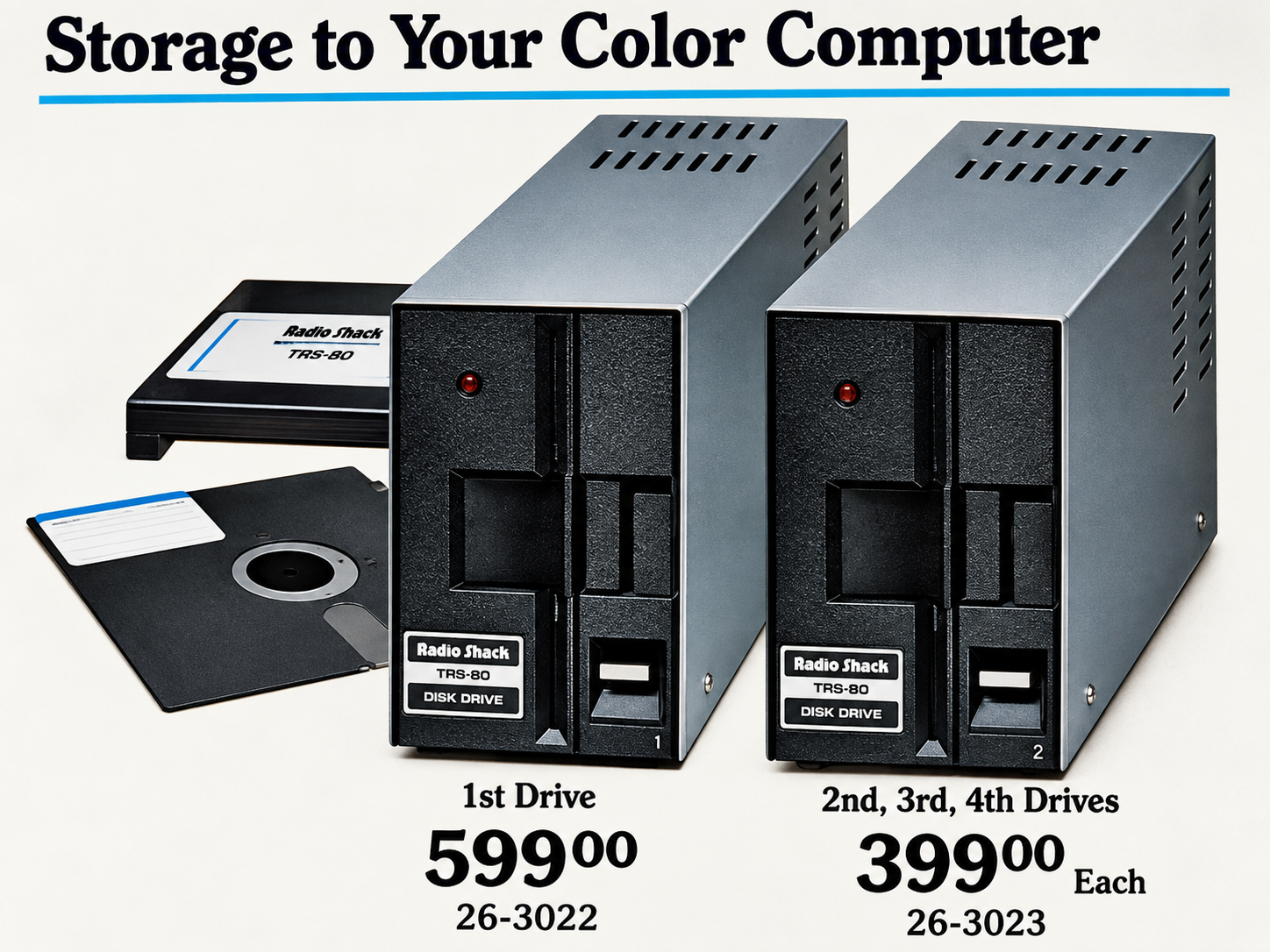
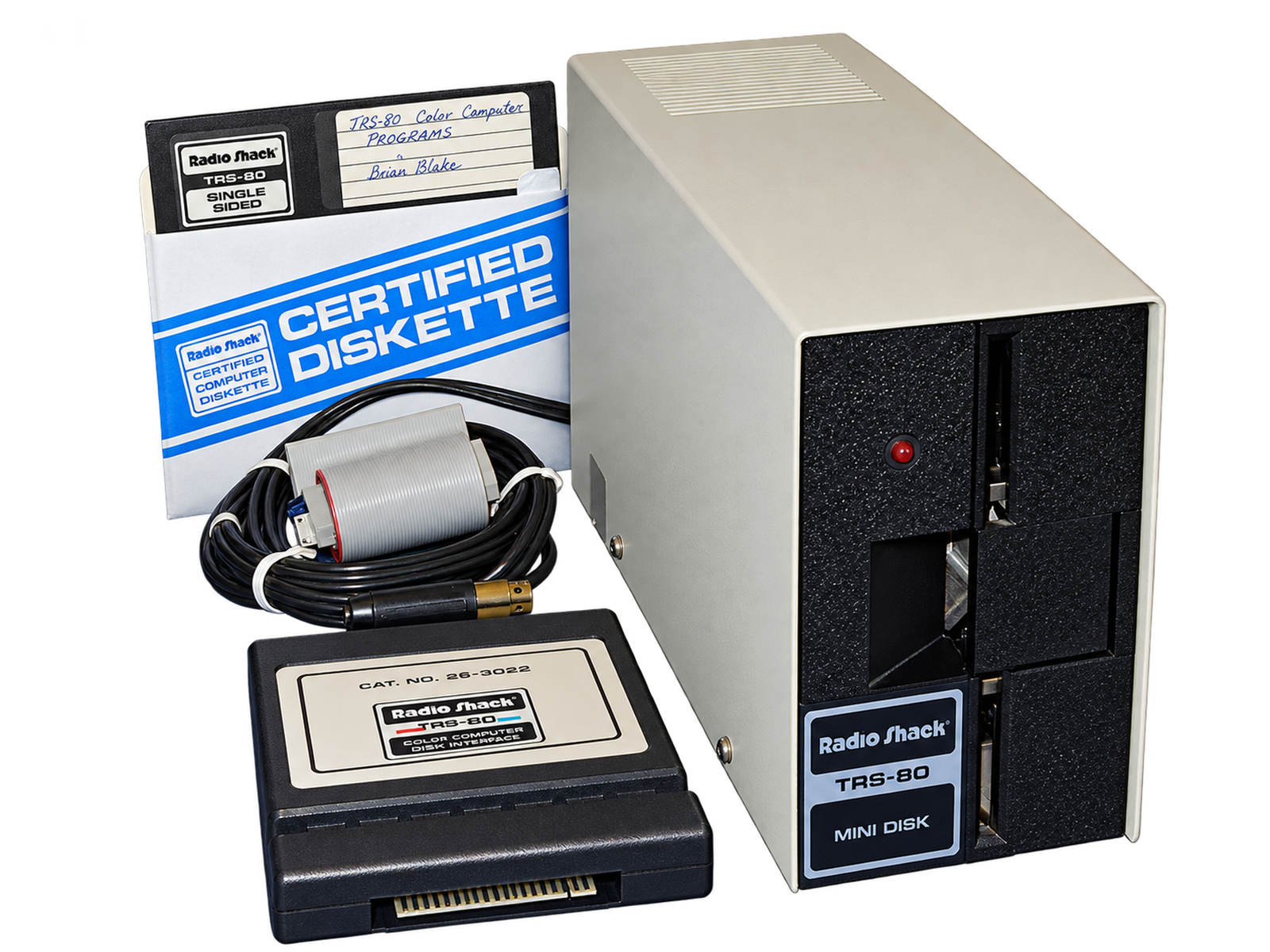
The Radio Shack 26-3022 Mini-Disk System was the first official floppy-disk system for the TRS-80 Color Computer. For CoCo owners accustomed to cassette tape, it represented a major change in the way programs and data could be stored. Instead of searching sequentially through a tape, files could be saved, located and retrieved directly from a disk.
The original system used a 5¼-inch, single-sided, double-density (SS/DD), 35-track floppy drive. Each track contained 18 sectors of 256 bytes, giving a formatted capacity of 161,280 bytes. One track was reserved for the disk directory and allocation information, leaving 156,672 bytes — about 156K — available for files.
The first-drive kit included the drive, connecting cable, a blank 5¼-inch diskette, documentation and a plug-in Program Pak disk controller. Unlike later computers with disk-control hardware built into the machine, the CoCo's controller plugged directly into its cartridge port. The controller also contained Disk Extended Color BASIC in ROM, so the disk operating system did not have to be loaded from disk and consumed only about 2K of the computer's RAM. The original system required at least 16K of RAM and Extended Color BASIC.
Disk Extended Color BASIC greatly expanded what could be done from BASIC. In addition to loading and saving programs, it provided commands for directories, formatting, copying, renaming and deleting files, along with sequential and direct-access data files. Utilities including BACKUP, COPY and FORMAT were also provided.
Internally, Disk BASIC organized each disk into 68 allocation granules, each containing nine sectors or 2,304 bytes. Track 17 was reserved for the directory and allocation table, leaving the other 34 tracks for file storage. A standard disk could contain a maximum of 68 files. These details were normally invisible to the casual user, but they became important to programmers writing disk-based applications.
The system wasn't limited to one drive. The cable supplied with the 26-3022 supported a second drive, while an optional cable allowed the system to be expanded to four drives — numbered 0 through 3. Four drives provided more than 626,000 characters of online storage, an enormous increase over the cassette-based system with which most early CoCo owners started.
Performance was equally impressive compared with cassette storage. Radio Shack specified a 300 RPM disk speed, 30-millisecond track-to-track seek time, and a 250 Kbit/sec data-transfer rate.
The original controller itself was based around a Western Digital WD1793 floppy-disk controller and required both +5V and +12V. Its analog data-separator circuitry distinguished this earliest controller from the later CoCo disk controllers, which moved to newer designs that no longer required the 12-volt supply.
And floppy storage was not cheap. Radio Shack advertised the complete first-drive 26-3022 kit for $599, while additional 26-3023 drives cost $399 each. Outfitting a Color Computer with four drives therefore represented a substantial investment.
Despite the cost, the Mini-Disk System was an important milestone for the Color Computer. Programs loaded far more quickly than from cassette, files could be accessed directly, and applications could maintain organized data files on disk. Just as importantly, Radio Shack's disk format and Disk Extended Color BASIC established the floppy-disk environment that would become a standard part of the CoCo ecosystem.
35 tracks. 18 sectors per track. 256 bytes per sector. 156,672 bytes available to the user. For the early Color Computer owner making the jump from cassette tape, that was a very big deal.
Tallgrass and Cer-Comp
Early Disk System
CER-COMP / TALLGRASS TG-99 & CCMD+9
Cer-Comp's CCMD+9 Disk System, built around the Tallgrass Technologies TG-99 disk controller, was one of the earliest and most ambitious alternatives to Radio Shack's official Color Computer disk system. Rather than simply duplicating Tandy's hardware and Disk Extended BASIC, Cer-Comp combined Tallgrass controller hardware with its own disk operating system and extensive collection of utilities, producing a substantially different approach to floppy storage on the CoCo.
The system appeared during the formative period of Color Computer disk storage, when no single third-party standard had yet emerged and manufacturers were experimenting with different controllers, disk formats, drive mechanisms and operating systems.
The Tallgrass TG-99 Controller
The TG-99 plugged directly into the Color Computer's cartridge expansion port and provided a buffered floppy disk interface. Unlike the compact enclosed cartridges that became typical of later CoCo disk controllers, the early Tallgrass hardware was supplied as a bare circuit board.
The Rainbow's May 1982 reviewer specifically commented on this construction, noting that the board plugged directly into the cartridge slot and that the Radio Shack-style disk cable connector could require a minor physical adjustment to fit securely.
One of the TG-99's greatest advantages was that it wasn't tied to a particular floppy-drive mechanism. Contemporary Cer-Comp advertising specifically listed compatible drives from manufacturers including Shugart, Siemens, TEAC, Pertec, MPI and Tandon, among others. The contemporary Rainbow review likewise confirmed that the system could accommodate a wide variety of drive configurations.
The controller supported up to four drives, with configurations incorporating single- or double-density, single- or double-sided 5¼-inch mechanisms.
Cer-Comp specifically promoted the ability to use 35-, 40- and 80-track drives, and the system could accommodate different drive types within the same installation. This was considerably more flexible than Radio Shack's original CoCo disk system, which was designed around 35-track, single-sided drives.
Greater Disk Capacity
Cer-Comp advertised its double-density format as using ten sectors per track and providing approximately 180K of storage per side. It claimed this represented roughly 30 to 50 percent more storage capacity than competing Color Computer disk systems.
Configurations using double-sided, 80-track drives could provide as much as 3.2 MB of total storage across four drives, which Cer-Comp advertised as at least four times the capacity of a standard Color Computer disk system.
The actual capacity, obviously, depended upon the drive being used. Contemporary information indicates approximately 175K on a 35-track single-sided disk and about 200K on a 40-track disk, with substantially greater capacities available from double-sided and 80-track mechanisms.
In its May 1982 evaluation, The Rainbow described the Cer-Comp system as providing roughly twice the capacity of Radio Shack's disk system and approximately four times that of Exatron's disk system, illustrating just how ambitious the Tallgrass approach appeared at the time.
This ability to use larger and more capable drives was one of the strongest arguments for the Cer-Comp/Tallgrass system. At a time when Radio Shack's CoCo disk hardware remained centered around comparatively modest 35-track drives, CCMD+9 gave users a path toward much larger disk configurations without replacing the controller.
CCMD+9 Disk Operating System
The hardware was only part of the package. Cer-Comp supplied its own operating environment, CCMD+9, rather than relying upon Radio Shack's Disk Extended BASIC.
Contemporary Cer-Comp advertising describes CCMD+9 as a full-featured, BASIC-compatible disk operating system that did not require Extended BASIC and could operate on a 4K Color Computer.
CCMD+9 supported 35-, 40- and 80-track drives, including mixed drive configurations. The DOS provided commands for loading and saving programs, opening and closing files, examining directories, removing and renaming files, checking disks and executing machine-language programs.
It also provided sequential and random-access disk I/O and included both direct BASIC commands and an indirect command interface intended to give programs greater control over disk operations.
One particularly interesting feature was CCMD+9's use of disk labels. A disk could be assigned a name and subsequently referenced by that label rather than strictly by its physical drive number. This allowed software to request a particular disk regardless of which drive it had been inserted into—an unusually sophisticated feature for an early Color Computer disk system.
Disk Allocation and Performance
Cer-Comp also promoted CCMD+9's approach to disk-space allocation.
Rather than permanently allocating large blocks of disk space when a file was created, CCMD+9 could expand files as additional storage was required. When files were deleted, the operating system automatically repacked available space to reduce fragmentation and improve access.
Cer-Comp specifically contrasted this with operating systems that allocated disk space in larger fixed blocks, arguing that its approach wasted less capacity and reduced the fragmentation that accumulated as files were created and deleted.
The company also emphasized that the disk operating system occupied its own ROM and working areas rather than consuming large amounts of the Color Computer's normal BASIC program space.
This had an additional practical advantage. Radio Shack's Disk Extended BASIC used memory in areas occupied by some early cassette-based machine-language programs. Contemporary testing of CCMD+9 found that its different memory arrangement allowed some older cassette programs that conflicted with Radio Shack's disk system to continue functioning with the Cer-Comp system.
Hard-Sectored Media
One of the system's more unusual characteristics was its use of hard-sectored disks. Rather than the ordinary soft-sectored media used by Radio Shack's system, CCMD+9 required disks with physical sector holes.
The Rainbow's May 1982 reviewer singled this out as one of the system's few significant disadvantages, noting that owners had to purchase hard-sectored rather than the much more common soft-sectored diskettes.
This also contributed to the incompatibility between CCMD+9 disks and the rapidly growing library of software distributed in Radio Shack's disk format.
A Complete Software Environment
Cer-Comp supported the TG-99 with considerably more than CCMD+9 itself.
Contemporary advertising lists an extensive collection of supporting software, including a disk assembler, disk text editor, disk disassembler/source generator, disk utilities, disk system monitor and word-processing software. Cer-Comp also sold disk-based games and other application software.
This made the TG-99/CCMD+9 combination less of a standalone controller and more of an alternative disk platform for the Color Computer.
Cer-Comp didn't limit this software effort to its own Tallgrass hardware. By July 1982, the company was also offering versions of its software for the Radio Shack disk controller. The Rainbow reviewed the package and specifically noted that it had been impressed with Cer-Comp's earlier Tallgrass operating system and utilities and had the same favorable opinion of the Radio Shack version.
The package included an editor/assembler, text editor/word processor and terminal software. The assembler supported the full 6809 instruction set, could translate 6800 instructions into 6809 equivalents, and could generate output directly to memory, cassette or disk.
Cer-Comp's advertised price for the:
TG-99 Disk Controller with CCMD+9 DOS ROM — $159.95
A contemporary limited-offer package included a 40-track single-sided disk drive, power supply, enclosure, two-drive cable, TG-99 controller, CCMD+9, disk utilities and disk text editor for $499.00.
An additional 40-track drive with power supply and enclosure was advertised for $300, while double-sided drives added $100 per drive.
Compatibility and Limitations
The flexibility of the Cer-Comp system came at the price of compatibility.
CCMD+9 was its own disk environment rather than an implementation of Radio Shack Disk Extended BASIC. Consequently, disks and software written specifically for the Radio Shack system could not simply be inserted and used with CCMD+9.
Contemporary reviewers also reported occasional difficulty reading a disk in a drive other than the one on which it had originally been written. Some machine-language programs presented compatibility problems when executed directly under the original CCMD+9 environment as well.
Cer-Comp continued developing the software. By early 1983, Bill Vergona of Cer-Comp was reportedly working on a new DOS intended to more closely emulate Radio Shack's Disk Extended BASIC, including familiar commands such as LOADM, SAVEM, DIR, KILL and RENAME, along with support for random-access BASIC files.
Early Development
Perhaps the most interesting aspect of the Cer-Comp/Tallgrass system is how early its development began.
Correspondence from Tallgrass Technologies shows that the company was investigating a Color Computer disk system during 1981, while disk storage for the CoCo was still in its infancy. At one stage Tallgrass was even considering the then-new Sony 3½-inch microfloppy, although the eventual commercial system was built around conventional 5¼-inch mechanisms.
By May 1982, there is no question that the Cer-Comp/Tallgrass system had progressed beyond announcement or prototype status. The Rainbow published a hands-on evaluation of the complete system, describing the physical controller board, connecting disk drives to it, using CCMD+9 and its utilities, commenting on its hard-sectored media, and publishing contemporary prices.
The reviewer concluded that the system was “highly professional and easy to use” and recommended that anyone considering a disk system take a serious look at it.
Only two months later, The Rainbow was already reviewing Cer-Comp software adapted for Radio Shack's own disk controller, showing how quickly the company was expanding its Color Computer disk-software business.
This places Tallgrass and Cer-Comp among the earliest companies seriously developing third-party floppy storage for the Color Computer, during essentially the same formative period in which Radio Shack was developing and introducing its own disk system.
An Ambitious Alternative
Radio Shack's controller and Disk Extended BASIC ultimately became the de facto Color Computer disk standard. Software publishers naturally gravitated toward the hardware owned by the largest number of users, and compatibility with the Radio Shack disk format became increasingly important as the CoCo software library expanded.
That worked against systems such as CCMD+9.
Technically, however, the Cer-Comp/Tallgrass TG-99 system was remarkably capable for such an early product. It offered multiple drive types, higher track counts, double-sided operation, four-drive support, considerably greater potential storage capacity, sophisticated file handling and a complete alternative disk operating environment.
For an early Color Computer owner willing to step outside Radio Shack's emerging standard, CCMD+9 offered capabilities considerably beyond those of the original 35-track Tandy disk system.
Its ultimate weakness wasn't necessarily what it could do.
It was that it did those things differently.
Documentation: The Cer-Comp/Tallgrass system is unusually well documented for such an early third-party Color Computer disk system. Contemporary Cer-Comp advertising has been located along with coverage in Color Computer News, The Rainbow and 80-U.S./68 Micro Journal. Most importantly, The Rainbow's May 1982 hands-on review documents an actual TG-99/CCMD+9 system in use, including its physical controller board, drive compatibility, hard-sectored media, operating system, supporting software and contemporary pricing. A July 1982 follow-up also documents Cer-Comp software adapted for Radio Shack's disk controller. An original photograph of the TG-99 controller or a complete Cer-Comp/Tallgrass Color Computer disk system has not yet been located.
The CoCo's Second Disk
RS Catalog 26-3029
The Radio Shack 26-3029 Color Computer Mini Disk System followed the original 26-3022 and addressed one of the most important compatibility problems with the first Color Computer disk controller. Although outwardly similar to its predecessor, the newer system revised the controller electronics so that it no longer depended upon the +12-volt supply provided by the original Color Computer's expansion port.
That became increasingly important with the arrival of the Color Computer 2, which did not provide the +12V supply used by the original 26-3022 controller.
A Revised Disk Controller
Like the original controller, the 26-3029 was housed in the familiar long cartridge enclosure and plugged into the Color Computer's expansion port.
Internally, however, the design was revised. The later controller eliminated the +12V requirement and the troublesome analog data-separator circuitry associated with the original 26-3022 design. This made it directly usable with later Color Computers without requiring another source of +12V.
The controller contained Disk Extended Color BASIC in ROM, providing the same basic disk environment established by the original system. Existing CoCo disks and software therefore remained compatible rather than requiring owners to adopt a new disk format.
The Second-Generation Mini Disk Drive
The matching 26-3029 Mini Disk drive retained much of the physical arrangement of the original 26-3022 system. It still used a full-height 5¼-inch floppy mechanism mounted vertically in its own external enclosure.
The most immediately visible change was its appearance. Instead of the dark gray cabinet designed to complement the original Color Computer, the 26-3029 used a white enclosure, matching the styling of the newer CoCo hardware.
The drive connected through a 34-pin card-edge connector on the rear of the cabinet rather than using a permanently attached ribbon cable. Additional drives were separate self-contained units, each with its own cabinet and power supply.
The Familiar CoCo Disk Format
Despite the revised hardware, Radio Shack retained the established Color Computer floppy format. Under standard Disk Extended Color BASIC, disks were formatted as single-sided, double-density (SS/DD) using:
35 tracks × 18 sectors × 256 bytes
That yielded 161,280 bytes of formatted capacity, with 156,672 bytes available for files after reserving space for the directory and allocation information.
Maintaining the same format was important. A disk written on the earlier Radio Shack system could continue to be used with the 26-3029, and the growing library of commercial CoCo disk software remained compatible.
Up to Four Drives
The 26-3029 continued the CoCo's support for multiple floppy drives, identified by Disk BASIC as Drives 0 through 3. A multi-drive system greatly reduced disk swapping and made operations such as disk duplication much more convenient.
The physical arrangement, however, was still decidedly early-1980s. Each additional drive required another full-height mechanism, cabinet and power supply. A heavily equipped CoCo disk system could therefore occupy a considerable amount of desk space.
More Evolution Than Revolution
The 26-3029 wasn't intended to reinvent CoCo disk storage. Its importance lies precisely in the fact that it didn't. For existing software compatabilty, the physical size and disk structure was retained.
Radio Shack retained the established 5¼-inch disk format, Disk Extended Color BASIC environment and software compatibility while updating the controller for the changing Color Computer hardware.
Externally, the tall vertical drive still had much in common with the original Mini Disk system. Internally, however, the revised controller eliminated the original design's dependence on the CoCo 1's +12V expansion-port supply and moved away from its problematic analog data separator. Without the 12V requirement, this controller was forward compatible with the incoming Color Computer 2, and the Color Computer 3 - neither of which had +12V available without a Multipack Interface.
It was therefore an important transitional Color Computer disk system: still recognizably descended from the original 26-3022, but better suited to the newer generation of CoCo hardware.
Radio Shack 26-3029 — Color Computer Mini Disk System
- 5¼-inch full-height floppy drive
- Vertical white drive enclosure
- Single-sided, double-density (SS/DD)
- 35 tracks / 18 sectors per track / 256 bytes per sector
- 161,280 bytes formatted / 156,672 bytes available
Disk Extended Color BASIC in ROM - No +12V expansion-port requirement
- Support for up to four drives
Amdek
Amdisk III
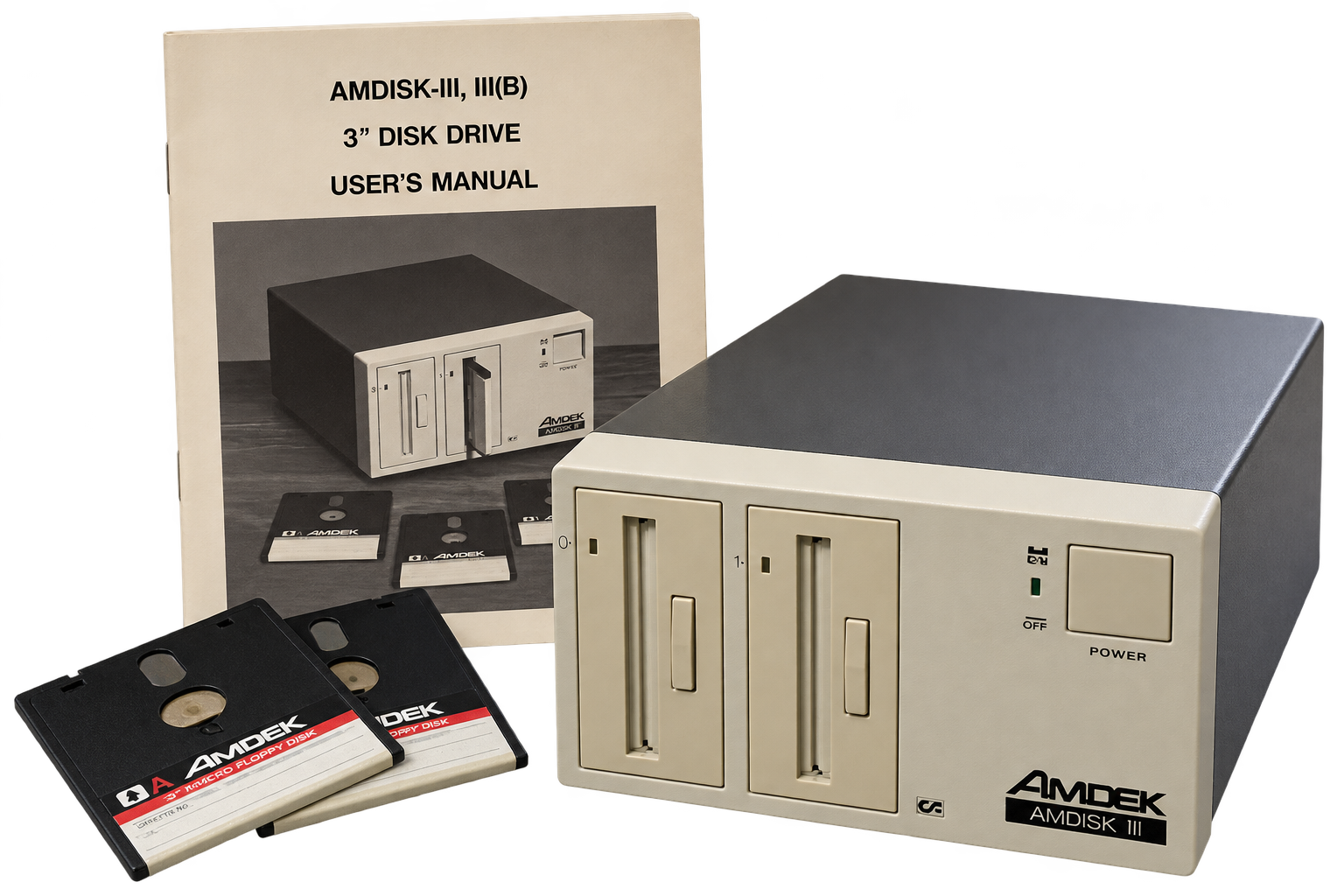
Image Supplied by Brian Wieseler
Bringing 3-Inch Disk Storage to the CoCo
During the early 1980s, the 5¼-inch floppy disk was the dominant removable storage format for the TRS-80 Color Computer. Radio Shack's disk systems used conventional 5¼-inch drives, and most third-party manufacturers followed the same approach.
Amdek Corporation, however, offered Color Computer owners something rather different: the AMDISK-III, a floppy disk system using compact 3-inch diskettes enclosed in rigid plastic cartridges.
The AMDISK-III was not a new disk controller or an alternative disk operating system. Instead, it offered a different physical disk format while retaining compatibility with conventional floppy disk interfaces.
For CoCo owners interested in a smaller, more durable storage medium, the AMDISK-III represented an unusual alternative to the familiar 5¼-inch floppy drive.
The AMDISK-III Disk System
The AMDISK-III was a self-contained external drive system featuring a metal enclosure, internal power supply, front-mounted power switch, and two 3-inch floppy disk drives.
Its appearance was quite different from the typical Radio Shack drive enclosure. The two narrow disk slots and compact cartridges gave the system a distinctly modern appearance compared with conventional 5¼-inch drives.
Amdek advertised the system as offering 624 KB of formatted storage capacity, with the advertisement's footnote specifying that this figure required recording on both sides of the diskettes.
The advertised price was $599, including two diskettes.
Although the system's physical design was unusual, its operation was fundamentally similar to other floppy disk drives of the period. Data was recorded magnetically onto flexible media, with the disk controller responsible for managing the recording and retrieval of information.
The 3-Inch Floppy Diskette
Perhaps the AMDISK-III's most distinctive feature was its removable media.
Unlike conventional 5¼-inch floppy disks, which were housed in relatively flexible protective jackets, Amdek's 3-inch diskettes were enclosed in rigid plastic cartridges.
The cartridges incorporated a protective shutter that covered the disk's recording surface when it was not in use. This helped protect the magnetic media from accidental contact, dust, and handling damage.
The diskettes also included write-protection provisions to help prevent accidental modification or erasure of stored information.
Amdek promoted the smaller format as being easier to store, transport, and mail than conventional floppy disks. The advertisement even emphasized that the compact cartridges could fit into a shirt pocket.
The AMDISK-III manual describes single-sided and double-sided media configurations, with unformatted capacities of up to 500 KB per diskette depending on the recording arrangement.
Although these features were attractive, the 3-inch format was not physically interchangeable with the 5¼-inch disks used by most Color Computer owners.
A disk written in an AMDISK-III drive therefore required a compatible 3-inch drive to be read elsewhere.
Compatibility with Color Computer Disk Controllers
An important characteristic of the AMDISK-III was that it did not require a proprietary Amdek disk controller.
The Color Computer-compatible AMDISK-III(B) used a conventional 34-pin floppy disk interface, allowing it to connect to existing disk controller hardware.
This meant that the AMDISK-III could be used with the standard Radio Shack disk controller, as well as compatible third-party controllers such as those manufactured by J&M Systems, DISTO, and other companies.
The controller did not need to recognize a special Amdek disk format simply because the physical diskette was smaller. From the controller's perspective, the drive performed conventional floppy disk operations.
What mattered was the drive's electrical compatibility, recording characteristics, and configuration.
Proper operation required attention to several details:
- Interface cabling: The drive needed the appropriate cable or adapter for the controller and drive arrangement.
- Drive selection: The AMDISK-III drives had to be configured with drive-select settings that did not conflict with other attached drives.
- Termination: As with conventional floppy systems, the termination arrangement needed to match the connected drive configuration.
- Disk formatting: Usable storage capacity depended on the disk operating system and the recording format selected.
Amdek's own manual includes a technical section specifically addressing the Radio Shack Color Computer, with instructions for connecting the drives, assigning drive-select codes, and configuring systems containing both Amdek and conventional floppy drives.
In other words, the AMDISK-III offered a different type of floppy disk, not a completely different CoCo disk subsystem.
Connecting the AMDISK-III to the CoCo
Amdek manufactured versions of the AMDISK-III with different external connections.
The original AMDISK-III used a 37-pin D-subminiature connector, while the AMDISK-III(B) used a 34-pin interface more directly suited to conventional floppy drive connections.
The manual identifies several cables intended for different computer systems and drive configurations, including cables specifically intended for the Radio Shack Color Computer.
It also explains how to configure the drive-select settings so that Amdek drives could coexist with conventional 5¼-inch drives.
This flexibility allowed an owner to use the AMDISK-III as an alternative to, or an addition to, an existing floppy disk system.
However, the smaller media format did not automatically provide greater storage capacity under Radio Shack Disk BASIC. Actual formatted capacity was determined by the operating system's supported disk geometry and formatting conventions.
A Drive System for More Than the Color Computer
The AMDISK-III was not designed exclusively for the CoCo.
Amdek marketed the system for use with several personal computers, and the manual includes installation information for the IBM Personal Computer, Radio Shack Model III, and other systems using compatible floppy interfaces.
This broad compatibility was part of the product's appeal. Rather than develop a different controller for every computer, Amdek adapted the drive system through appropriate interfaces, cables, and configuration settings.
For Color Computer owners, this meant that the AMDISK-III could be incorporated into an existing disk setup without abandoning the controller hardware they already owned.
An Interesting Alternative That Never Became the Standard
Despite its compact size and protective disk cartridges, the 3-inch floppy format never displaced the established 5¼-inch disk in the Color Computer market.
The AMDISK-III's principal disadvantage was the limited interchangeability of its media. Although the drive could operate with compatible CoCo disk controllers, its 3-inch diskettes could not be inserted into the 5¼-inch drives used by most other Color Computer owners.
Software distribution, disk copying, and exchanging programs with other users therefore remained more convenient with the established 5¼-inch format.
The AMDISK-III nevertheless demonstrated that a computer's floppy disk controller and the physical size of its disk media were not necessarily tied together.
Its compatibility with existing controllers made it a particularly interesting example of third-party innovation: Amdek changed the storage medium and drive hardware while leaving much of the computer's established disk system intact.
Historical Significance
The Amdek AMDISK-III occupies an unusual place in the history of Color Computer disk storage.
Unlike third-party products that introduced enhanced controllers, additional DOS commands, or new operating systems, the AMDISK-III offered an alternative physical storage format.
Its rigid 3-inch diskettes anticipated the growing interest in smaller, better-protected removable media, while its conventional floppy interface allowed it to work with existing computer hardware.
Although the 3-inch format did not become a mainstream standard for the CoCo, the AMDISK-III remains a fascinating example of the experimentation that characterized the early personal computer industry.
For the TRS-80 Color Computer, it was proof that a floppy disk system did not necessarily have to use a 5¼-inch disk.
Tandy FD-500 Disk System
Catalog No. 26-3129
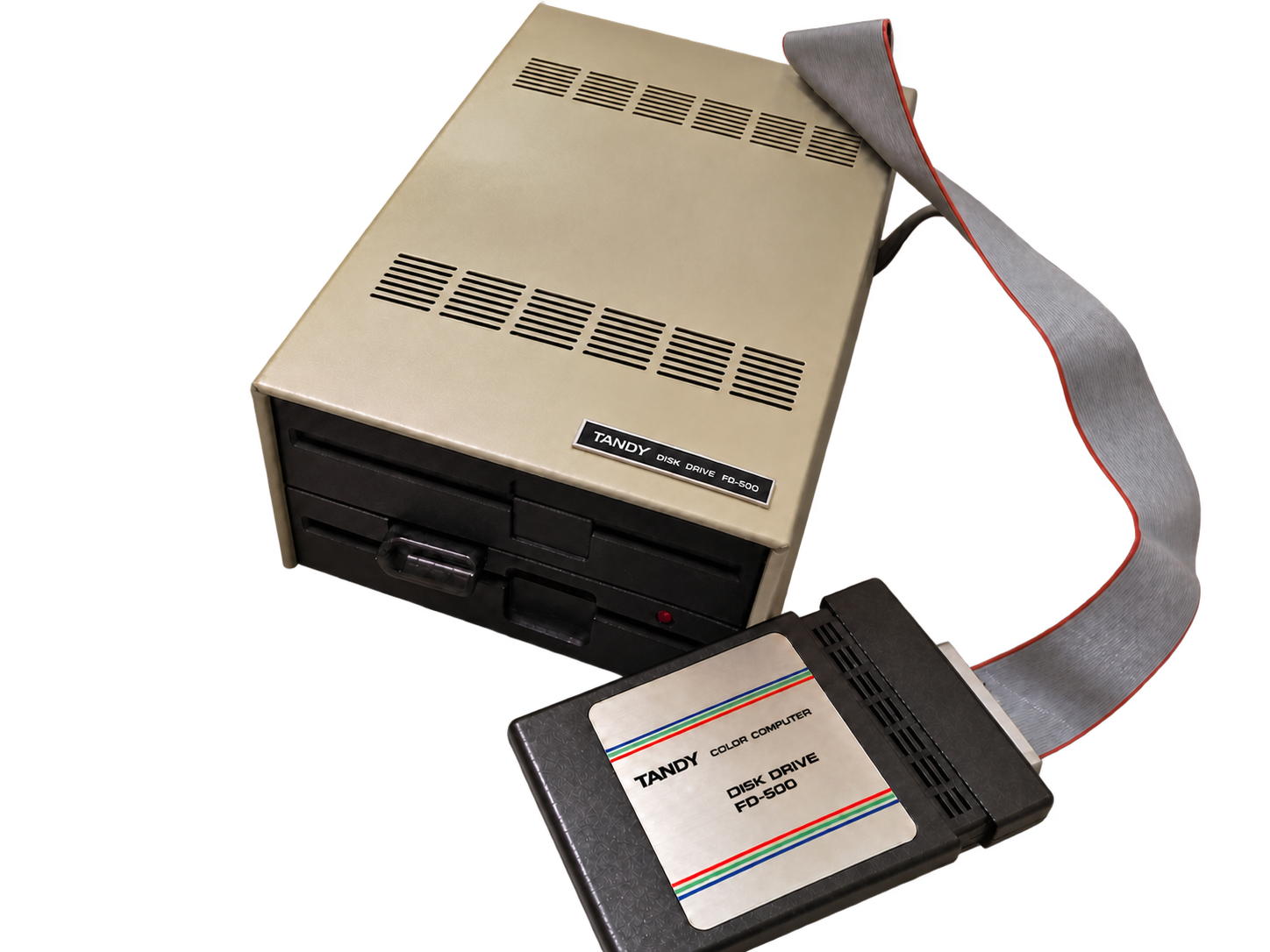
Introduced around 1984, the FD-500 was advertised as the Color Thinline Disk #0 Kit. Its original catalog price was approximately $399.95, later dropping to $349.95.
A New Style of CoCo Disk Drive
The most obvious change was the enclosure. Earlier Color Computer disk systems used large, full-height mechanisms mounted vertically in individual cabinets. The FD-500 adopted a much more compact horizontal cabinet containing a half-height 5¼-inch floppy drive.
The cabinet was designed to accommodate two half-height mechanisms. A standard FD-500 contained Drive 0 in the lower bay with a blanking plate covering the second opening. Owners could later install an additional drive in the upper bay, allowing two drives to share the same enclosure and power supply.
When a second drive was installed, the upgrade included a 12-volt cooling fan to provide the additional airflow required by two mechanisms operating inside the compact cabinet.
The FD-500 Controller
The FD-500 was supplied with a cartridge-style floppy-disk controller that connected the drives to the Color Computer's expansion port.
The controller used the Western Digital WD1773 floppy-disk controller, eliminating both the separate analog data-separator circuitry and the +12-volt requirement associated with the earliest 26-3022 controller. This made the system suitable for later Color Computer models that did not provide the original CoCo's +12V supply at the cartridge port.
40-Track Hardware, 35-Track Disk BASIC
The FD-500's half-height mechanism was capable of 40-track operation, but standard Radio Shack Disk Extended Color BASIC continued to use the established 35-track CoCo disk format.
A normally formatted disk therefore contained:
35 tracks × 18 sectors × 256 bytes
This provided 161,280 bytes of formatted capacity, with 156,672 bytes available for files after the directory and allocation information were taken into account.
The standard format remained single-sided, double-density (SS/DD). Maintaining the established 35-track format also preserved compatibility with disks created on earlier Radio Shack Color Computer drives.
The additional physical tracks could be accessed with modified disk software and alternative operating systems, but they were not used by an ordinary Disk BASIC-formatted disk.
Disk Extended Color BASIC
The controller's ROM extended Color BASIC with commands specifically intended for disk storage. Programs could be loaded and saved by filename, directories displayed, disks formatted and backed up, and files copied, renamed or deleted.
More importantly, programs could create and manipulate sequential and direct-access data files. This made floppy storage considerably more than a faster substitute for cassette tape. Applications could maintain databases, records, configuration information and other persistent data in ways that were cumbersome with sequential cassette storage.
Multiple-Drive Operation
Although the FD-500 cabinet itself accommodated two mechanisms, the Color Computer's disk system could address multiple drives. Drives were identified numerically by Disk BASIC, allowing programs and utilities to explicitly access individual disks.
A two-drive FD-500 was especially useful for disk duplication, separate program and data disks, and applications requiring frequent access to multiple disks. It also eliminated much of the disk swapping associated with a single-drive system.
An Important Physical Redesign
The FD-500's significance wasn't increased storage capacity—the standard Disk BASIC disk still provided the familiar 156,672 bytes available to the user.
Instead, the improvement was largely in the hardware surrounding the disk.
Half-height mechanisms substantially reduced the size of the drive system. Two drives could now occupy a single enclosure rather than requiring separate full-height cabinets, while the newer controller eliminated some of the electrical peculiarities of the original CoCo disk interface.
The result was a considerably more compact and practical floppy-disk system while retaining compatibility with the enormous library of software and disks already created for the Color Computer.
- Tandy FD-500 — Catalog No. 26-3129
- 5¼-inch half-height floppy drive
- 40-track-capable mechanism
- 35 tracks under standard Disk BASIC
- Single-sided, double-density (SS/DD)
- 18 sectors per track / 256 bytes per sector
- 161,280 bytes formatted / 156,672 bytes available
- WD1773-based controller
- Two-drive capability in a single cabinet
J&M Systems
JFD & JDOS Drive System
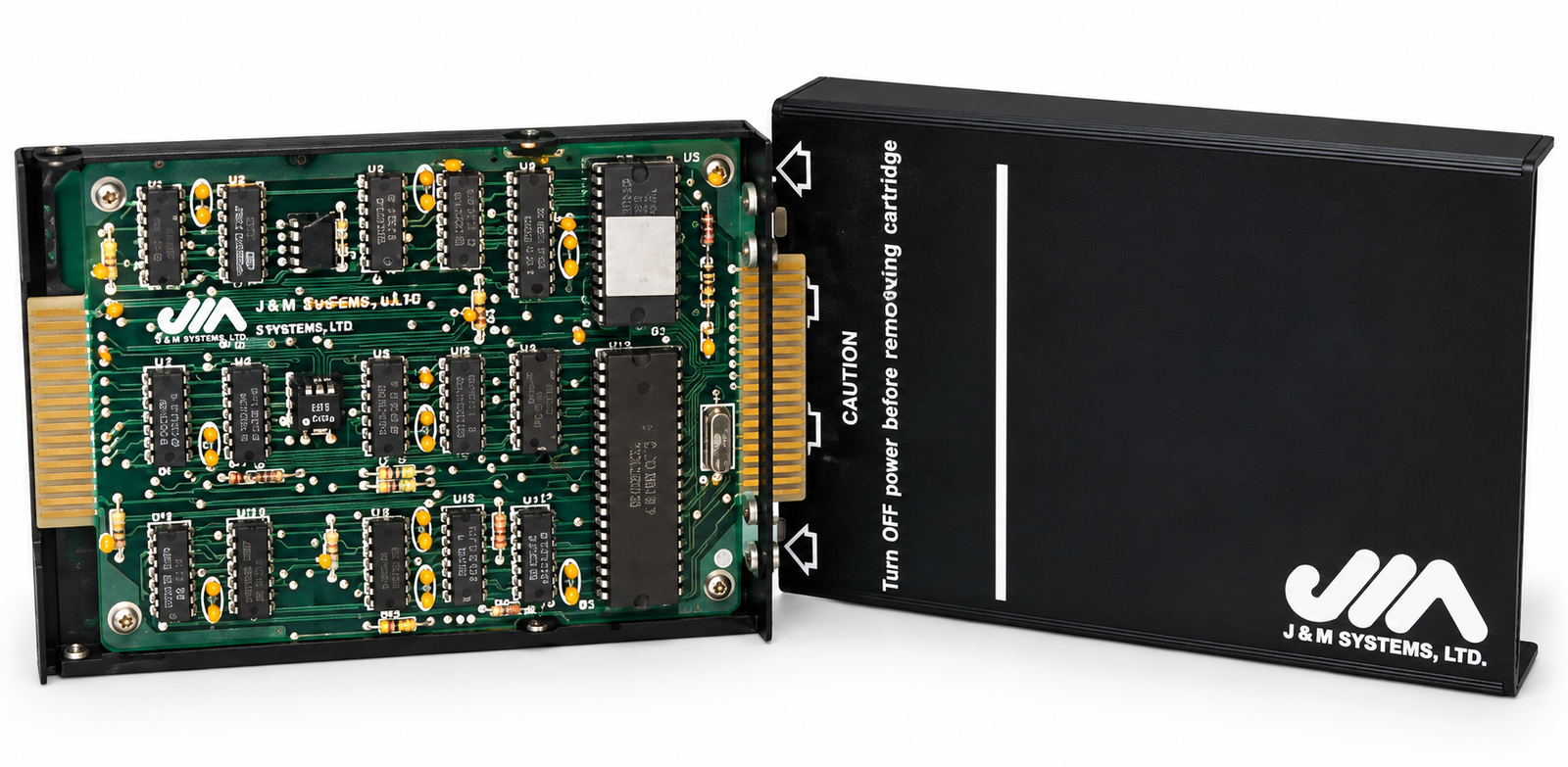
J&M Disk Systems — A Different DOS for the Color Computer
Giving CoCo Owners Another Choice
During the early 1980s, upgrading a TRS-80 Color Computer from cassette storage to floppy disks was one of the most significant improvements an owner could make. Disk drives provided faster loading, more convenient file management, and the ability to run increasingly sophisticated software.
Radio Shack offered its own disk system, but independent manufacturers soon recognized an opportunity to provide alternatives. Among them was J&M Systems, Ltd., of Albuquerque, New Mexico, a company already familiar with disk storage products for other TRS-80 computers.
J&M introduced its JFD disk controller for the Color Computer at the first RainbowFest in April 1983. Unlike some third-party peripherals that merely duplicated Radio Shack's offerings, J&M developed a complete disk storage solution that combined quality hardware with its own enhanced disk operating system.
The result was the JFD-COCO Disk System, accompanied by J&M's proprietary JDOS Extended Disk BASIC.
The JFD-COCO Disk Controller
The JFD-COCO was designed as a direct alternative to Radio Shack's floppy disk controller. Housed in a black aluminum cartridge enclosure, the controller connected to the Color Computer's expansion port without requiring modifications to the computer.
Its internal construction was one of its selling points. The controller used gold-plated edge contacts, a digital phase-locked loop for separating data from the disk signal, and write precompensation circuitry to improve recording reliability.
Unlike the Radio Shack controller, which incorporated adjustable circuitry requiring occasional calibration, J&M's design eliminated the need for those adjustments.
The JFD-COCO also avoided the 12-volt power requirement associated with some Radio Shack disk controllers, allowing it to operate with both the original Color Computer and the Color Computer 2.
The controller was compatible with Radio Shack's disk drives, while J&M's own drives could also be used with Radio Shack controllers. This flexibility allowed owners to upgrade or replace individual components without purchasing an entirely new disk system.
The Disk Drives — More Tracks and Faster Access
J&M offered several drive configurations, including full-height and half-height floppy disk drives.
An April 1984 review in The Rainbow described a J&M system equipped with a Tandon TM100-1 drive, a 40-track mechanism housed in an aluminum enclosure with its own power supply.
This drive offered a significant advantage over the earlier 35-track mechanisms supplied by Radio Shack.
The Tandon mechanism was rated for a 5-millisecond head stepping time, compared with approximately 30 milliseconds for the older Radio Shack drives. This meant that the drive's read/write head could move between adjacent tracks considerably faster, reducing seek times during disk operations.
J&M also offered configurations using double-sided drives, allowing considerably more information to be stored on a single diskette.
The original Radio Shack Disk BASIC typically used 35 tracks on a single side, providing approximately 156 KB of usable formatted storage. JDOS could take advantage of 40-track, double-sided drives, increasing usable storage to approximately 368 KB per disk.
For Color Computer owners accustomed to cassette tapes or single-sided floppy disks, this represented a substantial improvement.
JDOS — The Real Difference
Although J&M's controller hardware was well regarded, the company's most interesting contribution was arguably JDOS.
Rather than relying entirely on Radio Shack's Disk Extended Color BASIC, J&M developed its own replacement ROM containing additional disk and programming functions.
JDOS was supplied on an EPROM that installed in the disk controller cartridge. It could also be installed in a compatible Radio Shack controller, allowing users to benefit from its enhanced commands without replacing their existing hardware.
JDOS retained the familiar Disk BASIC environment while extending its capabilities with commands and features not found in Radio Shack's original ROM.
Among its additions were:
- AUTO — Automatically generated BASIC line numbers while entering programs.
- DSKINI — Supported additional disk formatting options, including 35- and 40-track formats.
- RATE — Allowed the disk drive stepping rate to be adjusted for different mechanisms.
- RUNM — Loaded and executed machine-language programs directly from disk.
- FLEX — Booted the FLEX operating system directly.
- DOS — Provided operating-system boot capabilities, including OS-9.
- RAM — Copied ROM contents into RAM and switched a suitably equipped 64K Color Computer into all-RAM operation.
- ERL, ERR, and ERROR — Provided improved error identification and trapping for BASIC programs.
JDOS also included disk backup and file-management functions, along with additional conveniences for BASIC programming.
Many of these capabilities previously required separate utility programs. By incorporating them directly into the disk ROM, J&M made them available immediately when the computer was powered on.
Greater Disk Capacity — With a Trade-Off
One of JDOS's major advantages was its ability to support different floppy disk formats.
The original Radio Shack disk format used 35 tracks, 18 sectors per track, and 256 bytes per sector on a single-sided disk.
JDOS extended this arrangement to support 40-track mechanisms and double-sided disks while retaining the ability to read and write standard Radio Shack-compatible disks.
Disk configuration |
Approx. usable capacity |
|---|---|
| 35-track, single-sided | 156 KB |
| 40-track, single-sided | 184 KB |
| 40-track, double-sided | 368 KB |
JDOS could also expand the disk directory from 68 file entries to 72 when using a 40-track formatted disk.
There was, however, an important limitation.
Radio Shack used pin 32 of its floppy drive interface to select a fourth drive. J&M instead used that connection to select the second side of a double-sided disk.
As a result, JDOS supported a maximum of three physical drives rather than the four supported by Radio Shack's standard arrangement.
For users who wanted higher-capacity double-sided disks, this was generally a reasonable compromise.
Compatibility Wasn't Always Perfect
J&M designed JDOS to maintain a high degree of compatibility with Radio Shack's Disk BASIC, but not every program behaved exactly as expected.
Some commercial software accessed undocumented locations or internal routines within Radio Shack's disk ROM rather than using the recommended entry points.
Programs written this way could fail when used with JDOS, even though the disk controller itself was electrically compatible with Radio Shack hardware.
JDOS maintained the standard DSKCON disk access entry point, but differences elsewhere in the ROM could still cause problems with software that depended on undocumented behavior.
Early versions of JDOS also had differences in command syntax. J&M addressed several of these issues through subsequent revisions, improving compatibility with existing Disk BASIC programs.
In the April 1984 Rainbow review, Ed Ellers noted that J&M had already released multiple updates to improve command compatibility.
The company continued refining JDOS, eventually producing versions 1.11 and 1.2, with updated documentation and additional features.
J&M's Commitment to Support
One aspect of the J&M system that received particular praise in contemporary reviews was the company's customer support.
In the July 1984 issue of HOT CoCo, reviewer Howard Culbreth reported receiving two JDOS upgrades and a revised reference manual, with his only expense being the postage required to return the original EPROM.
This was particularly noteworthy at a time when firmware updates often required physically replacing a ROM chip.
Culbreth considered the J&M controller a reliable and reasonably priced alternative to Radio Shack's equipment, although he did not suggest that existing Radio Shack owners needed to replace a functioning controller simply to obtain the J&M hardware.
The value of JDOS itself was a different matter. Its additional capabilities could make it a worthwhile upgrade even for owners who already had a disk system.
What Did It Cost?
By April 1984, J&M was advertising a complete single-drive system for approximately $449, including the disk controller, Tandon floppy drive, and software.
For comparison, The Rainbow review listed Radio Shack's single-drive disk system at $399.95.
J&M's package was therefore not necessarily the least expensive choice. Its appeal came from the combination of improved disk performance, greater capacity, additional operating-system features, and the flexibility to use different disk drive mechanisms.
The July 1984 HOT CoCo review also listed the J&M controller separately at $149 and JDOS Disk BASIC at $49.
This allowed owners who already had disk hardware to purchase only the components they needed.
The Continuing Development of JDOS
J&M continued improving its software after the introduction of the JFD-COCO.
The September 1984 JDOS 1.11 reference manual documented the company's extended BASIC commands, disk access routines, and machine-language programming interfaces.
Later documentation for JDOS 1.2 expanded on these capabilities and included additional technical information concerning controller installation, disk operations, and programming interfaces.
The surviving manuals illustrate how much effort J&M invested in the software side of its disk systems.
Rather than treating JDOS as a simple replacement for Radio Shack's ROM, the company developed it into a more capable disk operating environment intended for users who wanted to push their Color Computers beyond their original limitations.
J&M's controller family would also evolve, with later models offering additional interfaces and improved compatibility with newer Color Computer hardware.
An Important Chapter in CoCo History
The J&M Disk System represents an important period in the Color Computer's development, when independent manufacturers were expanding the machine's capabilities far beyond its original cassette-based configuration.
The JFD-COCO offered solid engineering, flexible drive compatibility, and improved performance. JDOS provided additional programming tools, greater disk capacity, and features that made the Color Computer more useful for serious applications.
Perhaps most importantly, J&M demonstrated that CoCo owners were not limited to the hardware and software available through Radio Shack.
For enthusiasts willing to explore third-party alternatives, the Color Computer could become a considerably more capable machine than its modest price and original specifications might suggest.
J&M didn't just offer another disk drive for the CoCo. It offered another way to get more out of the computer itself.
The Gold (Plated) Standard
FD-501
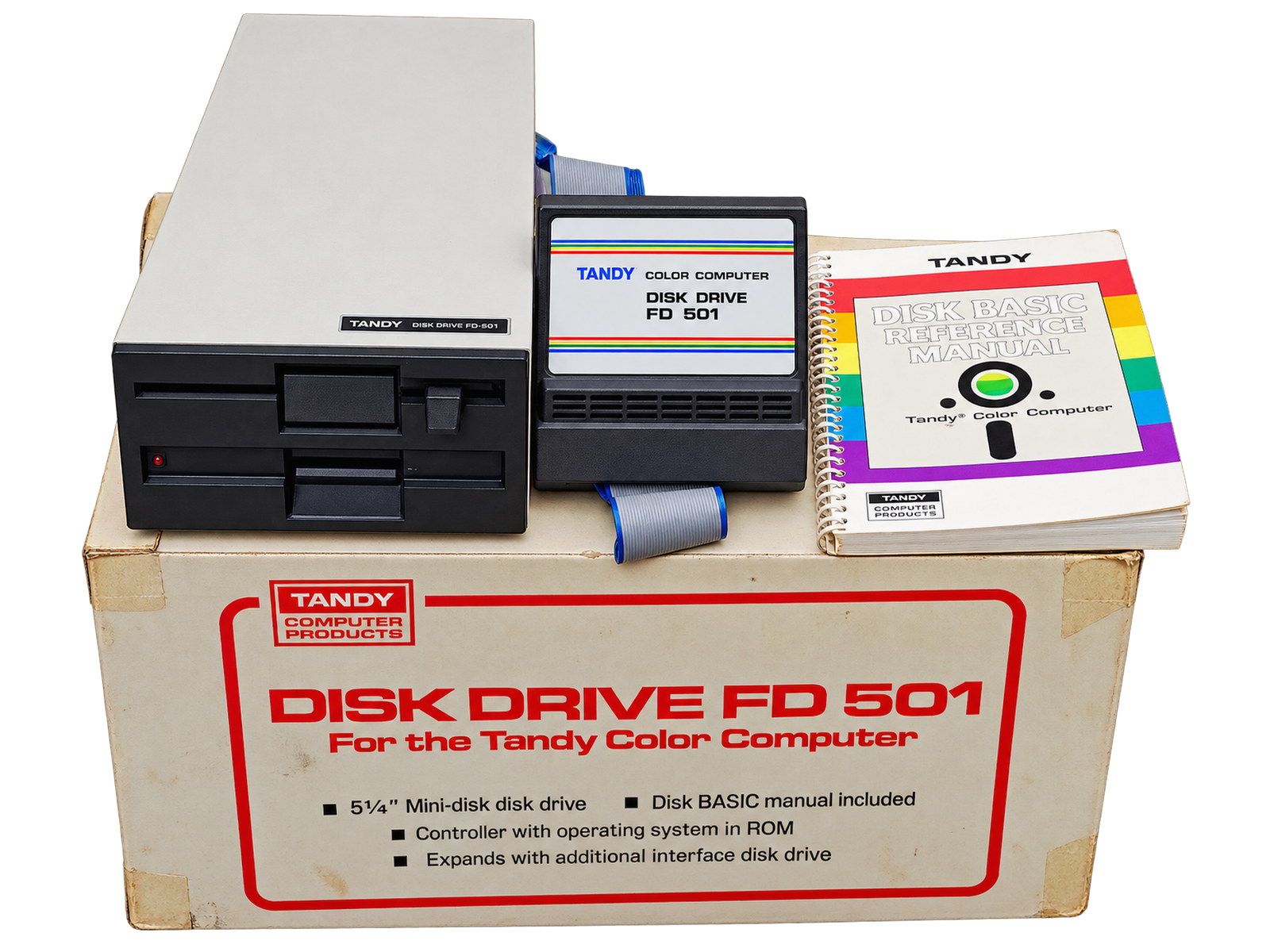
The Tandy FD-501 Disk Drive System, catalog number 26-3131, represented a further refinement of Radio Shack's disk storage system for the Color Computer. Introduced in the 1986 Radio Shack catalog, the FD-501 combined a more compact disk controller with the horizontal, half-height 5¼-inch drive arrangement introduced by the preceding generation.
The complete Drive 0 system originally listed for $299.95, while the optional Drive 1 expansion kit, catalog number 26-3132, sold for $179.95. By December 1986, Radio Shack was advertising the Drive 0 system for $199.95.
The drive cabinet was designed to accommodate two half-height 5¼-inch mechanisms. A standard FD-501 contained Drive 0 in the lower bay with a blanking plate covering the upper position.
The FD-501 Drive
The mechanism commonly supplied with the FD-501 was a TEC 501, a half-height, single-sided, 40-track-capable 5¼-inch drive. Contemporary technical coverage described the TEC mechanism as particularly rugged and reliable and specified a 6-millisecond track-to-track stepping rate.
Although the mechanism itself could travel across 40 tracks, Disk Extended Color BASIC continued to use the traditional 35-track Radio Shack format for compatibility with the enormous existing library of CoCo disks.
A standard disk therefore remained:
35 tracks × 18 sectors × 256 bytes = 161,280 bytes formatted
Radio Shack advertised the FD-501 as providing more than 156K of data storage, reflecting the usable capacity after the filesystem's reserved structures were taken into account.
The FD-501 Controller
The FD-501 also introduced a visibly different controller. Earlier Radio Shack disk controllers had occupied the familiar long cartridge enclosure; the FD-501 controller was redesigned into a shorter cartridge case, making it more in keeping with later Color Computer peripherals.
Internally, the controller used the Western Digital WD1773 floppy disk controller. Unlike the original 26-3022 design, the WD1773 incorporated the functionality that eliminated the need for the earlier separate analog data-separator arrangement. The controller also required only the normal 5-volt supply and consequently worked with all models of the Color Computer, including machines lacking the original CoCo's +12V cartridge-port supply.
One seemingly minor feature makes the FD-501 controller particularly distinctive today: it was the only Radio Shack CoCo floppy controller fitted with gold-plated card-edge contacts.
Gold resists oxidation considerably better than exposed tin, making the connector less prone to the intermittent contact problems familiar to owners of aging cartridge hardware.
Like other Radio Shack CoCo controllers, the FD-501 used 7416 open-collector buffers between the controller circuitry and the drive interface. These ICs are a known potential failure point in aging controllers. A common repair is replacement with the more robust 7406 equivalent.
Adding Drive 1
Radio Shack offered the second-drive upgrade separately as the FD-501 Drive 1 Kit, catalog number 26-3132. The additional mechanism occupied the otherwise empty upper bay of the FD-501 enclosure. The original 1986 price was $179.95.
There was one important complication: heat.
A single mechanism could operate satisfactorily in the enclosure without forced-air cooling, but two drives produced enough heat that the dual-drive installation required a 12-volt cooling fan. The second-drive installation kit included the necessary cooling provision.
Once installed, the two-drive arrangement was far more convenient than a single-drive system. Programs and data could remain on separate disks, and copying an entire disk no longer required repeatedly swapping the source and destination media in one drive.
Arriving Alongside the CoCo 3
The FD-501 arrived at an interesting point in Color Computer history. 1986 was also the year of the Color Computer 3, meaning that this relatively mature floppy system was being sold alongside a dramatically more capable CoCo with more memory, improved graphics and OS-9 Level II on the horizon. Radio Shack's 1986 product listings show the FD-501 alongside the new CoCo 3 and its 512K memory expansion.
Yet Tandy deliberately retained the established CoCo floppy format. That decision meant a new FD-501 owner could continue using disks created on much older Radio Shack drives. The hardware had become smaller, faster and more reliable without abandoning the software and media accumulated during the preceding years.
It also left room for enthusiasts and alternative operating systems to go beyond Tandy's standard 35-track format. The mechanism was physically capable of 40 tracks, even though standard Disk BASIC didn't normally use them. Contemporary third-party storage products explicitly advertised the ability to work with both 35- and 40-track CoCo disks, demonstrating that expanded formats were very much part of the CoCo storage world.
A Mature CoCo Floppy System
The FD-501 wasn't revolutionary because of increased disk capacity. In standard use, a disk still held roughly the same amount of information as it had on the earlier Radio Shack systems.
Its improvements were instead about refinement.
The enormous full-height mechanisms of the early CoCo era had given way to a compact half-height drive. Two drives could occupy a single cabinet. The mechanism itself was capable of 40 tracks and faster stepping. The troublesome electronics of the original controller generation were long gone. The controller cartridge was smaller, worked across the entire CoCo family, and even received unusually durable gold-plated contacts.
For many Color Computer owners, the FD-501 represents the mature form of Tandy's traditional single-sided 5¼-inch floppy system—the point at which the original CoCo disk architecture had been refined into a compact, reliable and thoroughly established peripheral.
The Final Tandy Disk
FD-502
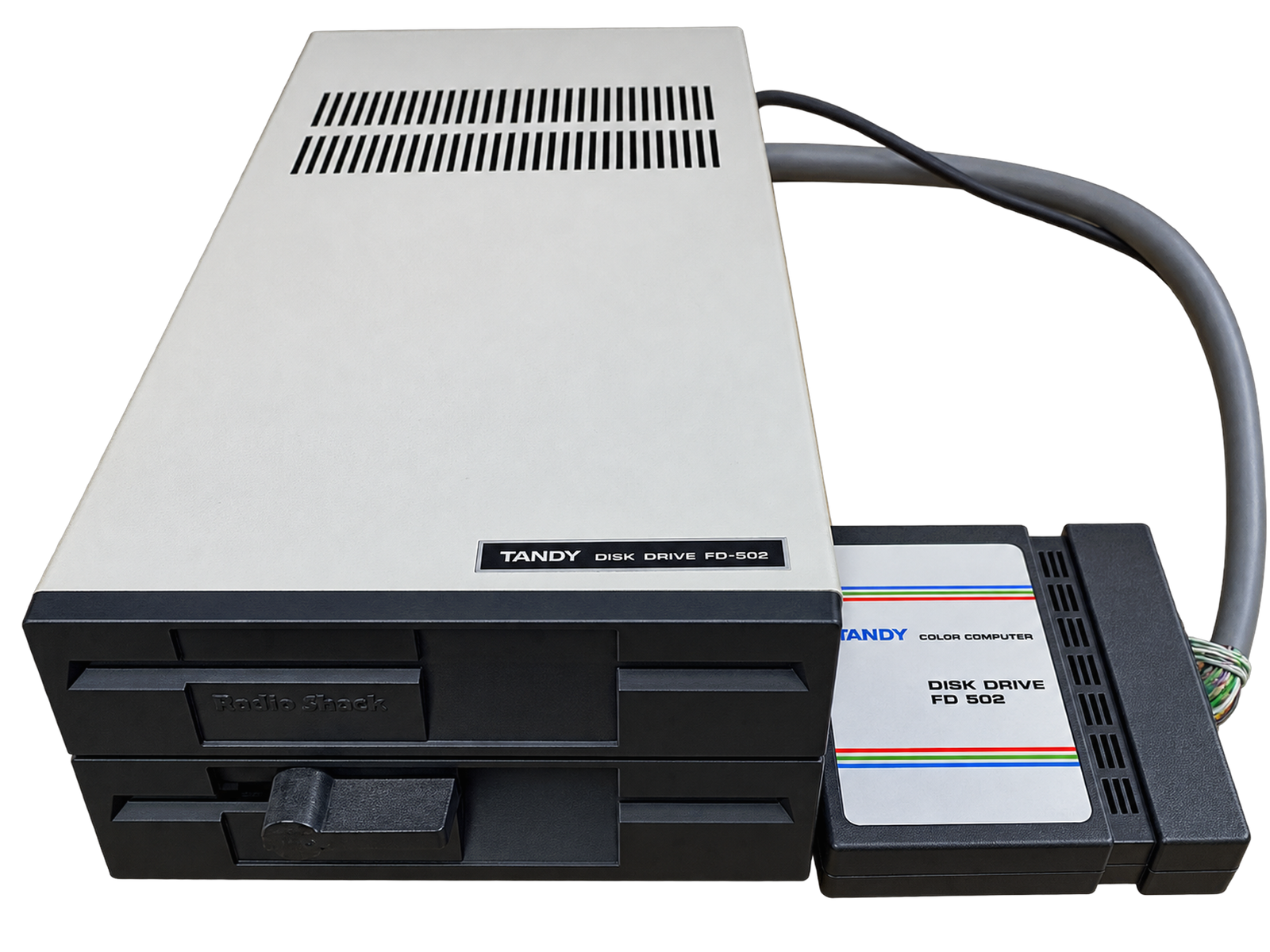
The Tandy FD-502 Disk Drive System, catalog number 26-3133, was the final floppy disk system marketed by Tandy specifically for the Color Computer. Introduced in the 1988 Radio Shack catalog, it retained the compact dual-drive enclosure and short controller cartridge of the FD-501 generation, but incorporated one very significant improvement: the FD-502 was Tandy's first and only official CoCo disk system equipped with double-sided floppy drives.
Physically, the FD-502 closely followed the arrangement established by the FD-500 and FD-501. It used half-height 5¼-inch drives mounted horizontally in a cabinet capable of accepting two mechanisms. A standard system was supplied with Drive 0 installed in the lower bay, while the upper position could accommodate an optional second drive.
That made the FD-502 considerably more compact than the original Color Computer Mini Disk systems, while still providing the possibility of a two-drive configuration within a single enclosure.
The FD-502 Controller
The matching FD-502 controller continued to use the Western Digital WD1773 floppy disk controller, with the reliable digital data-separation circuitry used by the later generations of Tandy CoCo controllers. It required no +12V supply from the Color Computer's cartridge port and could therefore be used with the CoCo 1, CoCo 2 or CoCo 3.
Unlike the FD-501 controller, however, the FD-502 returned to conventional solder-tinned card-edge contacts rather than the gold-plated contacts found on the FD-501.
The FD-502 controller also introduced another internal change. Earlier Tandy CoCo disk controllers used a 24-pin ROM for Disk Extended Color BASIC; the FD-502 instead used a 28-pin ROM device. This makes the FD-502 readily distinguishable internally from its predecessors and is important when replacing or upgrading the controller ROM.
Like the other Tandy controllers, the FD-502 used 7416 open-collector buffer ICs for communication with the floppy drives. Aging or failed 7416s can cause drive-selection and communication problems and may be replaced with the more robust 7406 equivalents.
Double-Sided Drives — With a Catch
The most important difference between the FD-502 and every earlier Tandy CoCo disk system was its use of double-sided, double-density (DS/DD) 5¼-inch drives.
Earlier Tandy CoCo systems used single-sided drives and the familiar Disk BASIC format of:
35 tracks × 18 sectors × 256 bytes = 161,280 bytes per disk
A double-sided mechanism could theoretically provide approximately twice that physical storage by using both recording surfaces.
There was a catch, however: standard Tandy Disk Extended Color BASIC did not automatically take advantage of the second side. Its normal disk format remained the traditional single-sided CoCo format. Using both sides of an FD-502 disk therefore required a patched or enhanced version of Disk BASIC, or another operating system or disk utility capable of addressing the second head.
Consequently, simply connecting an FD-502 did not suddenly double the capacity of an ordinary DECB disk. When used with unmodified Disk BASIC, it remained compatible with the enormous existing library of standard CoCo disks.
An Unusual Power Connection
The FD-502 drives also differed electrically from the mechanisms used in the earlier Tandy enclosures.
Rather than the conventional larger power connectors normally associated with 5¼-inch floppy drives, the FD-502 mechanisms used the smaller style of power connector commonly associated with 3½-inch floppy drives.
There is an important warning for anyone restoring one today: surviving technical information indicates that the FD-502's smaller power connectors may not be wired the same way as a standard PC 3½-inch floppy connector. They should therefore not be treated as interchangeable without first verifying the pinout.
Adding a Second Drive
Like the FD-501, the FD-502 enclosure could accommodate a second half-height drive in its unused upper bay. This provided a neat two-drive installation without requiring another external cabinet and power supply.
A dual-drive FD-502 installation also required additional cooling. With two mechanisms operating inside the enclosure, a 12-volt cooling fan was necessary to prevent excessive heat buildup.
With two double-sided mechanisms and software capable of using both surfaces, the FD-502 offered substantially more potential storage than any previous Tandy-branded CoCo floppy system.
The End of Tandy's CoCo Floppy Line
The FD-502 is particularly interesting because it represents both the most advanced and the last official Tandy Color Computer floppy system.
By 1988, the basic architecture of CoCo disk storage was already several years old. The standard Disk BASIC filesystem still reflected the 35-track, single-sided format established by the earliest systems. Rather than abandoning that compatibility, Tandy retained it while supplying hardware that was capable of more.
The FD-502 therefore occupies an unusual position in Color Computer history. Its double-sided drives provided capabilities beyond what standard Disk Extended Color BASIC normally used, leaving third-party software, operating systems and modified Disk BASIC implementations to exploit the additional capacity.
It was a fitting final evolution of Tandy's traditional CoCo floppy system: half-height 5¼-inch drives, two-drive capability, double-density recording, double-sided mechanisms, a mature WD1773-based controller—and complete compatibility with the traditional CoCo disk environment when used in its standard configuration.
One distinction I'd make very visible on the museum page is “Double-sided hardware does not mean a standard DECB disk suddenly became double-sided.” That's probably the most historically interesting thing about the FD-502, and it prevents readers from assuming it simply doubled the normal 160K capacity out of the box.


Floppy Controller Frenzy
During the entire run of the Color Computer, there was one thing the aftermarket certainly wasn't short of: floppy disk controllers.
Many companies manufactured controllers for the CoCo. Far fewer actually manufactured floppy disk drives.
The drive mechanisms themselves generally came from established manufacturers such as TEAC, Tandon, Chinon, Shugart and others. Third-party suppliers could purchase these mechanisms, package them in their own enclosures and combine them with their own controller hardware to create a complete disk system. The particular drive mechanism supplied could therefore vary depending upon price, availability and when the system was purchased.
We're not going to attempt to catalog every floppy drive mechanism that found its way onto a Color Computer. There were simply too many combinations, and the drive itself usually wasn't what made a third-party CoCo disk system interesting.
The controllers were.
Companies such as J&M Systems, DISTO, Sardis Technologies and others designed controllers specifically for the Color Computer, sometimes closely following Tandy's approach and sometimes expanding well beyond it.
Those controllers — and the different capabilities they brought to the CoCo — are what we'll look at next.
Hard Drive Systems
Floppy Disk Controller
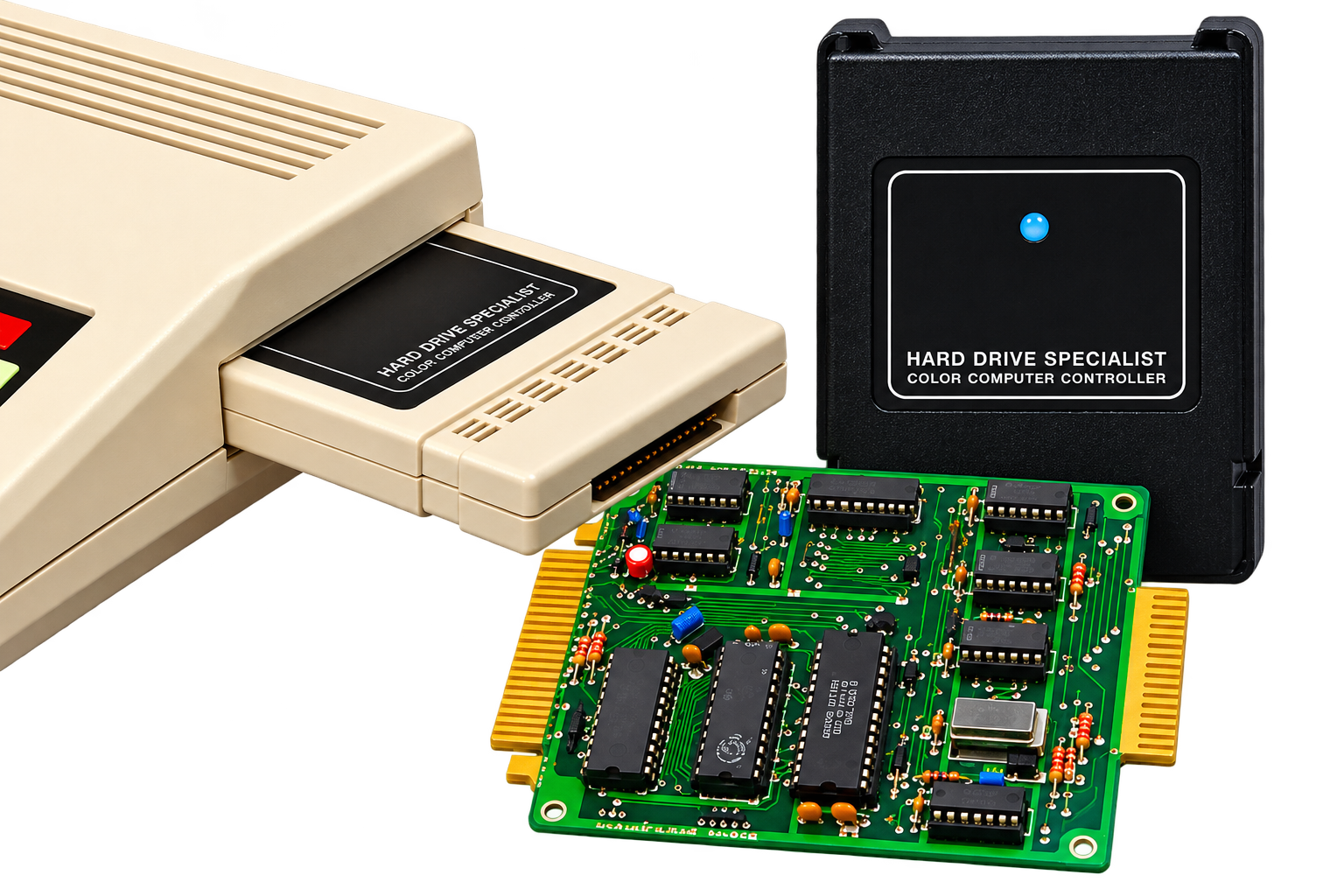
An Alternative to Radio Shack's Disk Controller
As the TRS-80 Color Computer gained popularity during the early 1980s, third-party manufacturers began offering alternatives to Radio Shack's original floppy disk hardware. These products often provided additional features, greater flexibility, or lower prices than the equipment available through Radio Shack stores.
Among these manufacturers was Hard Drive Specialist (HDS), based in Houston, Texas. Despite the company's name, HDS offered more than hard disk equipment. Its product line included floppy disk controllers, complete drive systems, and software for the Color Computer.
The HDS Floppy Drive Controller was designed as a replacement for Radio Shack's standard disk controller, retaining compatibility with existing disk software while providing additional capabilities. Its most notable feature was the ability to accommodate two different disk operating system ROMs, allowing owners to switch between operating environments without physically exchanging ROM chips.
HDS offered its controllers both as fully assembled products and as kits for computer enthusiasts comfortable with assembling electronic hardware.
The Original HDS Floppy Drive Controller
The HDS controller was being advertised by early 1985, with an advertisement and a product announcement appearing in the January 1985 issue of HOT CoCo magazine.
The controller was marketed as a direct replacement for Radio Shack's disk interface, supporting the Color Computer 1 and Color Computer 2.
Among the features promoted by HDS were gold-plated cartridge-edge contacts, support for single- and double-density disk operation, and compatibility with existing Radio Shack disk software.
The gold-plated contacts were intended to provide a durable electrical connection between the controller and the computer's cartridge port. HDS also emphasized its circuit-board design and the elimination of adjustable potentiometers, presenting these features as improvements over conventional controller hardware.
Although HDS promoted the design as particularly reliable, no independent contemporary performance evaluation has yet been identified to verify those claims.
Two Selectable DOS ROMs
One of the HDS controller's most useful features was its provision for two disk operating system ROM sockets.
Instead of removing a ROM chip whenever a different disk operating system was needed, users could install two compatible ROMs and select between them.
The documented configuration provided one 24-pin socket and one 28-pin socket, accommodating different ROM and EPROM arrangements.
ROM selection was accomplished through a small jumper arrangement on the circuit board. This was not software-controlled ROM switching; the user selected the desired ROM by changing the jumper position.
For Color Computer owners experimenting with alternative disk operating systems, this was a convenient improvement over controllers equipped with only one ROM socket.
The HDS advertisements specifically promoted compatibility with Radio Shack's disk operating system ROMs while also offering support for alternative software.
Second-Generation HDS Controller
HDS subsequently advertised a second-generation floppy disk controller, emphasizing improvements to the electronic design.
The second-generation advertisements identified the Western Digital WD1773 floppy disk controller integrated circuit as an important component of the revised hardware.
The WD1773 incorporated functions that had previously required additional external circuitry, including data separation and write precompensation.
By integrating these functions into the controller chip, the design could reduce the number of supporting components needed on the circuit board.
HDS presented this simplified circuitry as a way to improve reliability and reduce the need for adjustments.
The company also continued to promote the controller's gold-plated contacts, dual ROM sockets, and compatibility with conventional Color Computer disk software.
The WD1773 Controller Chip
The Western Digital WD1773 was a 28-pin integrated circuit operating from a single five-volt power supply.
It provided the fundamental functions required for floppy disk operation, including reading and writing sectors and controlling the movement of the drive's read/write heads.
The chip was software-compatible with the WD1793 and MB8877 controllers used in earlier disk hardware, helping preserve compatibility with existing disk software.
An important historical distinction is that the surviving Revision C manual already documents the WD1773. The chip therefore cannot be attributed exclusively to the later Revision F board.
The second-generation advertising confirms that HDS promoted the WD1773-based design, but the available documentation does not establish precisely which circuit-board revision marked the transition between its advertised product generations.
Revision C and Revision F
Two surviving HDS assembly manuals provide valuable insight into the controller's construction and development.
The Revision C manual documents a WD1773-based controller with two ROM sockets, jumper-controlled ROM selection, a 16 MHz clock module, and conventional Color Computer disk-controller circuitry.
Its circuit description explains the use of the WD1773, the controller's CPU HALT and interrupt logic, and the electronic interface used to communicate with the floppy drives.
The manual also contains a detailed parts list and step-by-step assembly instructions.
The Revision F manual documents the same general controller architecture, including the WD1773 and dual ROM capability.
One documented difference is the clock circuitry. Revision C describes using an integrated clock module rather than a conventional crystal-and-inverter arrangement, while Revision F specifies a 16 MHz crystal.
This suggests that HDS continued refining its circuit-board design, although the surviving documentation does not establish a complete chronology of the changes.
It is also important to distinguish these board revisions from HDS's advertising terminology. Revision C and Revision F identify documented hardware or manual revisions; they should not automatically be treated as synonymous with the first- and second-generation products.
Compatibility with Existing Disk Systems
HDS designed its floppy controller to work with the established Color Computer disk environment.
The controller used the conventional disk hardware interface, including the familiar memory-mapped registers beginning at address $FF40.
This allowed compatible disk operating systems to communicate with the controller using the same general methods employed by Radio Shack hardware.
The controller supported conventional floppy disk operations, including drive selection, motor control, track positioning, and sector reading and writing.
Its design also retained the processor HALT and non-maskable interrupt mechanisms used during disk transfers.
Unlike later buffered controllers, such as the DISTO Super Controller II, the documented HDS controller did not provide a separate sector-buffer system intended to free the processor during disk operations.
Its principal improvements were instead ROM flexibility and refinements to the controller circuitry.
Available ROM and Software Options
HDS advertised several ROM configurations for its controller.
Buyers could purchase an assembled board with a Radio Shack-compatible DOS ROM, obtain the controller without a ROM, or assemble a kit and install their own compatible ROM.
The advertisements also offered ADOS, an alternative disk operating system developed by SpectroSystems.
HDS advertised ADOS as supporting additional drive configurations, including double-sided drives and expanded track arrangements, depending on the version.
Because the HDS controller could accommodate two DOS ROMs, an owner could potentially maintain a standard Radio Shack-compatible disk environment while also installing an alternative DOS for additional features.
This flexibility was one of the controller's principal selling points.
Assembled Controllers and Do-It-Yourself Kits
HDS catered to both customers who wanted ready-to-use equipment and hobbyists interested in assembling their own hardware.
The company's advertisements offered fully assembled and tested controllers, bare circuit boards, and component kits.
Period advertised prices included:
Configuration |
Advertised price |
|---|---|
| Assembled controller with Radio Shack ROM | $139 |
| Assembled controller without ROM | $119 |
| Bare circuit board with instruction manual | $40 |
| Component kit for bare board, without ROM | $40 |
| Radio Shack ROM, current version | $20 |
| Radio Shack ROM 1.0 | $40 |
These prices are taken from one of the surviving HDS advertisements. Other advertisements show lower prices, reflecting changes in the company's offerings over time.
The kit manuals provide an unusually detailed look at what was involved in assembling a third-party disk controller during the 1980s.
Instructions cover identifying components, checking the printed circuit board, installing sockets, soldering resistors and capacitors, fitting integrated circuits, and configuring the ROM-selection jumpers.
The manuals also explain how to test the completed controller by initializing a floppy disk, saving a BASIC program, and reading it back.
For electronics hobbyists, the kit option offered both a cost-saving opportunity and the satisfaction of constructing a functional computer peripheral.
Warranty and Support
HDS advertised a 120-day warranty on its controller products.
The kit documentation also explains that customers who decided not to complete assembly could return an unused kit and pay the difference to receive an assembled and tested controller.
This arrangement provided an alternative for buyers who initially intended to build the controller themselves but later preferred a factory-assembled unit.
A Competitive Third-Party Market
The HDS controller entered a market in which several independent manufacturers were developing alternatives to Radio Shack's disk hardware.
Companies such as J&M Systems and CRC Computers, through its DISTO product line, also offered enhanced floppy disk controllers for the Color Computer.
Each manufacturer approached the market somewhat differently.
J&M emphasized alternative disk operating systems and controller configurations, while DISTO introduced more extensive ROM expansion capabilities and, later, buffered disk operation for OS-9.
HDS concentrated on a relatively straightforward Radio Shack-compatible controller with selectable ROMs, updated circuitry, and a range of assembled and kit purchasing options.
The result was a product that offered additional flexibility without requiring owners to abandon their existing disk drives or familiar software.
Historical Significance
The Hard Drive Specialist floppy disk controllers represent another example of the independent hardware development that helped expand the TRS-80 Color Computer ecosystem.
Although their basic function was the same as Radio Shack's disk controller, the HDS boards offered practical advantages through their dual ROM sockets, alternative DOS support, and availability as electronics kits.
The surviving Revision C and Revision F manuals also document how HDS refined its hardware and how much technical information manufacturers were willing to provide to customers assembling their own equipment.
The HDS controller may not have introduced the dramatic multitasking improvements of later buffered disk controllers, but it offered an accessible alternative for CoCo owners seeking greater flexibility from their floppy disk systems.
Its combination of compatibility, configurable ROM support, and hobbyist-friendly kit options makes it a noteworthy part of the Color Computer's third-party hardware history.
Sardis Technologies
DMC Floppy Disk Controller
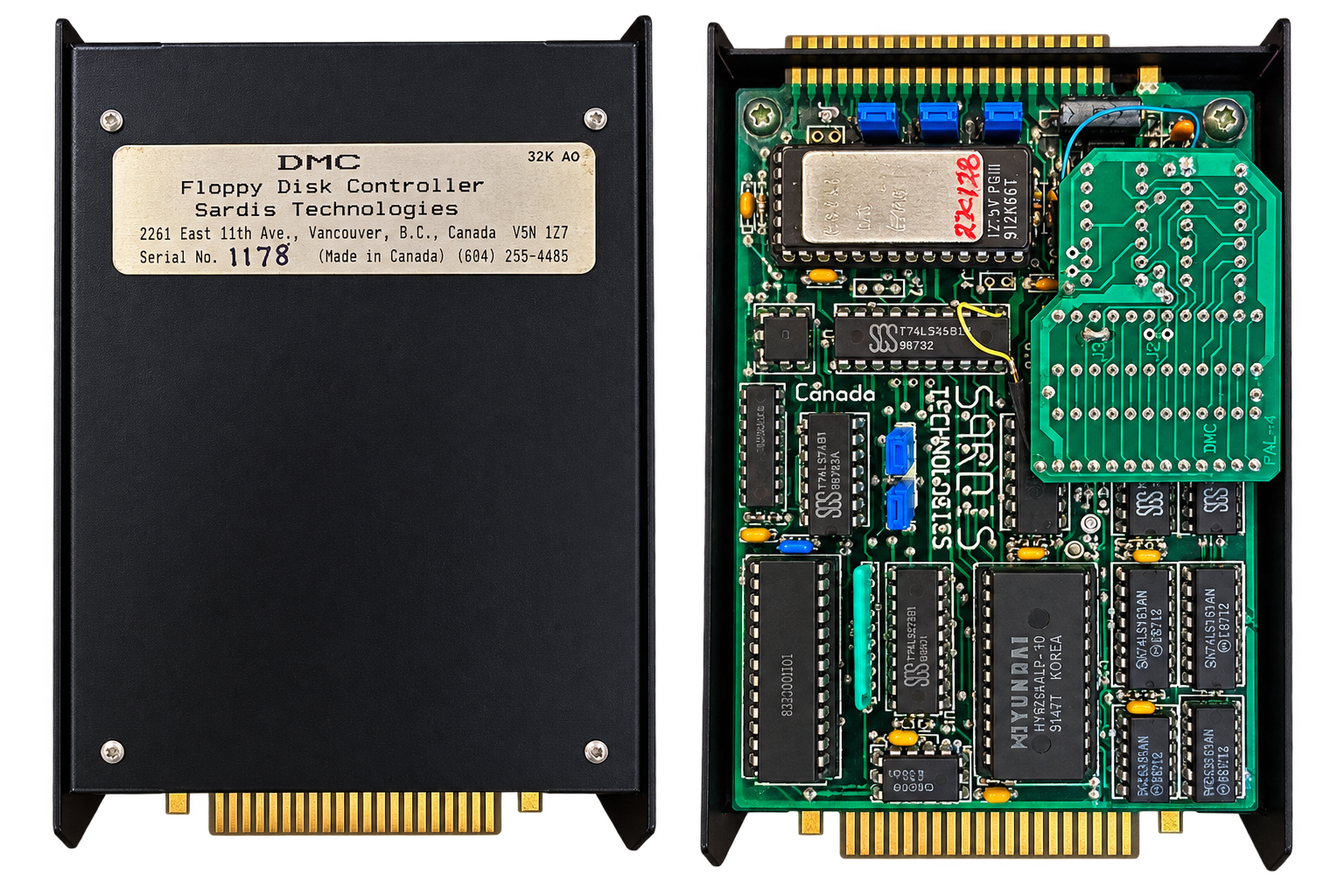
Bringing NO-HALT Disk Operation to the TRS-80 Color Computer
Introduction
When Tandy introduced the TRS-80 Color Computer 3 in July 1986, it represented a significant advancement for the Color Computer family. With improved graphics, expanded memory capabilities, and the anticipated release of Microware's OS-9 Level II operating system, the CoCo 3 promised to become a considerably more capable multitasking computer.
However, one component of the system remained largely unchanged: its floppy disk controller.
The standard Radio Shack disk controller used a method commonly called HALT-mode operation, which effectively suspended the 6809 processor during portions of floppy disk data transfers. Although this approach was adequate for Disk Extended Color BASIC and many traditional applications, it presented significant limitations for a multitasking operating system such as OS-9.
Sardis Technologies, a small electronics company based in Vancouver, British Columbia, recognized this limitation and developed an ambitious alternative.
The DMC (Dual Mode Controller) introduced a new operating mode that allowed floppy disk transfers to proceed without continuously halting the computer's processor. By combining a Western Digital floppy disk controller with onboard buffer memory and specialized control logic, Sardis created one of the earliest commercial attempts to overcome this longstanding limitation of the Color Computer.
Although only approximately 200 controllers were ultimately shipped, the Sardis DMC remains an interesting example of independent hardware development during the final years of the Color Computer's commercial life.
The Problem with Conventional Floppy Disk Controllers
To understand the significance of the Sardis DMC, it is necessary to examine how conventional Color Computer floppy disk controllers operated.
The original Radio Shack disk controller used a Western Digital floppy disk controller IC to manage communication with the disk drive. During a disk read or write operation, the controller required data to be transferred at a rate determined by the rotating disk.
The Color Computer's standard controller design relied on the processor being halted while the disk controller waited for data transfers. The CPU was therefore unable to perform other useful work during these periods.
For a computer running Disk Extended Color BASIC, this behavior was generally acceptable. Most programs performed disk operations sequentially, waiting until an operation completed before continuing.
OS-9, however, was designed to support multiple processes, interrupt-driven operations, and concurrent system activities.
A disk controller that repeatedly halted the processor undermined these capabilities.
The consequences could include delayed keyboard input, interrupted serial communications, reduced responsiveness, and other timing-related problems.
Sardis emphasized these limitations in its advertising, pointing out that characters could be lost during keyboard or serial communications while the computer accessed a floppy disk.
The problem became particularly noticeable on the CoCo 3, whose higher processor speed made the time lost to conventional disk-controller operation more significant.
For users interested in making full use of OS-9's multitasking capabilities, a different approach was desirable.
Development of the Sardis DMC
According to the controller's designer, development began shortly after Tandy announced the Color Computer 3 in July 1986.
He recognized that the relatively inexpensive CoCo 3, combined with OS-9 Level II, could provide capabilities previously associated with substantially more expensive 6809-based computer systems.
However, the existing floppy disk controller represented a serious limitation.
Some larger 6809 computer systems used direct memory access (DMA) controllers to transfer disk data directly into system memory without requiring the processor to move every byte.
Unfortunately, the architecture of the Color Computer's cartridge expansion connector and Multi-Pak Interface made this type of conventional system-memory DMA impractical.
The designer instead drew inspiration from the Smoke Signal Broadcasting DCB-4 floppy disk controller, developed for SS-50 bus computer systems.
That controller incorporated a small SRAM buffer, allowing its disk controller to transfer an entire sector without requiring continuous CPU involvement.
Sardis expanded upon this concept.
Rather than using a 256-byte sector buffer, the DMC employed 8 KB of onboard static RAM, with an option to expand the buffer to 32 KB.
This larger buffer could accommodate an entire floppy disk track and support sector sizes beyond the conventional 256 bytes.
The additional memory also made disk caching possible.
During approximately two months of development, the designer assembled a working prototype using a combination of wire-wrapped and point-to-point wiring.
The prototype was operational by October 1986.
That month, he attended RAINBOWfest in Princeton, New Jersey, where he privately showed the hardware to several interested individuals.
In his retrospective account, the designer recalled hearing that other companies were planning similar controllers, but believed his prototype was the first working example.
This claim reflects his firsthand recollection rather than an independently established industry-wide priority.
From Prototype to Production
Developing a working prototype was only the beginning.
Sardis contracted with an outside company to design the production printed circuit board.
The resulting board used four layers rather than the two-layer construction the designer had hoped for. This substantially increased manufacturing costs.
According to his later account, the least expensive PCB quotation was approximately C$21.10 per board in quantities of 100, excluding setup charges.
He also reported inconsistent manufacturing quality, including uneven etching and warped circuit boards.
The production controller contained approximately 24 integrated circuits, with later revisions increasing that number to 26.
This relatively complex design contributed to another unexpected problem: power consumption.
The DMC required more current than the Color Computer's cartridge expansion connector was intended to supply.
As a result, Sardis recommended installing the controller in a powered Multi-Pak Interface rather than directly into the computer.
Although the DMC could physically connect to the cartridge slot, its power requirements placed it at a disadvantage compared with simpler competing controllers.
Sardis exhibited the controller at the April 1987 RAINBOWfest in Schaumburg, Illinois, distributing promotional material and collecting names of interested customers.
Commercial shipments finally began in July 1987, initially accompanied by preliminary software and documentation.
How the NO-HALT Controller Worked
The central innovation of the DMC was its ability to transfer data between the floppy disk drive and its own onboard memory without requiring the Color Computer's CPU to remain halted throughout the operation.
At the heart of the design was a Western Digital WD1773 floppy disk controller.
The WD1773 handled the low-level operations required to read, write, seek, and format floppy disks.
Sardis surrounded this controller with additional logic, including a programmable array logic device, counters, data buffers, and static RAM.
During a NO-HALT disk operation, the DMC could transfer data between the WD1773 and its local SRAM buffer independently of the 6809.
The computer's processor was therefore free to execute other instructions during the disk transfer.
When necessary, the CPU still transferred data between the DMC's buffer memory and the computer's main memory.
This distinction is important.
The Sardis DMC did not perform conventional DMA directly into the Color Computer's system RAM.
Instead, it used a locally buffered transfer mechanism to eliminate the need for continuous processor involvement during disk-drive operations.
This approach allowed the DMC to work within the limitations of the Color Computer's cartridge interface.
It also made possible the buffering of larger sectors and entire tracks, including operations involved in formatting disks.
Two Modes of Operation
As its name suggested, the Dual Mode Controller supported two different operating methods.
HALT mode retained the conventional behavior expected by Radio Shack-compatible disk software. This provided compatibility with existing Disk Extended Color BASIC applications and software written for standard controllers.
NO-HALT mode allowed disk operations to proceed through the controller's onboard buffering system while the CPU continued executing other tasks.
The NO-HALT mode required software designed to use the DMC's additional hardware capabilities.
Simply installing the cartridge did not automatically convert every existing disk application into a nonblocking program.
The controller's greatest benefits were realized when used with appropriate OS-9 drivers.
Hardware Specifications
The Sardis DMC was a sophisticated cartridge for its period, incorporating considerably more circuitry than a conventional Color Computer disk controller.
Feature |
Specification |
|---|---|
| Manufacturer | Sardis Technologies |
| Product | DMC — Dual Mode Controller |
| Initial commercial shipments | July 1987 |
| Supported computers | Color Computer 1, 2, and 3 |
| Main floppy controller | Western Digital WD1773 |
| Controller clock | 8 MHz crystal |
| Operating modes | Conventional HALT and buffered NO-HALT |
| Standard onboard RAM | 8 KB SRAM |
| Optional onboard RAM | 32 KB SRAM |
| ROM compatibility | 24-pin ROM or 28-pin EPROM, with appropriate configuration |
| Supplied DOS ROM | Radio Shack Disk BASIC 1.1, in the advertised configuration |
| Optional ROM feature | Dual-DOS selection |
| Data separation | Digital data separator |
| Write circuitry | Write precompensation |
| Drive support | Single- and double-sided, single- and double-density drives |
| OS-9 software | Modified SDISK drivers |
| Enclosure | Black aluminum case |
| Expansion recommendation | Powered Multi-Pak Interface |
| Original warranty | 120 days, limited |
Sardis advertised support for different disk-drive step rates and configurations.
The company's brochure also described the ability to access several disk formats through the SDISK software, including OS-9 formats and other systems' disk structures.
The controller's hardware and software were designed to support a wider range of disk configurations than the basic Radio Shack controller alone.
Onboard Cache Memory
The DMC shipped with 8 KB of onboard static RAM, expandable to 32 KB.
The original hardware manual describes the memory upgrade as a straightforward replacement of the installed SRAM chip with a larger compatible device.
The controller's buffering capability was essential to its NO-HALT operation, but the additional RAM could also be used for disk caching.
Caching allowed recently accessed disk data to remain available in the controller's memory.
If the same information was requested again, it could potentially be retrieved from the cache without another physical disk access.
This was especially useful with floppy disk drives, where mechanical head movement and rotational delays could be significant.
The brochure described automatic caching behavior and emphasized that the cache was used to accelerate disk access rather than to replace ordinary floppy storage.
The 32 KB option offered greater caching capacity than the standard 8 KB configuration.
However, actual performance improvements depended on the software, disk format, and access patterns involved.
Software Support and OS-9
Hardware alone could not provide the full benefits of the DMC.
Sardis licensed D.P. Johnson's SDISK software, including the corresponding software for OS-9 Level II, and adapted it to support the controller.
This avoided the need to develop an entirely new disk-driver package while also providing access to SDISK's additional disk-format capabilities.
The software could support different track counts, disk geometries, sector sizes, and certain nonstandard disk formats.
According to Sardis's brochure, supported sector lengths included 128, 256, 512, and 1,024 bytes.
The SDISK software was also intended to facilitate access to disk formats used by other operating systems, subject to the appropriate software support.
For OS-9 users, however, the principal attraction remained the ability to perform disk operations without continuously halting the CPU.
The Multi-Pak Interrupt Problem
One of the most difficult challenges encountered during software development involved the Color Computer's Multi-Pak Interface.
The DMC needed a reliable way to notify OS-9 when a disk operation had completed.
Unfortunately, the Multi-Pak's interrupt-routing behavior complicated the use of conventional IRQ signaling from cartridges in different slots.
The designer eventually developed several driver versions using three approaches identified as:
-
- NAP
- VIRQ
- IRQ
These alternatives were intended for different hardware and operating-system configurations.
Supporting them required additional hardware capabilities that had not been included in the original production design.
That discovery led to one of the DMC's most significant revisions.
The PAL-4 Daughterboard
The original DMC incorporated a programmable array logic device, or PAL, that implemented important control functions.
As software development progressed, Sardis discovered that the original hardware could not support all the driver methods being developed.
Unfortunately, the first production batch of approximately 100 controllers had already been assembled, and many units had been delivered to customers.
Rather than redesign the entire controller, Sardis developed a small replacement daughterboard called the PAL-4.
The PAL-4 plugged into the socket previously occupied by the original PAL device.
It incorporated additional logic and connections required to support the revised controller functionality.
Installation also involved an additional wire connecting the daughterboard to the main controller circuitry.
The surviving Sardis schematics include a separate PAL-4 daughterboard drawing dated October 1988, documenting the revised circuitry.
According to the designer's retrospective, controllers shipped after mid-January 1988 included the PAL-4 modification and corresponding updated software.
Earlier customers could receive upgrade packages, although not every existing controller was necessarily upgraded.
Importantly, the original DMC remained capable of operating in both HALT and NO-HALT modes without the PAL-4.
The daughterboard was intended to support the expanded driver functionality rather than introduce NO-HALT operation for the first time.
Today, the presence of the PAL-4 daughterboard is an important identifying feature when examining surviving DMC controllers.
Original Pricing
The Sardis brochure included a price list effective September 21, 1987.
Product or option |
Original US price |
|---|---|
| DMC with RS-DOS 1.1 and SDISK | $149.50 |
| DMC with SDISK, without ROM | $137.50 |
| 32 KB cache RAM option | +$16.00 |
| Both SDISK Level I and Level II versions | +$19.00 |
| Shipping and handling | $5.00 |
| Cash-on-delivery fee | $4.00 |
The brochure specified that the additional software and memory prices applied when ordered with the controller.
At $149.50, the DMC was a substantial investment for a Color Computer owner.
Its advanced buffering circuitry, relatively large number of components, and included software contributed to a higher manufacturing cost than simpler disk controllers.
Commercial Difficulties and Competition
Despite the DMC's technical capabilities, Sardis struggled to make the product commercially successful.
The designer's retrospective describes numerous challenges.
Manufacturing the four-layer circuit boards was expensive, and PCB assembly costs were higher than anticipated.
The controller's substantial power requirements meant customers were advised to use a powered Multi-Pak Interface, reducing its appeal to owners who wanted a simple plug-in replacement.
Software development and documentation required considerably more time than expected.
The PAL-4 modification added further costs, including daughterboard production, testing, packaging, and distribution to existing customers.
Shipping presented another problem.
Because Sardis operated from Canada while most customers were in the United States, the designer frequently transported small batches of controllers across the border and shipped them from Blaine, Washington.
This avoided some international shipping complications but consumed considerable time and money.
Meanwhile, competitors were introducing their own NO-HALT controllers.
Products such as the DISTO Super Controller II offered additional expansion possibilities and eventually benefited from Radio Shack retail distribution.
Hard disk systems were also becoming increasingly accessible, giving some users an alternative way to improve storage performance.
Sardis could not easily compete on price, distribution, or the range of available accessories.
Advertising expenses further reduced the company's limited profit margins.
Although the controller attracted enthusiastic customers, sales never reached the level necessary to make the product financially successful.
An Unfinished Documentation Project
One particularly unusual aspect of the DMC's history concerns its documentation.
Sardis shipped preliminary manuals and continued working on revised software and instructions.
The designer intended to produce more polished final manuals, but the work was repeatedly delayed by other engineering projects, business obligations, and financial difficulties.
He later attempted to complete the manuals using GeoWorks Ensemble desktop-publishing software on an IBM PC-compatible computer.
However, slow software performance and limited available time contributed to further delays.
Ultimately, the final versions were never completed or distributed.
Some previously manufactured PAL-4 upgrade packages also remained undistributed.
The designer later expressed regret that these upgrades had not been sent to all earlier customers.
This history makes surviving preliminary manuals, software disks, and PAL-4-equipped controllers particularly useful for documenting the product's development.
A Surviving Sardis DMC: Serial Number 1178
The Tandy Computer Center collection includes an original Sardis Technologies DMC floppy disk controller bearing serial number 1178.
The controller retains its black metal enclosure and original identification label, which includes the Sardis Technologies name, Vancouver address, and Canadian manufacturing designation.
The label also carries a 32K marking, indicating the optional memory configuration. The installed memory capacity has not been independently verified.
An interior photograph reveals the DMC's densely populated circuit board, including its original integrated circuits, control logic, and the distinctive PAL-4 daughterboard.
The additional wiring associated with the PAL-4 modification is also visible.
This makes the controller an especially useful example of the revised DMC hardware.
The precise manufacturing date and original shipment configuration of this particular unit have not been established.
The presence of the PAL-4 board confirms that the controller incorporates the later hardware modification, but does not by itself establish whether the upgrade was installed at the factory or added afterward.
Original SDISK-DMC Software
The collection also includes a Sardis Technologies software disk labeled:
SDISK-DMC Level I — Preliminary Version
The disk carries a 1986 Sardis Technologies copyright notice.
Handwritten notes on its protective sleeve include file or directory references dated July 3 and July 4, 1987.
These dates are consistent with the period when Sardis began commercial shipments, although they do not independently establish when this particular disk was supplied.
The surviving disk provides a valuable physical example of the preliminary software distributed for the DMC.
Its exact contents and revision have not yet been verified through a disk-image examination.
Production Numbers and Rarity
In his retrospective account, the designer estimated that only approximately 200 Sardis DMC controllers were shipped.
This was a very small production run compared with mainstream Radio Shack accessories.
The number of surviving examples is unknown.
The number retaining their original software, documentation, enclosure, and PAL-4 modification is also unknown.
Consequently, an intact DMC represents an uncommon piece of Color Computer hardware history.
Its rarity is not simply a matter of limited production. The controller also illustrates an alternative engineering approach to a problem that affected many early microcomputer disk systems.
The Legacy of the Sardis DMC
The Sardis DMC never achieved the commercial success its designer had hoped for.
Nevertheless, it demonstrated that the Color Computer's limitations could be addressed through innovative peripheral hardware.
By using onboard SRAM and specialized control logic, the DMC allowed disk transfers to proceed without continuously suspending the processor.
For OS-9 users, this was a meaningful improvement over conventional HALT-mode disk operation.
The controller also illustrates the difficulties faced by independent hardware developers during the 1980s.
A technically successful product still required affordable manufacturing, reliable suppliers, compatible software, clear documentation, effective marketing, and distribution.
Sardis had to manage all these responsibilities with very limited resources.
In his later account, the designer acknowledged that the project had been a financial disappointment, but stated that he did not regret developing it.
He valued the engineering experience, the knowledge gained, and the people he encountered along the way.
His explanation was simple: he was born to create and design.
Today, the Sardis Technologies DMC stands as a reminder that some of the most interesting innovations in personal computing came not from major manufacturers, but from small independent developers determined to make existing machines do more than their designers originally intended.
For the TRS-80 Color Computer, the Sardis DMC was one such innovation.
Historical Sources and Documentation
This article was prepared using the following primary sources:
- Sardis Technologies, DMC Floppy Disk Controller Hardware Manual, preliminary version, revised July 14, 1987.
- Sardis Technologies, The New DMC Disk Controller: Advanced Design, Superior Performance, promotional brochure and September 21, 1987 price list.
- Sardis Technologies, DMC advertisements in the January 1988 issues of The Rainbow and 68' Micro Journal.
- Sardis Technologies, DMC Floppy Disk Controller Schematics, including the PAL-4 daughterboard drawing.
- The Story of the Sardis Technologies DMC Floppy Disk Controller for the CoCo, designer's retrospective, revised December 18, 2025.
- Original Sardis DMC controller, serial number 1178, and SDISK-DMC Level I preliminary software disk, photographed from the Tandy Computer Center collection.
Additional historical reading:
https://www.sardis-technologies.com/coco/dmc/dmc-story.htm
Historical note: Dates, production estimates, and certain details of the controller's development are based on the designer's retrospective recollections. Original advertisements, manuals, and surviving hardware provide additional contemporary documentation.
Disto/CRC
Floppy Disk Controllers
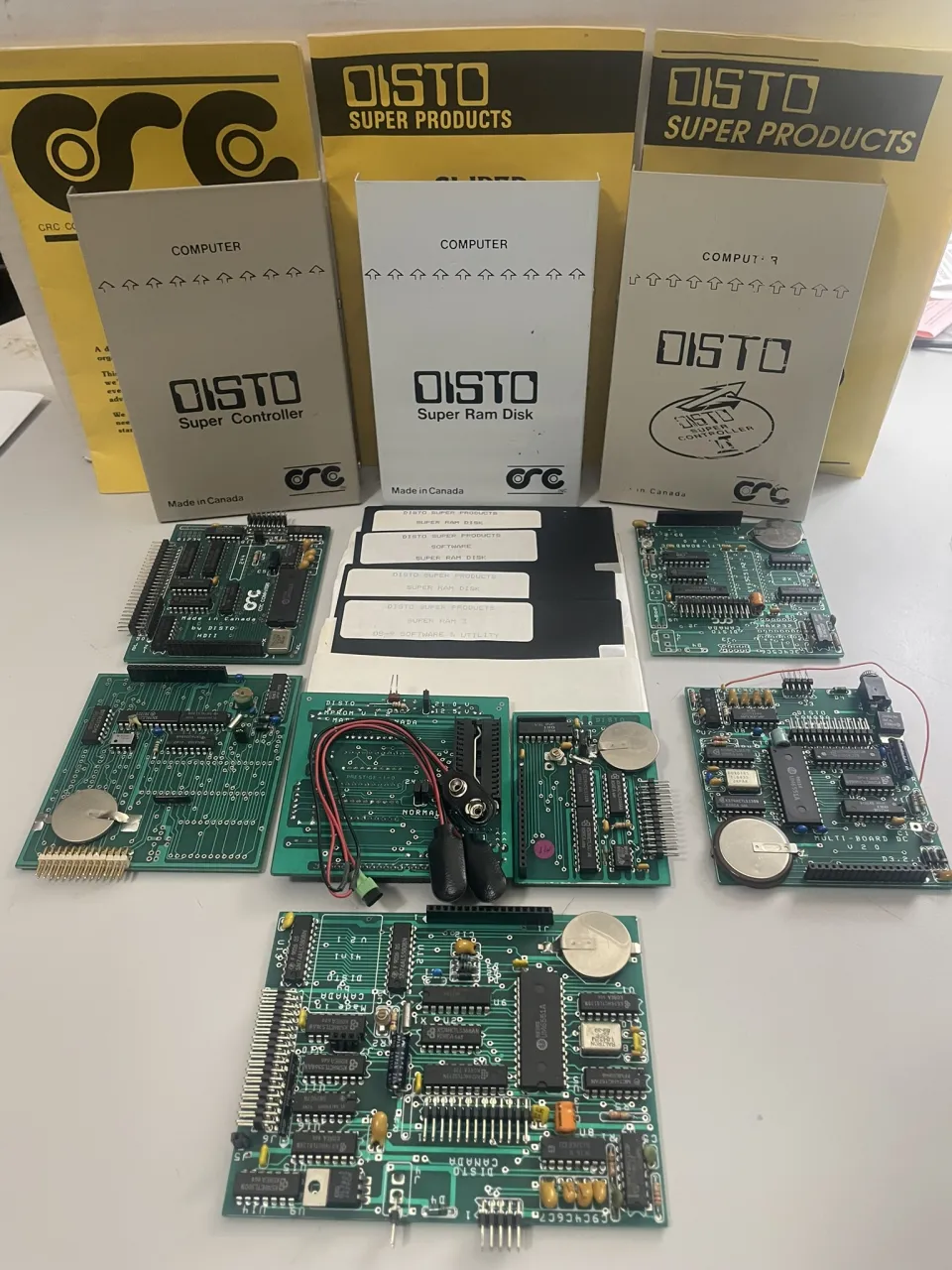
Image Supplied by Brian Wieseler
DISTO Super Controllers
Taking the Color Computer Beyond the Standard Disk Controller During the 1980s, the TRS-80 Color Computer attracted a growing number of third-party hardware manufacturers offering alternatives to Radio Shack's original equipment. Among the more ambitious were the disk controllers marketed under the DISTO name by CRC Computers. Rather than simply duplicate the functionality of Radio Shack's floppy disk controller, DISTO developed hardware that offered additional ROM capabilities, expansion options, and eventually a new approach to disk transfers under OS-9. The original DISTO Super Controller provided multiple operating-system ROM sockets and an internal expansion interface, making it considerably more versatile than a conventional floppy disk controller. Its successor, the Super Controller II, introduced buffered disk operations designed to improve the Color Computer's performance in a multitasking environment. Together, these controllers became notable examples of how third-party developers continued to extend the capabilities of the CoCo beyond its original design.
The Original DISTO Super Controller
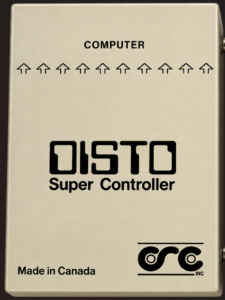
Introduced in the mid-1980s, the DISTO Super Controller was designed as an enhanced replacement for the Radio Shack disk controller. Its floppy disk controller circuitry handled conventional disk operations, while additional hardware provided ROM selection and expansion capabilities. The controller was housed in a shielded metal enclosure and featured gold-plated electrical contacts. Its circuitry operated from the Color Computer's five-volt supply, eliminating the need for an additional power source. DISTO emphasized compatibility with the existing Radio Shack disk system while providing several features unavailable on the standard controller.
Four ROM Sockets
Perhaps the most distinctive feature of the original Super Controller was its provision for four 28-pin ROM sockets. These sockets could accommodate 2764 or 27128 EPROMs, allowing multiple disk operating systems or ROM-based utilities to be installed simultaneously. The controller provided software selection of the installed ROMs, eliminating the need to physically remove and replace chips whenever the user wanted to change operating environments. This capability was particularly attractive to Color Computer owners who experimented with alternative disk operating systems or maintained software requiring different DOS ROMs. The Super Controller was supplied with DISTO's C-DOS, which provided compatibility with Radio Shack's Disk Extended Color BASIC environment. Other compatible ROM images could be installed by the user. Although switching ROMs did not eliminate the need to restart or reinitialize software when changing operating systems, it greatly simplified a process that otherwise required physically exchanging cartridges or ROM chips.
The Mini-Expansion Bus
Another important innovation was the Mini-Expansion Bus, commonly abbreviated MEB. Located inside the controller, this connector allowed additional hardware to be attached without occupying another cartridge slot in the Color Computer. DISTO developed or supported several accessories using this interface, including real-time clocks, parallel printer interfaces, EPROM programmers, and hard disk interfaces. For owners of Color Computers without a Multi-Pak Interface, the ability to combine a disk controller with additional peripheral hardware was particularly useful. The Mini-Expansion Bus also made the Super Controller more than a single-purpose disk interface. It provided the foundation for a family of expandable hardware products. CRC Computers also advertised a separate MEB Adapter for $24.95. This allowed compatible DISTO expansion boards to operate through a Multi-Pak Interface without requiring a Super Controller or DISTO RAM disk as their host.
Compatibility and Disk Operation
The original Super Controller was designed for the Color Computer 1 and Color Computer 2, providing compatibility with conventional floppy disk drives and Radio Shack's disk software environment. Despite its advanced features, the original Super Controller retained the conventional disk-transfer behavior used by standard Color Computer disk controllers. During a floppy disk transfer, the computer's processor had to participate closely in moving data between the controller and system memory. Under Disk BASIC, this behavior was generally acceptable, since the computer was already waiting for the disk operation to finish. Under a multitasking operating system such as OS-9, however, these interruptions could prevent the processor from performing other useful work while disk operations were underway. This limitation would become the principal target of DISTO's next-generation controller.
The DISTO Super Controller II
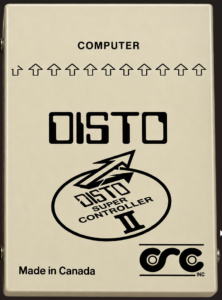
As the Color Computer 3 and OS-9 Level Two expanded the possibilities for multitasking, disk performance became increasingly important. DISTO responded with the Super Controller II, a redesigned floppy disk controller that retained compatibility with conventional Color Computer disk systems while introducing a buffered method of transferring disk data. The Super Controller II manual describes support for the Color Computer 1, 2, and 3, including systems equipped with the Multi-Pak Interface. Unlike the original four-ROM Super Controller, the documented Super Controller II configuration provided a single 24/28-pin ROM socket supporting several ROM and EPROM capacities, including 2764, 27128, and 27256 devices. The Super Controller II also retained the internal Mini-Expansion Bus, allowing compatible DISTO accessories to be installed. The most significant change, however, was not the ROM arrangement. It was the controller's ability to perform disk operations without continuously halting the computer's processor.
NO-HALT Disk Operation
The Super Controller II introduced what became known as NO-HALT Mode, a feature intended primarily for use with OS-9. On a conventional Color Computer disk controller, the processor must remain closely involved while data moves between the floppy drive and system memory. This prevents the computer from making effective use of its multitasking capabilities during portions of a disk operation. The Super Controller II addressed this problem by incorporating a dedicated sector buffer with its own RAM. When operating in buffered mode, the processor could issue a disk command and allow the controller's hardware to handle the transfer between the floppy disk and its internal buffer. Rather than remaining occupied throughout the transfer, the processor could return to executing other tasks. When the operation was complete, the controller signaled the computer, allowing the data to be transferred between the onboard buffer and system memory. This approach did not make the mechanical floppy drive itself faster. Instead, it reduced the amount of processor time consumed while waiting for the drive. For a multitasking operating system, that distinction was important.
Improvements Under OS-9
The Super Controller II's buffered operation offered several advantages under OS-9:
- The processor could continue executing other tasks during portions of floppy disk activity.
- Keyboard input could remain responsive while the disk was reading or writing.
- The operating system's clock no longer needed to lose time because of conventional disk-transfer halts.
- Interrupt-driven operation reduced the need for the processor to continually monitor the controller.
Contemporary advertising specifically emphasized buffered sector reads and writes without halting the CPU, continued keyboard operation, accurate system-clock operation, and interrupt-driven multitasking. The manufacturer's documentation describes an arrangement in which conventional non-maskable interrupt behavior was handled through an IRQ-based software interface, reducing processor overhead. Special OS-9 drivers were required to take advantage of buffered mode. Contemporary DISTO advertisements credit Kevin Darling with drivers for OS-9 Level One and Level Two. These improvements were particularly valuable on the Color Computer 3, where expanded memory and OS-9 Level Two made multitasking a more practical everyday activity.
Normal and Buffered Modes
Importantly, the Super Controller II did not abandon compatibility with existing software. It provided two operating modes. Normal Mode was the default when the computer was powered on. In this mode, the controller behaved like a conventional Radio Shack-compatible disk controller, preserving compatibility with software expecting traditional disk hardware. Buffered Mode was activated by suitable driver software and enabled the controller's onboard sector-buffer circuitry. This dual-mode design allowed the Super Controller II to function as an ordinary floppy disk controller under Disk BASIC while providing its advanced capabilities to operating systems equipped to use them. Although DISTO advertisements stated that the Super Controller II worked with both BASIC and OS-9, this should not be confused with NO-HALT operation being automatically available under both environments. The advanced buffered mode required suitable software support.
DISTO Model Numbers and Controller Variations
Period advertisements identify several DISTO controller designations in addition to the familiar Super Controller I and Super Controller II names. One advertisement lists the DC-3A as a disk controller supplied with C-DOS 4.0 ROM, priced at $98. Another advertises a DC-6 DISTO Super Controller at $129, describing Radio Shack compatibility, double-sided disk access, and a memory buffer that collects keystrokes during disk operations. A separate advertisement uses the DC-6 designation in connection with a $20 EPROM modification for CoCo 3 compatibility. These references establish that DISTO sold different controller configurations and upgrades, but the advertisements alone do not establish a complete model-number chronology. The similarly named offerings should therefore be distinguished without assuming that each designation represents a separate controller generation.
DISTO Expansion Boards and Accessories
One of DISTO's most significant contributions to the Color Computer was the range of accessories designed to complement its disk controllers. Through the Mini-Expansion Bus and associated adapters, CRC Computers offered hardware that could add printer connections, real-time clocks, serial ports, EPROM programming, and hard disk interfaces. Surviving circuit boards provide a particularly useful record of this expansion system, including several identifiable hardware revisions.
Real-Time Clock and Parallel Printer Interface
DISTO advertised a combination real-time clock and parallel printer interface for $39.95. The clock/calendar circuitry allowed the Color Computer to maintain date and time information, while the parallel interface provided a connection for conventional printers. Another advertisement identifies a DC-3C clock/calendar and parallel printer-port accessory at approximately $40. These products were particularly useful under operating systems and applications that benefited from accurate timekeeping and standard printer connectivity.
MPROM — EPROM Programming Hardware
DISTO offered a Mini EPROM Programmer, advertised at approximately $54.95 to $55, with support for 2764 and 27128 EPROMs. The programmer complemented the Super Controller's ROM-selection capabilities by allowing users to create or duplicate compatible EPROMs. A surviving board marked DISTO MPROM V1.2 documents an identifiable revision of DISTO's EPROM-related hardware. Its circuit board includes a clearly marked 24-pin socket and connections for external wiring.
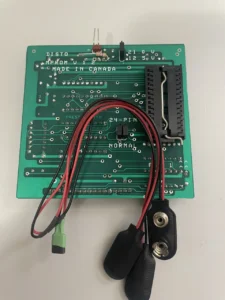
DISTO MPROM V1.2 expansion board. The visible PCB markings identify the board and revision; its precise relationship to each advertised programmer configuration requires additional documentation.
Hard Disk Interface — DISTO HDII
DISTO also offered a hard disk interface designed to expand the Color Computer beyond conventional floppy storage. A contemporary CRC Computers advertisement describes a SASI-compatible hard disk interface that could be installed inside a Super Controller, RAM disk, or compatible MEB adapter. OS-9 drivers were included, and the advertised price was $49.95. Surviving hardware includes a circuit board marked HDII V2.0, manufactured in Canada by DISTO. The photographed board features a 50-pin connector and additional interface circuitry, providing physical evidence of DISTO's hard disk expansion hardware. Although the board marking establishes its model and revision, additional documentation would be useful to confirm the precise relationship between the HDII V2.0 board and the earlier advertised hard disk interface.
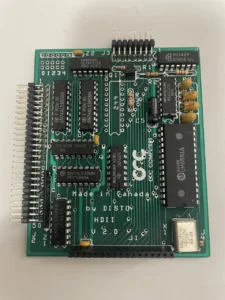
DISTO HDII V2.0 hard disk interface board. Its 50-pin connector and board revision marking are clearly visible.
DISTO Multi-Board
As the DISTO expansion family grew, the company developed boards that combined several peripheral functions into a single assembly. One surviving example is marked MULTI-BOARD DC V2.0. The photographed board includes a battery, multiple integrated circuits, expansion connectors, and additional interface circuitry. Its design illustrates the increasing complexity of DISTO's multifunction hardware. CRC Computers also advertised a 3-in-1 Multi-Board Adapter for $59.95, combining a Centronics-compatible printer interface, an improved real-time clock, and an RS-232 serial interface. The advertisement describes installation inside a compatible DISTO controller, RAM disk, or adapter, with an external 12-volt supply used for the serial interface. The photographed Multi-Board DC V2.0 should not automatically be treated as identical to every advertised 3-in-1 configuration, but it provides a valuable example of the multifunction expansion hardware DISTO manufactured.
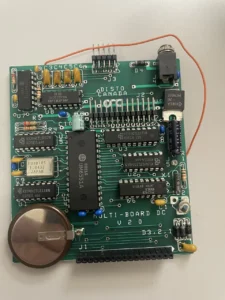
DISTO Multi-Board DC V2.0. The board combines several electronic subsystems and includes battery-backed circuitry.
The DISTO 4-in-1 Expansion Board
Another surviving circuit board is marked DISTO 4-in-1 V2.1. The photographed board contains multiple integrated circuits, a battery, and expansion connectors, demonstrating that DISTO's multifunction hardware continued to develop through additional board revisions. A CRC Computers advertisement also mentions a forthcoming 4-in-1 Super Board, intended to combine several peripheral capabilities in one package. The surviving V2.1 board is evidence of a product bearing the 4-in-1 designation. However, the photographs alone do not establish every supported function or prove that the pictured revision is identical to the configuration originally advertised.
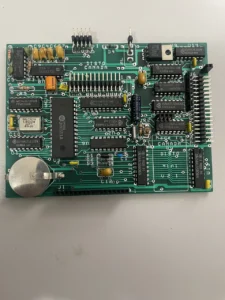
DISTO 4-in-1 V2.1 expansion board. Its PCB markings document another revision of DISTO's multifunction hardware family.
Other DISTO Expansion Products
CRC Computers marketed several additional products alongside its disk controllers. These included:
- MEB Adapter: A standalone Mini-Expansion Bus adapter advertised at $24.95.
- RS-232 SuperPack: A serial interface adapter advertised at $49.95, designed for use with a Multi-Pak Interface.
- Super RAM products: Memory expansion hardware, including products associated with upgrading the Color Computer 3 to 512 KB.
- Clock/calendar boards: Battery-backed timekeeping accessories for compatible DISTO expansion systems.
The variety of these products illustrates how the Super Controller evolved from a replacement floppy disk controller into the foundation of a much broader peripheral system.
Contemporary Review — The Rainbow, March 1989
In March 1989, The Rainbow magazine published an article titled “Disto Assortment — A Smorgasbord of Products,” examining several hardware accessories manufactured by CRC Computers under its DISTO brand. The reviewer discussed both the original Super Controller and the Super Controller II, noting the differences between their designs. Particular attention was given to the Super Controller II's buffered read/write circuitry, which allowed the Color Computer's processor to continue executing instructions during disk operations. The reviewer considered this capability especially beneficial for OS-9, where smoother disk access could improve multitasking performance. The article also documented contemporary pricing, listing the original Super Controller at $99.95 and the Super Controller II at $130. The reviewer characterized the Super Controller II as the better choice for demanding OS-9 users, providing independent contemporary support for one of DISTO's principal advertised advantages.
Comparing the Two Controllers
Feature |
Super Controller |
Super Controller II |
|---|---|---|
| ROM sockets | Four 28-pin sockets | One 24/28-pin socket in documented configuration |
| Software-selectable ROMs | Yes | Not the original four-ROM arrangement |
| Mini-Expansion Bus | Supported | Supported |
| Conventional Disk BASIC compatibility | Yes | Yes |
| CoCo 1 and 2 support | Yes | Yes |
| CoCo 3 support | Dependent on ROM/software configuration | Explicitly supported |
| Buffered sector transfers | No | Yes |
| NO-HALT operation under OS-9 | No | Yes, with appropriate drivers |
| Primary advantage | ROM flexibility and expansion | Improved OS-9 multitasking |
The two controllers shared the goal of improving upon Radio Shack's original disk hardware, but their principal advantages were different. The original Super Controller concentrated on ROM flexibility and expansion capabilities. The Super Controller II retained compatibility while introducing buffered disk operation better suited to OS-9.
More Than a Disk Controller
The DISTO Super Controller family demonstrated two different approaches to improving the Color Computer's floppy disk subsystem. The original Super Controller emphasized flexibility. Its four ROM sockets and internal expansion bus allowed users to configure a disk controller for several operating environments while adding hardware that would otherwise require additional cartridge connections. The Super Controller II placed greater emphasis on processor efficiency. By buffering disk transfers and using interrupt-driven software, it addressed a fundamental limitation of conventional Color Computer floppy disk operation under OS-9. Neither controller required users to abandon their existing floppy disk drives or familiar Disk BASIC software. Instead, DISTO built additional capabilities around the established Color Computer architecture. The company's expansion boards further demonstrated the possibilities of this approach. By supporting clocks, printer ports, serial interfaces, EPROM programmers, hard disk interfaces, and memory accessories, DISTO developed an interconnected family of hardware products. These designs reflected an increasingly sophisticated third-party hardware market, one in which manufacturers were no longer content merely to reproduce Radio Shack accessories.
Historical Significance
The DISTO Super Controller and Super Controller II represent an important stage in the evolution of the TRS-80 Color Computer. The original controller offered a level of ROM flexibility and peripheral expandability rarely found in ordinary floppy disk controllers. The Super Controller II went further, addressing the relationship between disk hardware and multitasking software. For OS-9 users in particular, the ability to continue working while floppy disk operations were underway represented a meaningful improvement in how the computer behaved. Both controllers illustrate the ingenuity of the independent hardware developers who continued expanding the CoCo platform long after its original specifications had been established. The surviving hardware, original advertisements, software disks, and documentation provide a valuable record of this development. They show that DISTO was not simply manufacturing replacement disk controllers, but creating a family of expansion products intended to make the Color Computer more versatile. What began as a replacement disk controller ultimately became part of a much larger range of DISTO hardware, helping extend the practical usefulness of the Color Computer well beyond its original capabilities.