
EXPANDING THE COLOR COMPUTER
THE COMPUTER THAT REFUSED TO STAY STOCK
ANOTHER ONE RIDES THE BUSS

From it's inception as the AgVision or VideoTex terminal, the device that eventually because the TRS-80 Color Computer had untold possibilities waiting for it. With its 40 pin expansion port, that allowed RS-232, storage devices, additional memory and MUCH more. The 'much more' part is included in this category.
The items in this category really only have one purpose - to increase the number, and types, of devices that can be connected to your CoCo at any one time. The increased number can be from two to twenty five devices; while the TYPES are virtually limitless.
The Color Computer could reach far beyond the keyboard and screen. Through its expansion and I/O ports, the CoCo could connect to sensors, switches, relays, controllers, and other electronics, making it useful for experimentation, automation, robotics, and data acquisition.
With the right hardware and a little programming, the CoCo could not only process information—it could sense and control the real world around it.
ENDLESS (ALMOST) EXPANSION POSSIBILITES
A MORE FLEXIBLE BUSS
Not long after the CoCo was released, it became apparent that the cartridge slot on the right side of our favorite 8-bitter opened the CoCo up to the world. Yes, only one slot was limiting. However, it didn't take long before enterprising people decided to create methods to increase the slot from one to... many.
Those devices that were just or mostly slot count increasers are listed as 'Multi-cart Expansion.
Then there are devices that may or may not increase the number of slots, but they DID increase the functionality of the CoCo in some fashion.
Multi-cart Expansion
- Radio Shack MPI
- Companion BT-1000
- Companion BT-2000
- General Automation CX-P1
- PBJ C-C Bus
- Orion Tech. X-Port
- Computize Y Box
- Spectrum Switcher
- Slotpak II & III
- Maple Leaf Systems Multiport
- J-NOR USER80C
- Ed Snider Mini MPI
System Function Enhancements
- FHL Solution II
- Magnum CMJ-IF
- Color Systems Colormate
- Color Power II
- Wayne Tech. CoCo Coupler
- MAXSYS Colorburst
- Ed Snider MEGA Mini MPI
The Radio Shack/Tandy
Multipack Interface
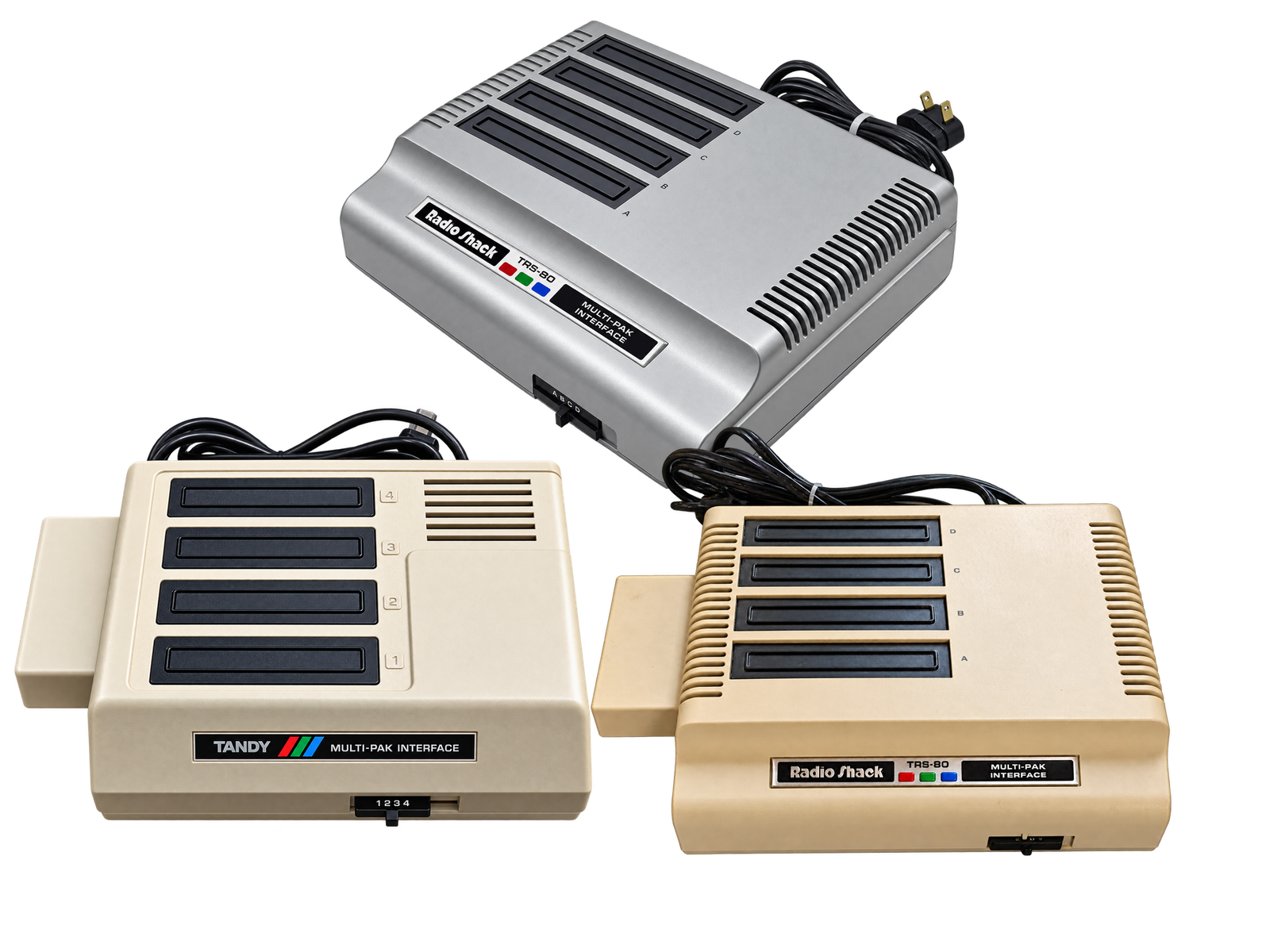
Radio Shack/Tandy MPI
While the most common and well known, the Radio Shack/Tandy entrant into this category was not actually the first. The venerable MPI, as it is most commonly known, was introduced in 1983, but made it's first Radio Shack Computer catalog appearance in the 1984 RSC10 catalog. Over the years, there were several versions:
26-3042 - original design, in grey and white (not fully CoCo 3 compatible)
26-3124 - design to match the appearance of the CoCo 2; a number of IC's were combined to reduce component count (not fully CoCo 3 compatible)
26-3124A - similar in design to the non - 'A' version, brought as fully compatible with the CoCo 3
The 3024 & 3124 required a minor change in order to make them fully safe to use on a CoCo 3 under OS-9/NitrOS-9. This process is fairly well documented on the internet.
For both the CoCo 2 and CoCo 3, due to their redesign and lack of a 12vdc circuit, use of an MPI is needed to use any cart devices that needed 12vdc, such as an X-Pad.
The original, grey 26-3024 MPI was revied in Rainbow Magazine, by Paul S. Hoffman in the September 1983 issue.
The Solution II
Frank Hogg Laboratory
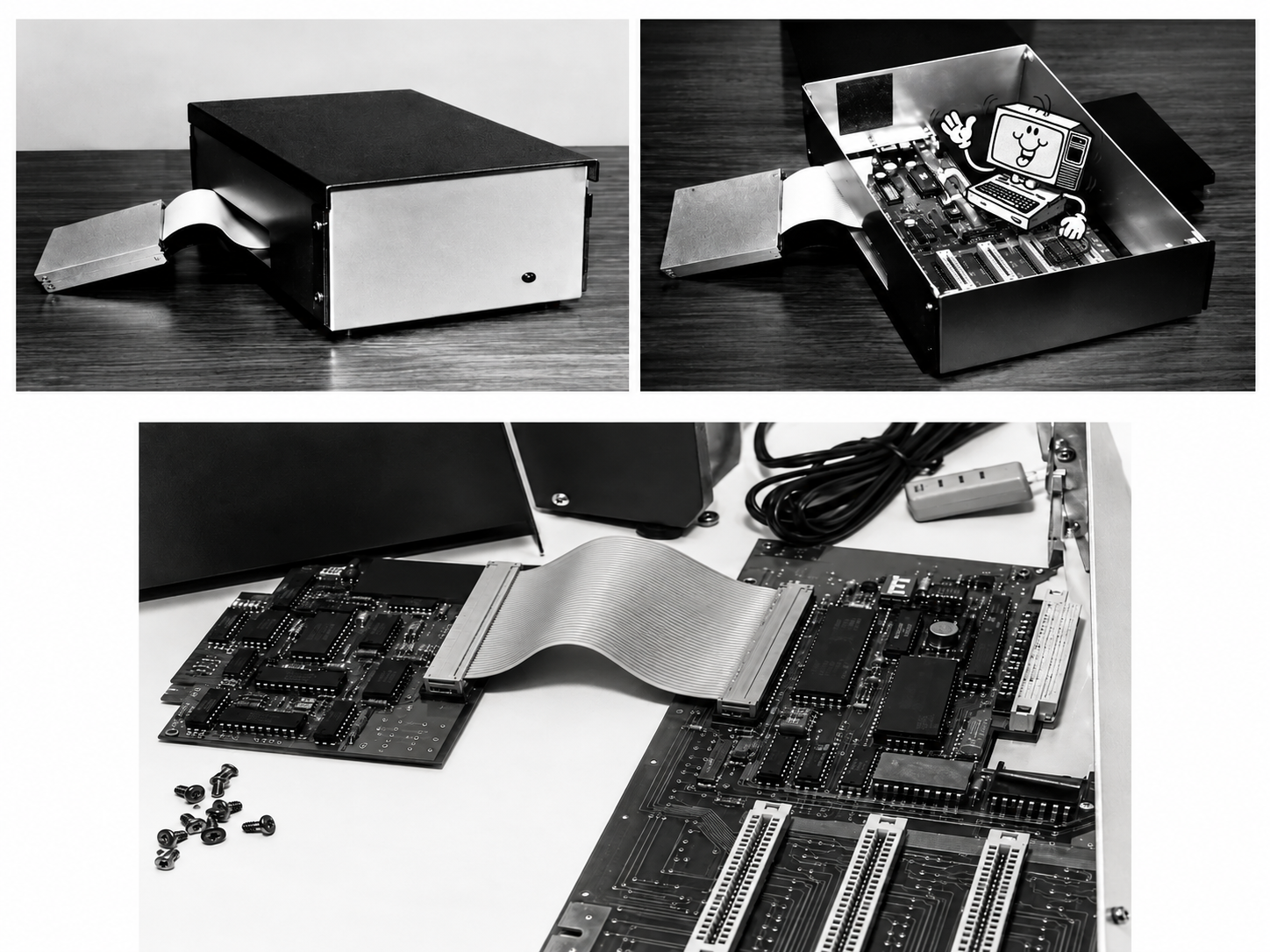
The Solution II
The Solution II was a five-slot expansion system developed by Frank Hogg Laboratory for the TRS-80 Color Computer. More sophisticated than a simple cartridge expander, it included its own 4K monitor ROM and provided support for 64K operation without requiring modifications to the CoCo itself.
FHL designed the system with serious development and business use in mind. The Solution II could also directly support FHL's Color FLEX and OS-9 environments.
Period notice: FHL was advertising The Solution II by late 1982 as a five-slot expansion and development system for the Color Computer, with availability following shortly afterward.
Expansion cards
FHL announced a fairly substantial ecosystem of Solution II cards:
- Dual-port RS-232 serial interface, using ACIAs
- Dual-port parallel interface, using PIAs
- Parallel printer interface, including cable
- Prototype/development card
- EPROM programmer, supporting 2K, 4K and 8K EPROMs
- Time-of-day clock with battery backup
Basic Technology
BT-1000 Companion
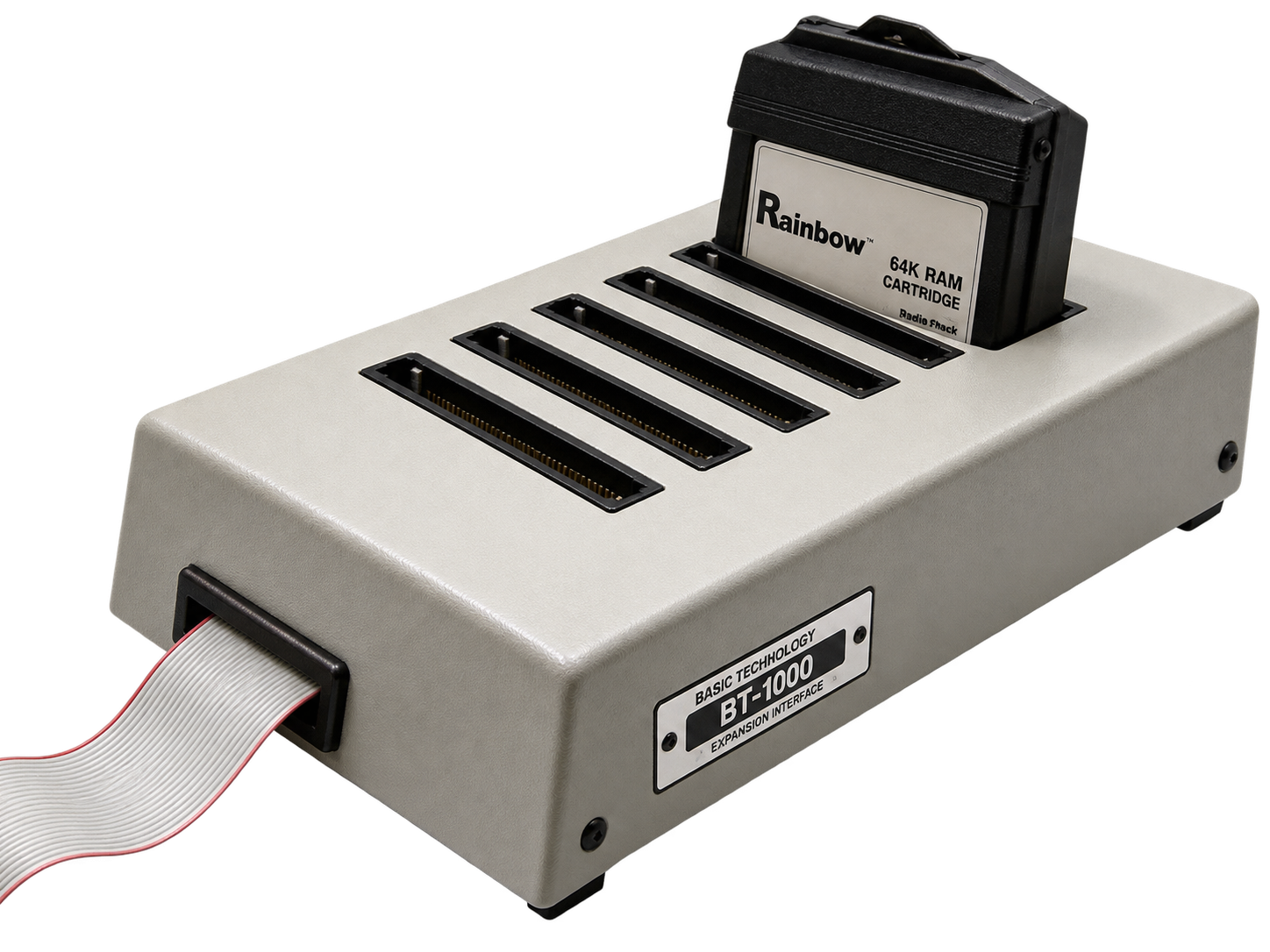
Basic Technology BT-1000 Companion
The BT-1000 was a five-slot expansion interface developed by Basic Technology for the TRS-80 Color Computer. Designed for users who needed considerably more than a simple cartridge expander, it allowed disk controllers, memory boards, printer interfaces, real-time clocks and other peripherals to be connected simultaneously.
The unit incorporated its own power supply and buffered the CoCo's address and data lines, reducing the electrical load placed on the computer itself. Four internal 24-pin sockets could accommodate up to 8K of static RAM or EPROM, while switch-selectable addressing allowed memory and ROM devices to coexist with other hardware. Basic Technology also reserved 256 bytes of I/O space for expansion devices.
The BT-1000 connected directly to the Color Computer's cartridge port through a buffered cable and required no modification to the computer. Basic Technology sold the interface for $270, or $300 equipped with 8K of SRAM.
Period review: Dr. Laurence D. Preble reviewed the BT-1000 in The Rainbow, January 1983, p. 198, in “Two Interfaces Expand CoCo's Powers.” The review noted the unit's substantial construction and expansion capabilities, while cautioning that its documentation was primarily intended for technically experienced users.
Basic Technology
BT-2000 Companion
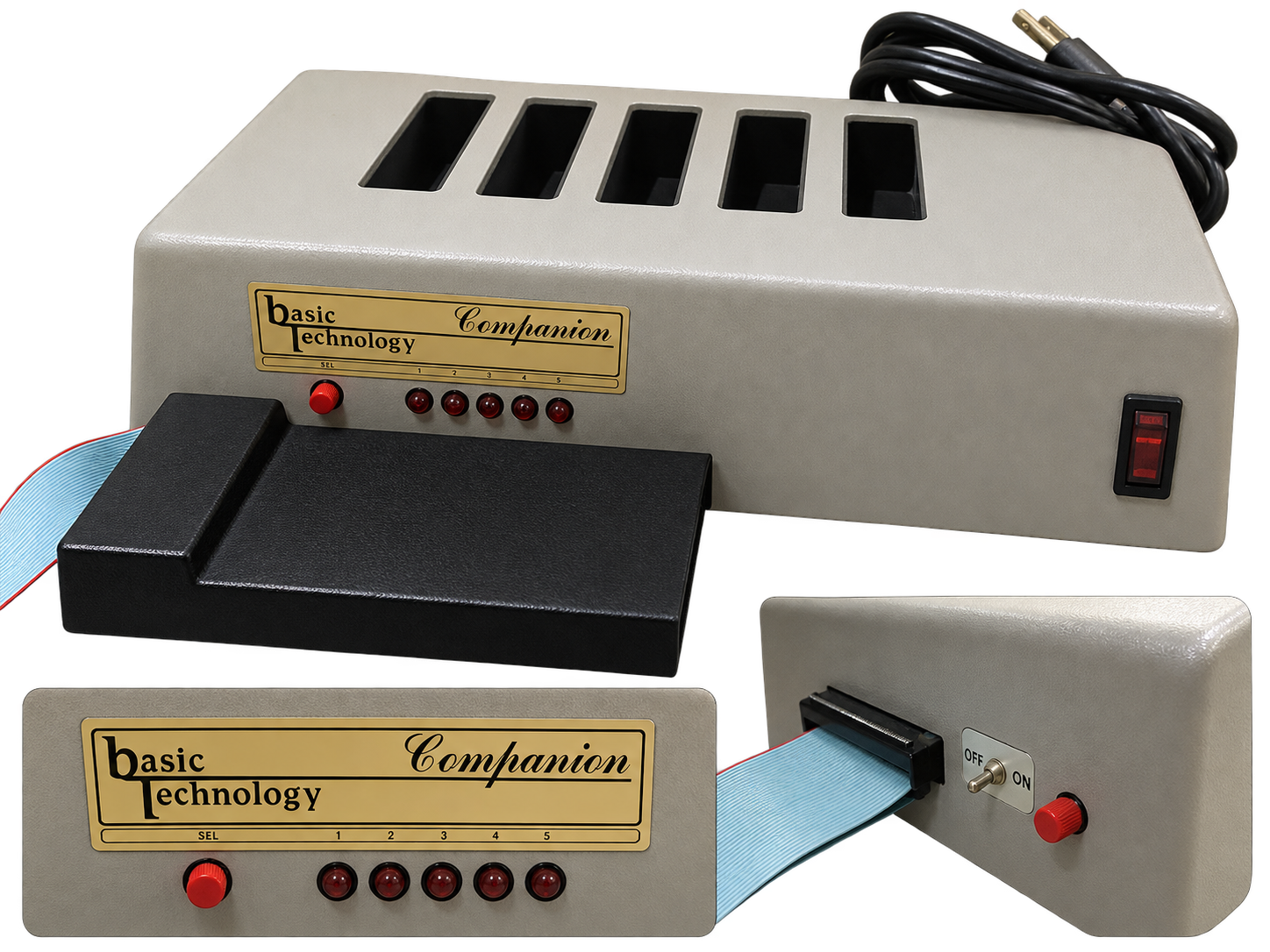
Basic Technology BT-2000 Companion
The BT-2000 Companion was a five-slot expansion interface produced by Basic Technology for the TRS-80 Color Computer. While the company's BT-1000 was promoted primarily toward advanced users and experimenters, the BT-2000 was designed as a convenient everyday peripheral for CoCo owners who wanted to leave several cartridges connected simultaneously.
The Companion could hold up to five cartridges, with push-button selection determining which cartridge was active. Front-panel indicator lights showed the currently selected slot. A separate RESTART function allowed the CoCo to be restarted without switching its power off and back on.
The BT-2000 used its own power supply and connected to the Color Computer through a ribbon cable and cartridge-port adapter. Contemporary advertising specifically mentioned use with ROM Paks, disk controllers, serial and parallel interfaces and other CoCo peripherals.
Period notice: Basic Technology was advertising the unit as the “BT-2000 Companion” by September 1983, describing it as “A Perfect Companion for CoCo.” The advertised price was $249.95. At the same time, the company continued offering the more elaborate BT-1000 for $270, or $300 with 8K RAM.
Images provided for use by Brian Wieseler
Magum Distributing
CMJ (Chuck, Mike & Jerry)-IF

Magnum Distributing CMJ-IF
Introduced in 1983 by Magnum Distributors, the CMJ-IF was a multifunction plug-in interface designed for the TRS-80 Color Computer and TDP-100. Rather than performing a single task, it provided a collection of hardware resources that could support a variety of peripherals and specialized projects.
Plugging into the cartridge port, the CMJ-IF provided two parallel ports, one serial communications port, two counter/timers, 4K or 8K of EPROM/ROM space, optional speech synthesis, and an extender connection. The extender allowed another Program Pak or disk controller to remain connected without removing the CMJ-IF. Magnum initially advertised the unit for about $199.
One of the more sophisticated applications was Magnum's own CMJ-TU Terminal Unit, which connected to the CMJ-IF and was used for amateur-radio applications including CW, RTTY, SSTV and FAX. A March 1984 Worldradio article documents the CMJ-IF/TU combination in actual use, demonstrating just how far the general-purpose interface could be taken.
The CMJ-IF therefore wasn't simply a speech cartridge, communications interface or port expander. It was a small general-purpose expansion platform, providing hardware that could be put to work in several very different ways.
The original BLUEPRINT can be found HERE.
General Automation
CX-P1
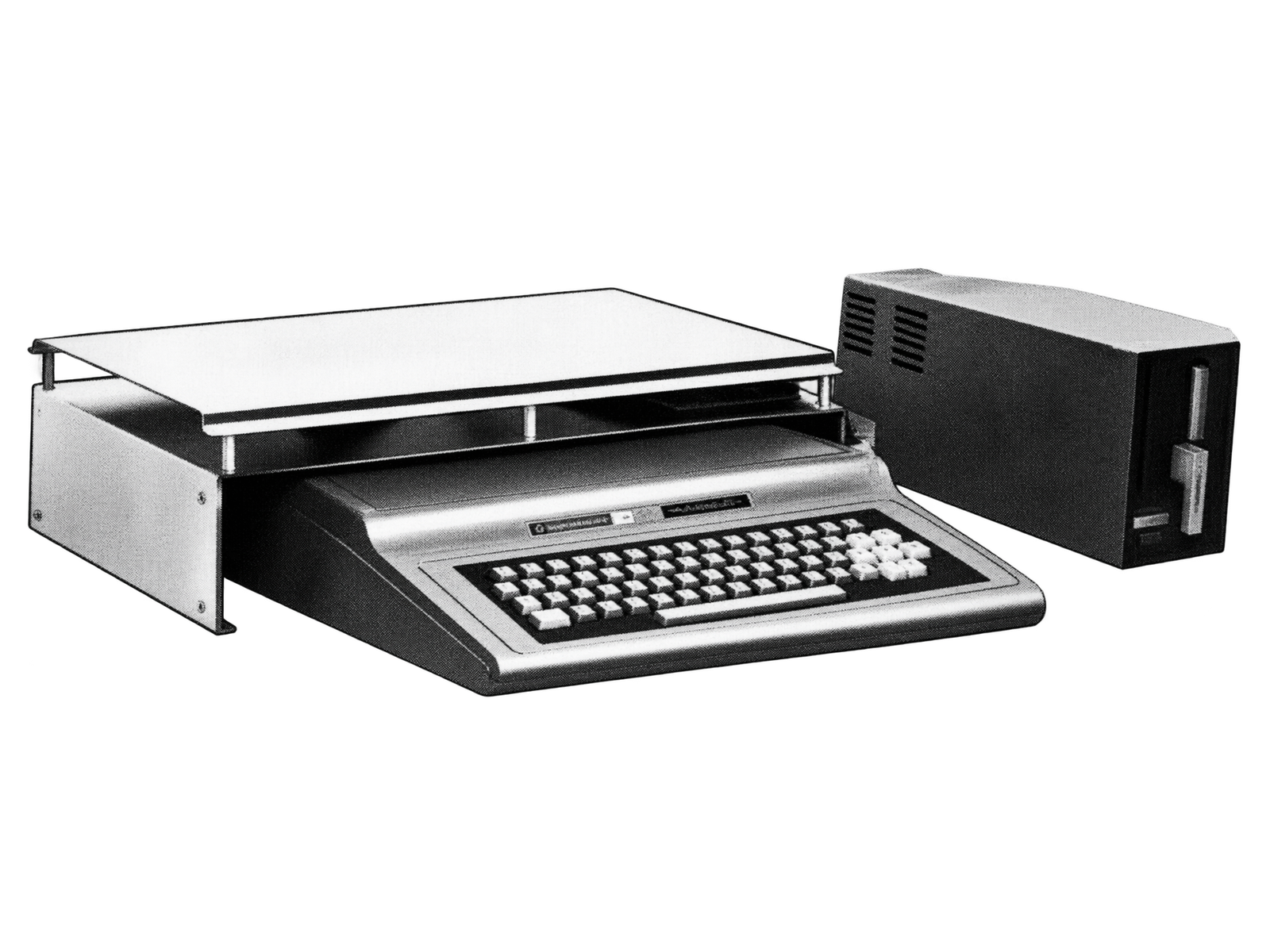
General Automation CX-P1 Expanstion Interface
The CX-P1 Expansion Interface, produced by General Automation for the TRS-80 Color Computer, was an ambitious attempt to transform the CoCo into a much more expandable peripheral and development platform. General Automation went so far as to advertise the system as giving Color Computer owners “power rivalling the Apple-II.”
Rather than simply providing additional cartridge slots, the CX-P1 created an expandable I/O system while adding several useful capabilities of its own.
The interface connected to the Color Computer through the CX-2401A extension ribbon cable and required no modification to the computer. The existing 24K BASIC ROM, cassette interface, serial port and joystick ports remained available while the expansion system was connected.
Internally, the CX-2001A Expander Card provided I/O expansion capability for as many as seven additional peripheral cards, making the CX-P1 considerably more than a cartridge multiplexer. General Automation intended it to serve as the foundation for an entire family of specialized Color Computer expansion hardware.
The system was also advertised as compatible with the Radio Shack Disk System.
Memory Expansion and Built-In I/O
One of the CX-P1's more unusual features was its 64K memory-access circuitry. General Automation specifically promoted this as allowing a 32K Revision-E Color Computer to double its available RAM, providing access to memory beyond the CoCo's normal 32K configuration.
The CX-P1 also provided a Centronics-compatible parallel I/O port, giving the Color Computer a convenient interface for parallel printers and other peripherals while leaving its serial interface available for a modem or other RS-232 equipment.
This combination of memory access, built-in parallel I/O and a seven-card expansion bus made the CX-P1 much closer to a general-purpose computer expansion chassis than the more familiar CoCo Multi-Pak-style cartridge expanders.
The CX-3001A Chassis
General Automation offered an aluminum chassis designed specifically for the system. The Color Computer could be positioned beneath the enclosure while a television or monitor was placed on top, producing a more integrated desktop arrangement.
The CX-3001A chassis housed and supported the interface electronics but was also advertised as suitable for stand-alone use.
The resulting arrangement was an interesting attempt to turn the otherwise self-contained Color Computer into something resembling a modular desktop computer system.
Expansion Cards and Options
General Automation planned a substantial collection of plug-in peripheral cards for the CX-P1.
Contemporary advertising specifically identifies the CX-2010A Quad Parallel I/O Port, based on two Motorola 6821 PIAs, and the CX-2016A Speech Synthesizer, which used the Votrax phoneme system.
The company also announced plans for additional specialized hardware including a 12-bit analog-to-digital converter and a television digitizer, along with other I/O cards.
This planned selection of hardware illustrates the larger idea behind the CX-P1: General Automation wasn't simply providing additional connectors but attempting to establish an expandable peripheral architecture around the Color Computer.
Pricing
The CX-P1 was available either as individual components or as a complete package.
Contemporary pricing located for the system includes the CX-2001A Expander Card at $139.95, the CX-2401A extension ribbon cable at $29.95, and the CX-3001A aluminum chassis at $49.95.
General Automation also offered the components together as the CX-P1 introductory package.
Interestingly, surviving contemporary material shows at least two prices associated with that package. One announcement advertises the CX-P1 at $189.95, while other material lists it at $199.95, suggesting that the introductory or advertised price changed during the product's marketing period.
The CX-2010A Quad Parallel I/O Port was advertised at $99.95, while the CX-2016A Speech Synthesizer was offered for $129.95.
Period Review
Dr. Laurence D. Preble reviewed the CX-P1 alongside Basic Technology's BT-1000 in the January 1983 issue of The Rainbow in “Two Interfaces Expand CoCo's Powers.”
Preble characterized the CX-P1 as the simpler of the two approaches and noted its useful peripheral-card expansion, parallel printer capability and available I/O cards, although he found the supplied documentation relatively brief.
An Attempt at a CoCo Expansion Bus
What makes the CX-P1 particularly interesting today is that General Automation approached Color Computer expansion from a different direction than Radio Shack.
Instead of merely allowing several Program Paks to be connected simultaneously, the CX-P1 attempted to provide the CoCo with something approaching a general-purpose expansion bus. Memory expansion, Centronics-compatible parallel I/O, seven peripheral-card positions and proposed hardware such as speech synthesis, analog-to-digital conversion and video digitizing could all become part of the same system.
General Automation's claim that the CX-P1 could give the Color Computer “power rivalling the Apple-II” was certainly advertising language, but it accurately reflects the company's ambition for the product.
The CX-P1 wasn't intended simply to give the CoCo more slots.
It was intended to give the CoCo an expansion architecture.
PBJ
C-C Bus
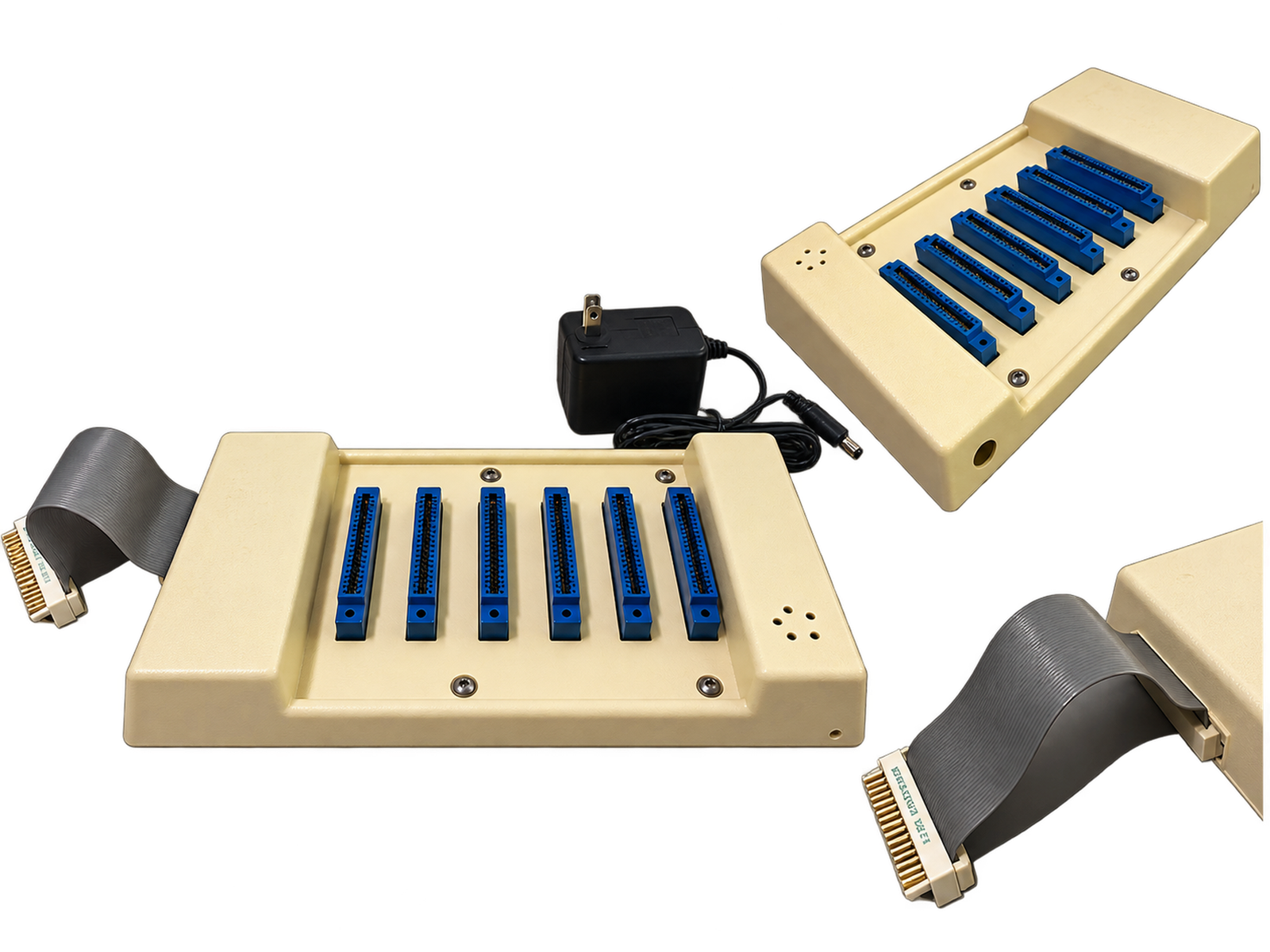
PBJ C-C Bus
The C-C BUS, manufactured by PBJ, Inc. for the TRS-80 Color Computer, was a sophisticated six-slot expansion bus designed to accommodate standard cartridges as well as dedicated accessory boards. Unlike a simple passive cartridge expander, each of its six slots was software selectable, allowing programs to turn individual slots on or off without requiring the user to physically switch cartridges.
The six slots were numbered 2 through 7, with slot 7 located nearest the ribbon-cable connection. Software selected a slot by writing its number to the C-C BUS latch at $FF7C. This gave programs direct control over which cartridge was connected to the CoCo's bus and made automated switching between peripherals possible.
PBJ fully buffered the signals entering the expansion bus. The buffers normally isolated the C-C BUS — and the cartridges installed in it — from the computer until the CPU actually needed to access the bus. PBJ also incorporated shielding intended to reduce RF interference caused by bringing the CoCo's signals outside its shielded case.
More Than a Cartridge Expander
PBJ designed the C-C BUS so that access to a cartridge which might conflict with internal RAM was prevented while the computer was operating in 64K mode. Once the machine returned to 32K operation, normal cartridge access resumed. Slot-independent devices could remain accessible regardless of which cartridge slot was selected.
Accessory boards could occupy the CoCo's $FF80–$FFFF high-memory I/O area, allowing them to operate independently of normal cartridge selection. The manual's memory map shows the conventional cartridge latch area at $C000–$FEFF, internal PIAs at $FF00–$FF3F, disk controller at $FF40–$FF5F, and the accessory I/O area beginning at $FF60.
Memory Expansion
Perhaps the most unusual capability of the C-C BUS was its provision for expanding the CoCo's memory beyond 64K.
Each slot could optionally contain as much as 16K of RAM. That memory could be used either as data storage or as program storage through bank switching. When used for programs, the computer had to be operating in its 32K mode with the appropriate C-C BUS slot selected.
The manual does include an interesting warning concerning this capability. Although the bus protection circuitry prevented address conflicts in 64K mode, it did not necessarily prevent writes to RAM installed on an expansion board. PBJ therefore recommended deselecting a slot containing RAM before entering 64K mode if its contents needed to be protected.
Disk Controller Support
PBJ clearly expected disk controllers to be one of the C-C BUS's principal applications.
At power-up, slot 7 was automatically selected, allowing a disk controller installed there to execute automatically. The disk controller wasn't required to occupy slot 7, however; it could be installed in any of the six positions and selected through software.
The manual even explains how to switch between Disk BASIC and other cartridges. Because selecting another slot while Disk BASIC was operating could remove the disk controller from the system and crash the computer, PBJ documented procedures for safely returning to Extended BASIC before changing slots.
Interestingly, PBJ recommended that the C-C BUS's cartridge auto-start feature normally be disabled because it could interfere with the disk controller and make returning to BASIC after running cartridge software more difficult.
PBJ Peripheral Family
PBJ envisioned the C-C BUS as the foundation for a larger peripheral system rather than merely a place to plug in ROM Paks.
The manual's I/O map identifies several PBJ peripherals:
Address |
Device |
|---|---|
$FF60–$FF63 |
Radio Shack Digitizer |
$FF7C–$FF7F |
C-C BUS slot-select latch |
$FF90–$FF93 |
PBJ Parallel Printer Port — P-C PAK |
$FF94–$FF97 |
PBJ Real-Time Clock — P-C PAK |
$FF98–$FF9F |
PBJ WORD-PAK CRT Controller |
Its Own Power Supply
The C-C BUS incorporated its own regulated 5-volt, 1-amp power supply for cartridges and accessories, with provision on the circuit board for an optional +12V supply.
PBJ also provided the ability for a bare-board C-C BUS to draw power from the Color Computer itself, but the manual warned that this substantially restricted how many peripherals could be operated. Depending upon cartridge power consumption, PBJ estimated that the CoCo's supply would generally be sufficient for only two or three cartridges at minimum.
A flexible ribbon cable connected the expansion bus to the computer, allowing the chassis to be positioned separately. PBJ normally supplied a six-inch cable and warned that longer cables could increase RF interference and eventually cause signal-loss problems. For longer installations, the company recommended shielding the ribbon cable with a grounded metal-mesh sleeve.
A Serious CoCo Expansion System
Period advertising described the C-C BUS as a “fully buffered, six slot expansion bus for your CoCo” and emphasized software-selectable slots, high-memory accessory boards and compatibility with both older and newer Color Computers. The advertised price was $125.00.
The surviving December 1983 Rev. C user's manual provides considerably more detail than the advertisements. In addition to operating instructions, it contains a complete board layout and circuit schematic, making the C-C BUS unusually well documented compared with many third-party CoCo expansion products from the period.
The C-C BUS therefore deserves to be considered more than simply another alternative to Radio Shack's Multi-Pak Interface. Its software-controlled cartridge selection, isolated accessory I/O space, memory banking, independent power supply and planned family of peripheral boards made it an attempt to provide the Color Computer with a genuine expandable peripheral bus.
Image supplied by Brian Wieseler
Orion Technologies
XPort
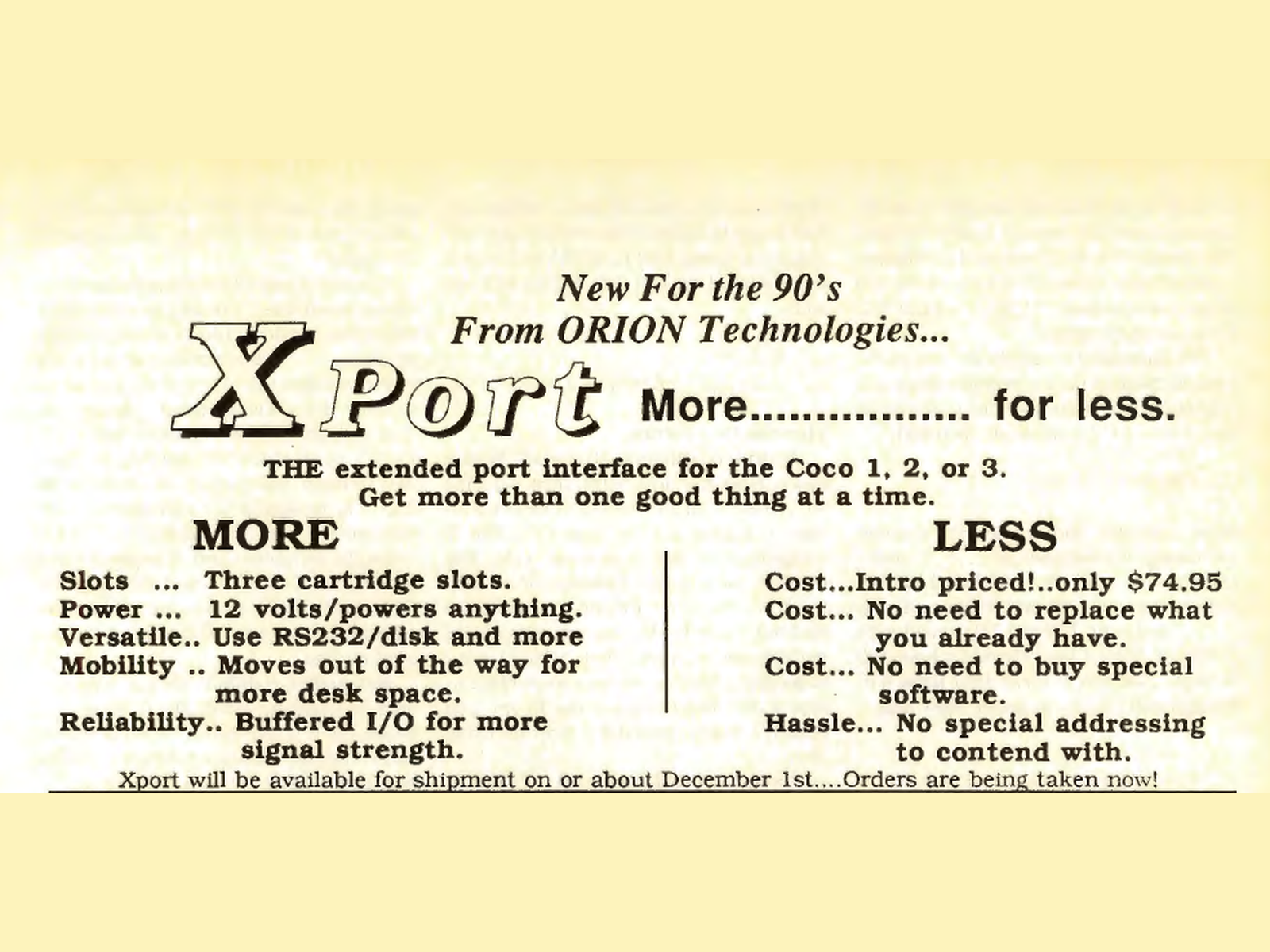
Orion Technologies X-Port
The XPort, introduced by Orion Technologies in late 1989, was a compact three-slot expansion interface for the TRS-80 Color Computer 1, 2 and 3. Intended as a lower-cost alternative to the Radio Shack Multi-Pak Interface, it allowed several cartridge-based peripherals to remain connected to the CoCo simultaneously.
The XPort provided three cartridge slots, connected to the computer through a short ribbon cable and interface box. Orion advertised buffered I/O for improved signal strength and a separate power supply providing 12 volts to the expansion slots, reducing the electrical load placed on the computer itself.
Unlike some expansion systems requiring special addressing arrangements, Orion promoted the XPort as requiring no special software or addressing. Its advertising specifically suggested using an RS-232 interface, disk controller and another cartridge simultaneously.
The XPort was announced in the December 1989 issue of The Rainbow, with Orion expecting shipments to begin around December 1. Its introductory price was $74.95, making it considerably less expensive than a Radio Shack Multi-Pak Interface.
A contemporary retrospective in Tandy's Little Wonder described the XPort as a direct Multi-Pak replacement with three slots and confirmed its ribbon-cable arrangement and separate 12-volt power supply.
Historical note: No photograph of an actual XPort is presently known to survive. The contemporary Orion Technologies advertisement shown here is therefore one of the few surviving visual records of the product.
Computize
Y Box
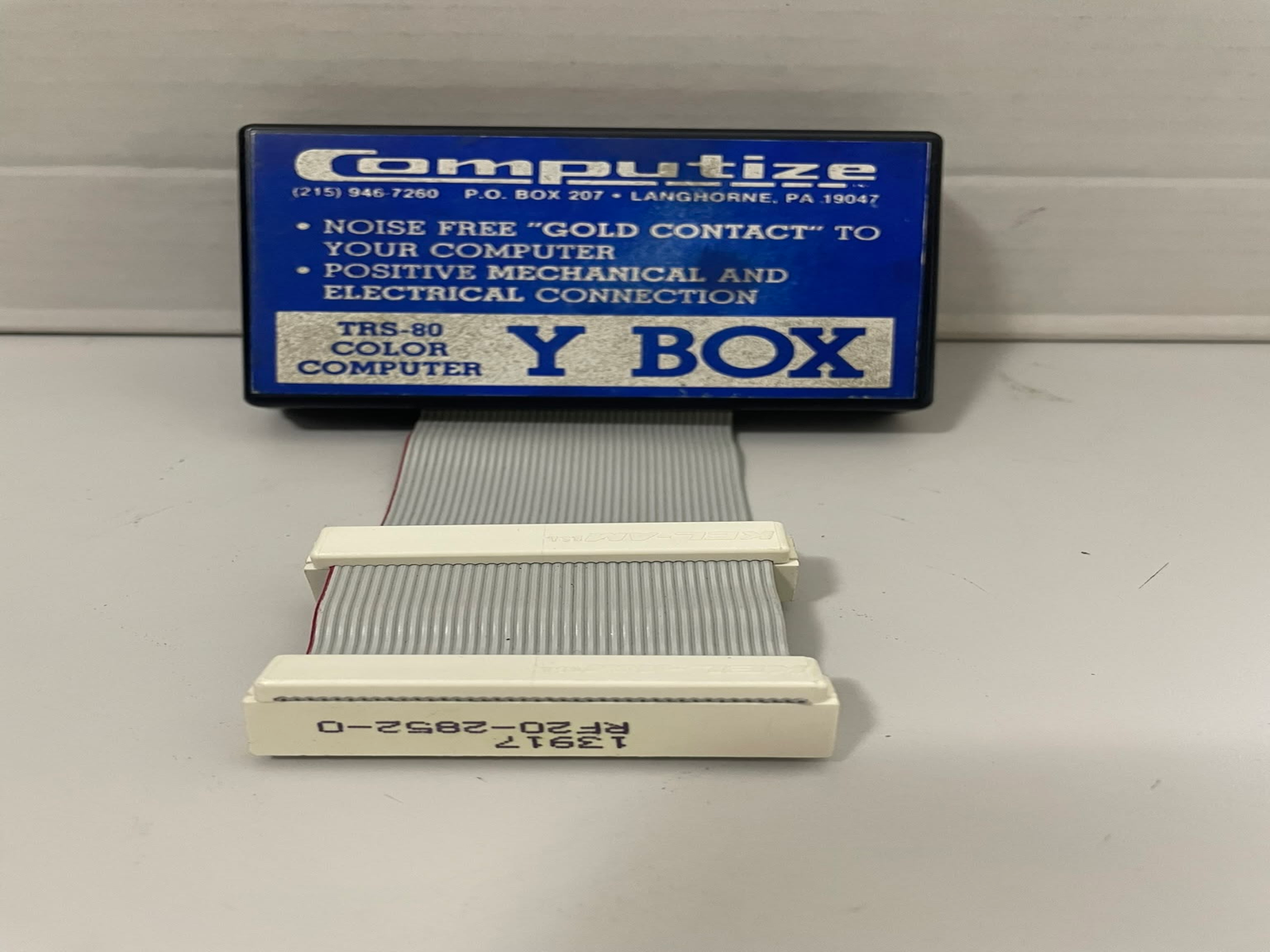
Computize Y-Box
The Y BOX, produced by Computize of Langhorne, Pennsylvania, was a simple but useful accessory for the TRS-80 Color Computer’s expansion port. Unlike multi-slot interfaces such as the Radio Shack Multi-Pak or Basic Technology Companion, the Y BOX did not provide multiple cartridge slots. Instead, it addressed a common reliability problem associated with extension or “Y” cables.
Computize advertised the Y BOX as providing a noise-free “gold contact” connection and a positive mechanical and electrical connection between the Color Computer and an expansion cable. The company specifically warned that ordinary Y cables could become loose or partially disconnected, potentially causing the computer to crash or even short the CoCo’s expansion bus.
The device consisted of a small enclosed interface connected to a ribbon cable terminating in an edge connector. Its purpose was therefore less about expanding the number of peripherals and more about providing a secure, dependable extension of the CoCo cartridge port, useful when relocating or connecting expansion hardware away from the computer itself.
Period notice: Computize advertised the Y BOX as Catalog No. 162CH for $29.95, emphasizing its gold-contact connector and improved mechanical connection as protection against the problems associated with loose expansion cables.
Images provided for use by Brian Wieseler
ColorMate
Computer Systems Distributors
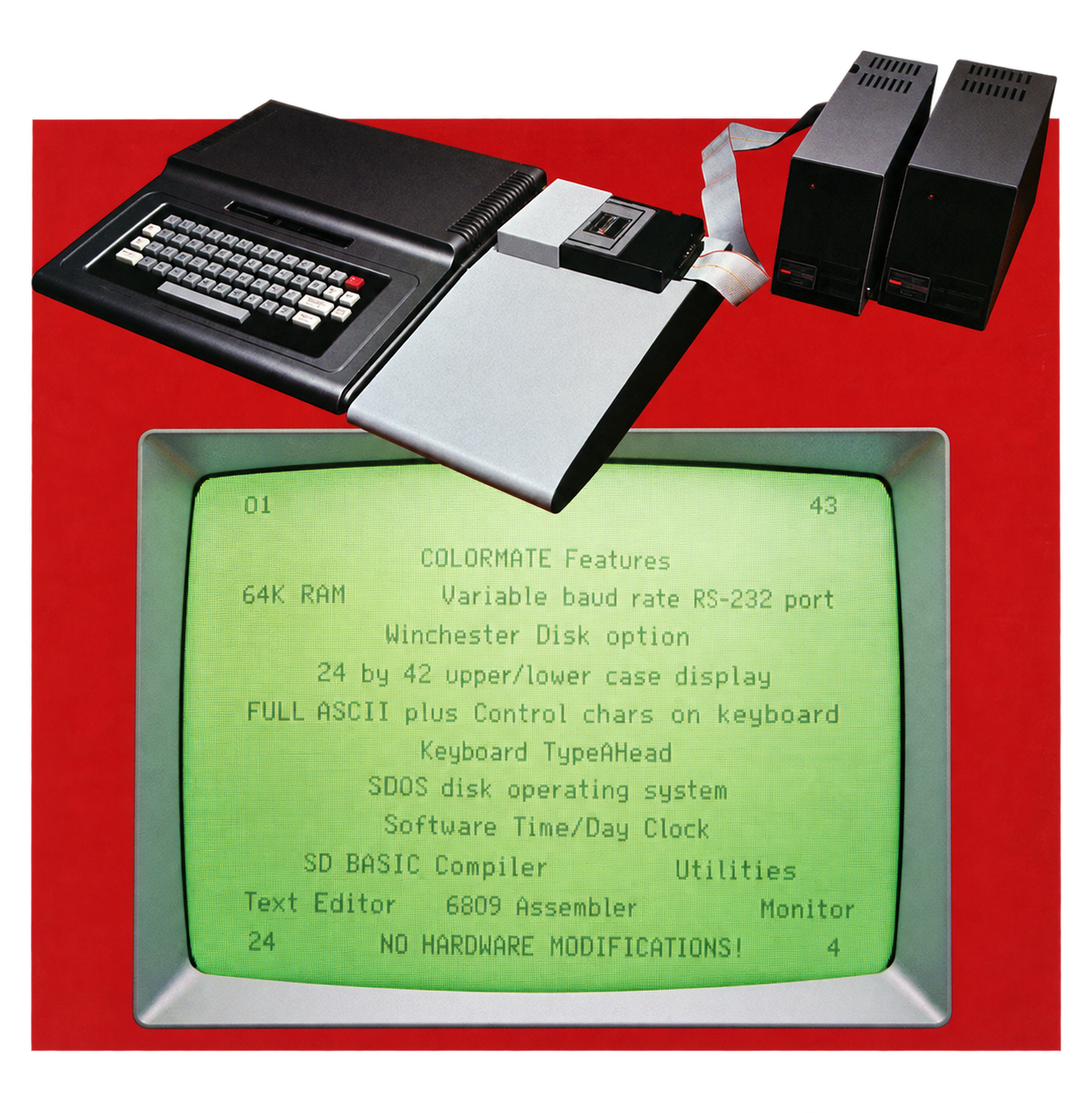
ColorMate
While the Color Computer was best known for games, educational software, and home programming, products such as the ColorMate demonstrated that third-party developers saw considerably greater potential in Motorola's 6809-based machine.
Bringing More Capabilities to the CoCo
The ColorMate was designed to work with a disk-equipped Color Computer containing as little as 16K of RAM. Its principal attraction was support for SDOS, an alternative disk operating system intended to provide capabilities beyond those of Radio Shack's standard Disk Extended Color BASIC environment.
Perhaps its most ambitious advertised feature was support for an optional Winchester hard disk. At a time when most Color Computer owners relied on cassette tapes or floppy disks, hard-disk storage represented a substantial step toward the capabilities associated with more expensive business computers.
An Expensive Proposition
With an advertised price of $495 in late 1983, the ColorMate was hardly an impulse purchase. Its cost reflected a market of enthusiasts and serious users willing to invest substantially in expanding the capabilities of their Color Computers.
The ColorMate is an interesting example of the early third-party CoCo expansion market, when independent manufacturers were exploring ways to push the machine well beyond its original consumer-oriented role.
Technical Specifications
Feature |
Details |
|---|---|
| Manufacturer | Alta Systems Inc. |
| Distributor | Computer Systems Distributors, Anaheim, California |
| First documented advertising | September 1983 |
| Advertised price | $495 |
| Host computer | TRS-80 Color Computer, 16K minimum, with floppy drive |
| Memory | 64K RAM |
| Operating system | Software Dynamics SDOS |
| Display | 42 columns × 24 rows, upper/lowercase |
| Serial interface | Programmable RS-232, up to 9600 baud |
| Disk support | Up to four Radio Shack floppy drives |
| Hard disk | Optional Winchester drive, 5 MB or larger |
| Development software | BASIC compiler, 6809 assembler, text editor, monitor and utilities |
| Installation | No internal hardware modifications required |
Historical Documentation
The ColorMate appeared in advertisements in the September and October 1983 issues of HOT CoCo. These advertisements establish its manufacturer, original specifications, pricing, and intended market.
CoCo Coupler
Wayne Technology
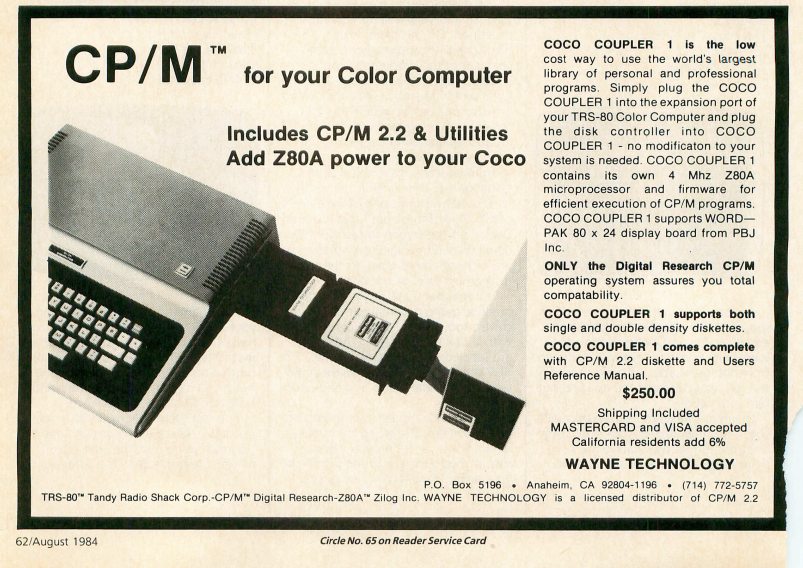
CoCo Coupler - Wayne Technology
Period: Mid-1984 (documentation dated December 1983)
Original Price: $250.00
Compatibility: TRS-80 Color Computer, 64K
Classification: Z80 Coprocessor / Expansion Bus Interface
Bringing CP/M to the Color Computer
By the early 1980s, Digital Research's CP/M operating system had established itself as one of the leading software platforms for business-oriented microcomputers. Thousands of programs were available for CP/M-based systems, including word processors, spreadsheets, database managers, and development utilities. Unfortunately, the TRS-80 Color Computer's Motorola 6809 processor was incompatible with the Z80 and Intel 8080 machine code used by most CP/M applications.
Wayne Technology of Anaheim, California, addressed this limitation with the COCO COUPLER 1, an external processor expansion system that allowed the Color Computer to run Digital Research CP/M 2.2 software.
Rather than replacing the Color Computer's existing hardware, the COCO COUPLER 1 added a second microprocessor through the computer's cartridge expansion bus, effectively allowing an inexpensive home computer to operate as a CP/M-compatible system.
A Second Processor on the Expansion Bus
At the heart of the COCO COUPLER 1 was a 4 MHz Zilog Z80A microprocessor, housed in a metal enclosure that connected directly to the Color Computer's expansion port.
Because the CoCo had only one cartridge connection, Wayne Technology designed the Coupler with a pass-through arrangement. The existing floppy disk controller was removed from the computer and connected to the opposite end of the Coupler, preserving access to the Color Computer's disk drives.
The Z80A provided the processor architecture required by CP/M applications, while the CoCo's existing hardware continued to supply essential system resources.
Installation required no internal modifications to the Color Computer, making the system accessible to owners who wanted CP/M compatibility without replacing their computer or undertaking extensive hardware alterations.
CP/M 2.2 and Disk Compatibility
The COCO COUPLER 1 was supplied with a licensed copy of Digital Research CP/M 2.2, along with Wayne Technology's supporting utilities and a user's reference manual.
The operating system used the Color Computer's floppy disk hardware and supported both single- and double-density disks, as well as 35-, 40-, and 80-track drive configurations.
A configuration utility allowed users to specify drive parameters, while other programs provided file transfers, disk management, and communication functions.
One particularly useful feature was the Phantom drive, which simulated a second drive when only one physical floppy drive was available. This permitted certain disk-copying and file-transfer operations without requiring a second drive, although users still had to exchange disks when prompted.
Wayne Technology also provided software for transferring files between CP/M systems using a serial connection.
Displaying CP/M on the CoCo
Although the COCO COUPLER 1 supplied the Z80 processor and operating system, it did not incorporate a dedicated 80-column video controller.
The Color Computer's standard display was poorly suited to many CP/M applications, which generally expected an 80-column text screen.
Wayne Technology supplied a program called Video80, which attempted to accommodate CP/M's 80-column display requirements using the CoCo's existing graphics capabilities. The software offered windowing and scrolling functions, allowing users to work with text wider than the physical display area.
For users requiring a conventional 80-column screen, the Coupler also supported PBJ's WORD-PAK 80 × 24 display interface.
This made it possible to operate CP/M software with a more traditional business-computer display, although additional hardware was required.
A Contemporary Hands-On Review
The July 1984 issue of Color Computer Magazine, reproduced in the July 4, 1984 edition of Tandy Times, featured an extensive review by Eugene Bruny.
The review examined the Coupler's hardware, CP/M implementation, utilities, and software compatibility in considerable detail.
Bruny found the system capable of running CP/M software but identified several practical limitations. The Video80 display software could be awkward to use, some software expected more conventional terminal behavior, and serial communication required careful configuration.
Disk compatibility also presented challenges. Although the Coupler supported multiple drive configurations, the variety of CP/M disk formats used by other manufacturers could complicate transferring commercial software between systems.
The reviewer nevertheless recognized the Coupler as a practical way to access CP/M's extensive software library without purchasing an entirely separate computer.
An Early Entry in the CoCo Coprocessor Market
The COCO COUPLER 1 was among the more ambitious third-party expansion products developed for the TRS-80 Color Computer.
Rather than simply adding memory, additional cartridge slots, or a display interface, it introduced an entirely different processor architecture through the CoCo's expansion bus.
This approach placed the Coupler in a small but historically interesting category of products that attempted to bridge the gap between inexpensive home computers and the established CP/M business software market.
Wayne Technology's solution also competed with Color Power Unlimited's Color Power II, another Z80-based CP/M expansion system introduced during the same general period. While Color Power II incorporated its own 80-column display hardware, the COCO COUPLER 1 offered a less expensive processor expansion that could use the Color Computer's existing display or an optional 80-column adapter.
Although the COCO COUPLER 1 never became a mainstream Color Computer accessory, it demonstrated how far independent developers were willing to push the machine's original expansion architecture.
For CoCo owners interested in business applications, programming tools, and experimenting with multiple processor architectures, the Coupler offered capabilities well beyond those envisioned for the original home computer.
Technical Specifications
Feature |
Specification |
|---|---|
| Manufacturer | Wayne Technology |
| Model | COCO COUPLER 1 |
| Documented availability | 1984 |
| Original price | $250.00, shipping included |
| Host computer | TRS-80 Color Computer, 64K |
| Additional processor | Zilog Z80A |
| Processor clock | 4 MHz |
| Operating system | Digital Research CP/M 2.2 |
| Interface | CoCo cartridge expansion bus |
| Disk controller | Original CoCo controller via pass-through |
| Disk support | Single/double density; 35-, 40-, and 80-track configurations |
| Standard display | CoCo display using Video80 software |
| Optional display | PBJ WORD-PAK 80 × 24 |
| Included software | CP/M utilities, configuration and transfer programs |
| Installation | No internal computer modifications required |
Historical Sources
- Eugene Bruny, review of the COCO COUPLER 1, Color Computer Magazine, reproduced in Tandy Times, July 4, 1984, pages 37–40.
- Wayne Technology, COCO COUPLER 1 advertisement, The Rainbow, August 1984, page 62.
- Wayne Technology, COCO COUPLER 1 user's manual, version 1.0, dated December 1983, as identified in the contemporary review.
Color Power II
Color Power Unlimited
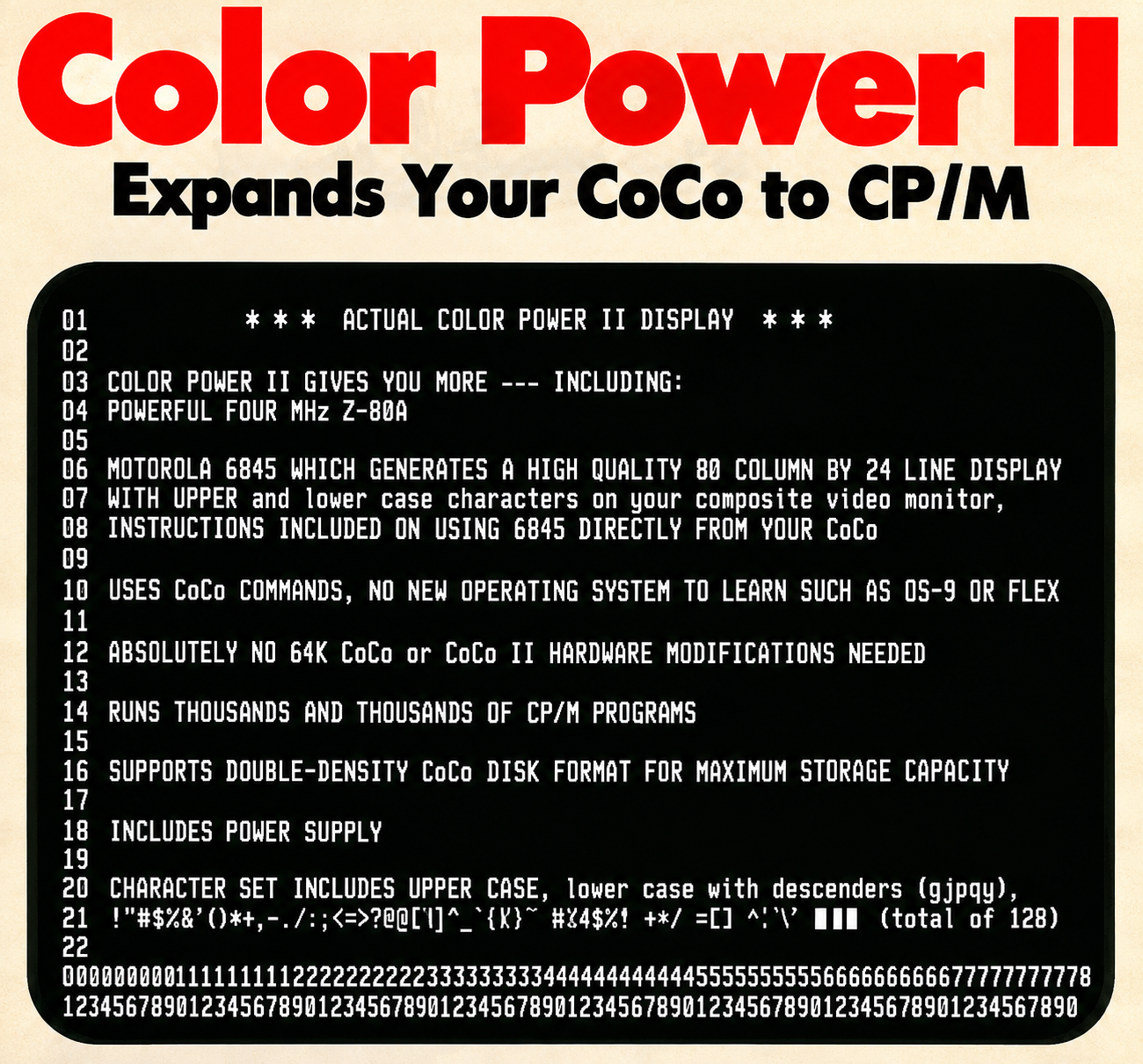
Color Power II - Color Power Unlimted
Period: Mid-1984
Original Price: $299.00 introductory; later $329.00
Compatibility: TRS-80 Color Computer and Color Computer 2, 64K
Classification: Z80 Coprocessor / Expansion Bus Interface
Bringing Business Computing to the Color Computer
During the early 1980s, Digital Research's CP/M operating system was one of the dominant software platforms for business-oriented microcomputers. Thousands of programs were available for CP/M-compatible computers, including word processors, spreadsheets, database applications, and programming utilities. Unfortunately, the TRS-80 Color Computer's Motorola 6809 processor could not directly execute software written for the Intel 8080 and Zilog Z80 processors commonly used by CP/M systems.
In 1984, Color Power Unlimited of New Providence, New Jersey, introduced Color Power II, an external expansion system designed to overcome that limitation by adding an entirely new processor architecture to the Color Computer.
Rather than replacing the CoCo or requiring extensive internal modifications, Color Power II connected through the computer's cartridge expansion bus. The system combined a Zilog Z80 processor, dedicated video hardware, and CP/M operating system software, transforming the Color Computer into a machine capable of running a substantial library of established business applications.
A Second Computer on the Expansion Bus
At the heart of Color Power II was a 4 MHz Zilog Z80 processor, accompanied by a Motorola 6845 video controller, 2K of dedicated video memory, an EPROM character generator, and additional control circuitry.
The hardware was housed in a metal enclosure approximately the size of a Radio Shack cassette recorder. The Color Computer connected to one side of the unit, while its existing floppy disk controller connected to the other, preserving access to the computer's disk drives.
Color Power II incorporated its own external power supply, avoiding the additional electrical load that would otherwise have been placed on the Color Computer.
Contemporary reviewers described the hardware as professionally constructed, with gold-plated connectors and a sturdy internal support structure.
The system required no internal modifications to either the original Color Computer or the Color Computer 2.
Two Processors Working Together
One of Color Power II's most interesting technical features was the cooperation between the Z80 and the Color Computer's original Motorola 6809 processor.
The Z80 handled execution of CP/M software, but Color Power Unlimited discovered that its 4 MHz processor could not reliably service the CoCo's double-density disk interface quickly enough.
Rather than redesigning the disk hardware, the developers assigned that responsibility to the Color Computer's existing 6809 processor.
This arrangement allowed the system to take advantage of the CoCo's established disk hardware while providing the Z80 environment required by CP/M applications.
The result was a genuine dual-processor expansion system, with two different processor architectures performing complementary tasks.
This cooperative operation is particularly significant because it demonstrates that Color Power II was much more than a simple cartridge-based peripheral. It was a substantial computing subsystem interfaced through the Color Computer's expansion bus.
A Dedicated 80-Column Display
Unlike some competing CP/M expansion systems, Color Power II included its own video display hardware.
The Motorola 6845 video controller generated an 80-column by 24-line monochrome text display, with upper- and lowercase characters, descenders, and a 128-character display set.
The system used a dedicated composite video output, which required connection to a suitable monochrome monitor. It did not generate an RF television signal through the Color Computer's normal video output.
The dedicated display provided a substantial improvement over the CoCo's standard 32-column text screen, particularly for business software designed around conventional 80-column terminals.
Color Power II's video interface also supported software emulation of the Lear Siegler ADM-3A terminal, providing compatibility with applications that expected standard terminal control sequences.
CP/M 2.2 and Disk Storage
Color Power II operated with Digital Research-compatible CP/M 2.2, adapted to work with the Color Computer's existing hardware.
The operating system was supplied on a specially formatted disk containing both the Color Computer startup software and the CP/M files.
Starting the system involved loading the Color Power II software from Disk BASIC, switching the computer into 64K operation, and transferring control to the CP/M environment.
Once running, users could access familiar CP/M commands and utilities, including directory listings, file copying, disk management, and software development tools.
Color Power II used the Color Computer's standard disk sector format, which consisted of 35 tracks with 256-byte sectors. Two logical CP/M sectors were packed into each physical disk sector, providing approximately 146K of CP/M storage per disk.
The system could also accommodate 40-track and 80-track drives, as well as double-sided configurations where supported.
Access to the CP/M Software Library
The primary attraction of Color Power II was its ability to run established CP/M applications.
Color Power Unlimited advertised compatibility with thousands of CP/M programs, including popular business packages such as WordStar, MailMerge, SpellStar, and StarIndex.
The system also included several utilities specifically adapted for the Color Computer, covering disk configuration, file management, communications, and software development.
One particularly ambitious utility was CONVERT, which could read disks written in 18 other CP/M formats, including those associated with Kaypro, Osborne, Xerox, and several TRS-80 systems.
This was especially useful because CP/M computers often used incompatible floppy disk formats despite running the same operating system.
However, CONVERT was primarily a one-way conversion utility. It could read supported foreign CP/M disk formats but could not write them, and it did not provide direct conversion between ordinary CoCo Disk BASIC files and CP/M files.
A Contemporary Review
In January 1985, The Rainbow published Peter A. Stark's three-page review, "Run CP/M With Color Power II," examining the hardware, operating system, software compatibility, and overall usefulness of the expansion.
Stark reviewed version 1.5 of Color Power II's CP/M software and generally found the system to be well constructed and capable of running established CP/M applications.
He reported successful operation of several commercial programs, including WordStar and SpellStar, although some software encountered minor display-control problems.
The review also identified several shortcomings. Certain keyboard combinations could interfere with applications, the system lacked a CP/M BASIC interpreter, and the supplied 29-page manual was considered inadequate for users unfamiliar with CP/M.
Despite these limitations, Stark concluded that Color Power II offered a solid hardware platform and a practical way for Color Computer owners to gain access to professional CP/M software.
Competing Approaches to CP/M Expansion
Color Power II was not the only product attempting to bring CP/M to the Color Computer.
Wayne Technology's COCO COUPLER 1, also marketed in 1984, offered a similar Z80-based processor expansion for approximately $250.
Both products connected through the Color Computer's cartridge expansion bus and retained the existing floppy disk controller.
The principal difference was that Color Power II incorporated its own dedicated 80-column display subsystem, while the COCO COUPLER 1 relied on software-based display techniques or an optional PBJ WORD-PAK 80-column adapter.
Color Power II was therefore a more integrated solution, although its additional video hardware contributed to a higher purchase price.
Both systems demonstrated the ingenuity of independent hardware developers attempting to extend the capabilities of the Color Computer beyond its original home-computing market.
An Unusual Dual-Processor Expansion
Color Power II represents one of the more sophisticated third-party expansion systems developed for the early TRS-80 Color Computer.
By combining a Z80 processor, dedicated video hardware, and cooperative operation with the CoCo's original 6809, it effectively added the capabilities of a CP/M business computer without requiring owners to abandon their existing hardware.
Although its commercial success and production numbers remain undocumented, Color Power II illustrates an important period in Color Computer development, when independent manufacturers were experimenting with alternative processors, operating systems, and peripheral architectures.
For owners seeking access to the established CP/M software library, Color Power II offered an ambitious alternative to purchasing a completely separate business computer.
Technical Specifications
Feature |
Specification |
|---|---|
| Manufacturer | Color Power Unlimited, Inc. |
| Model | Color Power II |
| Documented availability | 1984 |
| Introductory price | $299.00 |
| Later advertised price | $329.00 |
| Host computer | TRS-80 Color Computer / CoCo 2, 64K |
| Additional processor | Zilog Z80 |
| Processor clock | 4 MHz |
| Host processor | Motorola 6809 |
| Operating system | CP/M 2.2 |
| Video controller | Motorola 6845 |
| Video memory | 2K |
| Character generator | EPROM-based, 128-character set |
| Display resolution | 80 columns × 24 lines |
| Video output | Monochrome composite |
| Interface | CoCo cartridge expansion bus |
| Disk controller | Existing CoCo controller via pass-through |
| Disk format | 35-track CoCo format; 256-byte physical sectors |
| Disk capacity | Approximately 146K CP/M storage |
| Expanded disk support | 40/80-track and double-sided configurations |
| Included software | CP/M utilities, disk conversion and configuration programs |
| Power | External power supply |
| Installation | No internal computer modifications |
Historical Sources
- Color Power Unlimited, Inc., original Color Power II introductory advertisement, 1984 — Hardware specifications, capabilities, and introductory pricing.
- Peter A. Stark, "Run CP/M With Color Power II," The Rainbow, January 1985, pages 209–211 — Independent hardware and software review, including details of cooperative Z80/6809 operation, video hardware, disk formats, and compatibility.
- Eugene Bruny, review of Wayne Technology's COCO COUPLER 1, Color Computer Magazine, reproduced in Tandy Times, July 4, 1984 — Contemporary comparison with competing CP/M expansion hardware.
Spectrum Projects
Spectrum Switcher
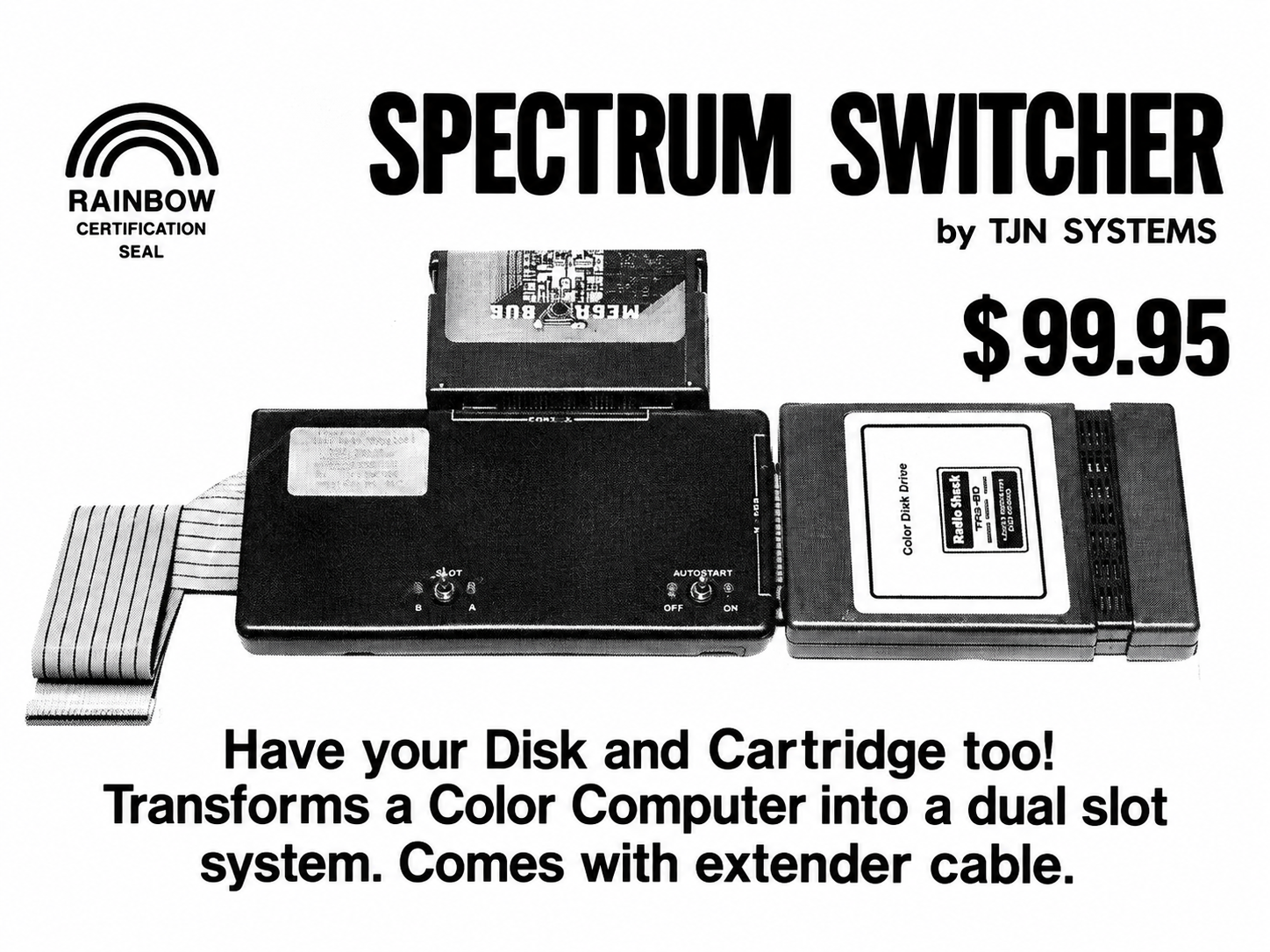
Spectrum Projects - Spectrum Switcher
The Spectrum Switcher was a two-port cartridge expansion device for the TRS-80 Color Computer, designed to solve one of the everyday annoyances of using multiple cartridges. Rather than repeatedly unplugging a disk controller to use another ROM Pak, the Switcher allowed two cartridges to remain connected simultaneously, with the active cartridge selected by a front-panel switch.
The unit connected to the CoCo through an extension ribbon cable and provided two clearly labeled cartridge connectors. Two switches controlled cartridge selection and operation, while LED indicators showed which slot was active. Switching from one cartridge to the other disabled the first and enabled the second, allowing combinations such as a disk controller and ROM Pak to remain connected.
An additional switch controlled whether the selected cartridge's auto-start function was enabled. This was particularly useful when transferring or backing up ROM cartridges to disk, since it eliminated the need to modify or tape cartridge contacts to prevent automatic execution.
Period review
The Spectrum Switcher received a notably favorable review in the April 1983 issue of The Rainbow, page 207. Reviewer Lawrence D. Preble described it as “by far, the easiest-to-use device we have yet encountered to keep two ROM Packs or cartridges ‘on line’ at the same time.”
Testing also specifically praised its gold contacts and reliable connections. The review reported that the unit worked without fault during extensive testing and reduced both connection problems and the wear caused by repeatedly inserting and removing cartridges from the CoCo's expansion port.
The reviewer found only one minor drawback: pressing the CoCo's RESET button or changing cartridge selection could cause a BASIC program in memory to be lost. Despite that limitation, the review concluded:
“The Spectrum Switcher is a fantastic device you will want to add to your setup.”
Period advertising listed the Spectrum Switcher at $99.95, describing it as transforming the Color Computer into a dual-slot system and supplying the required extender cable.
Howard Medical
SlotPak II & III
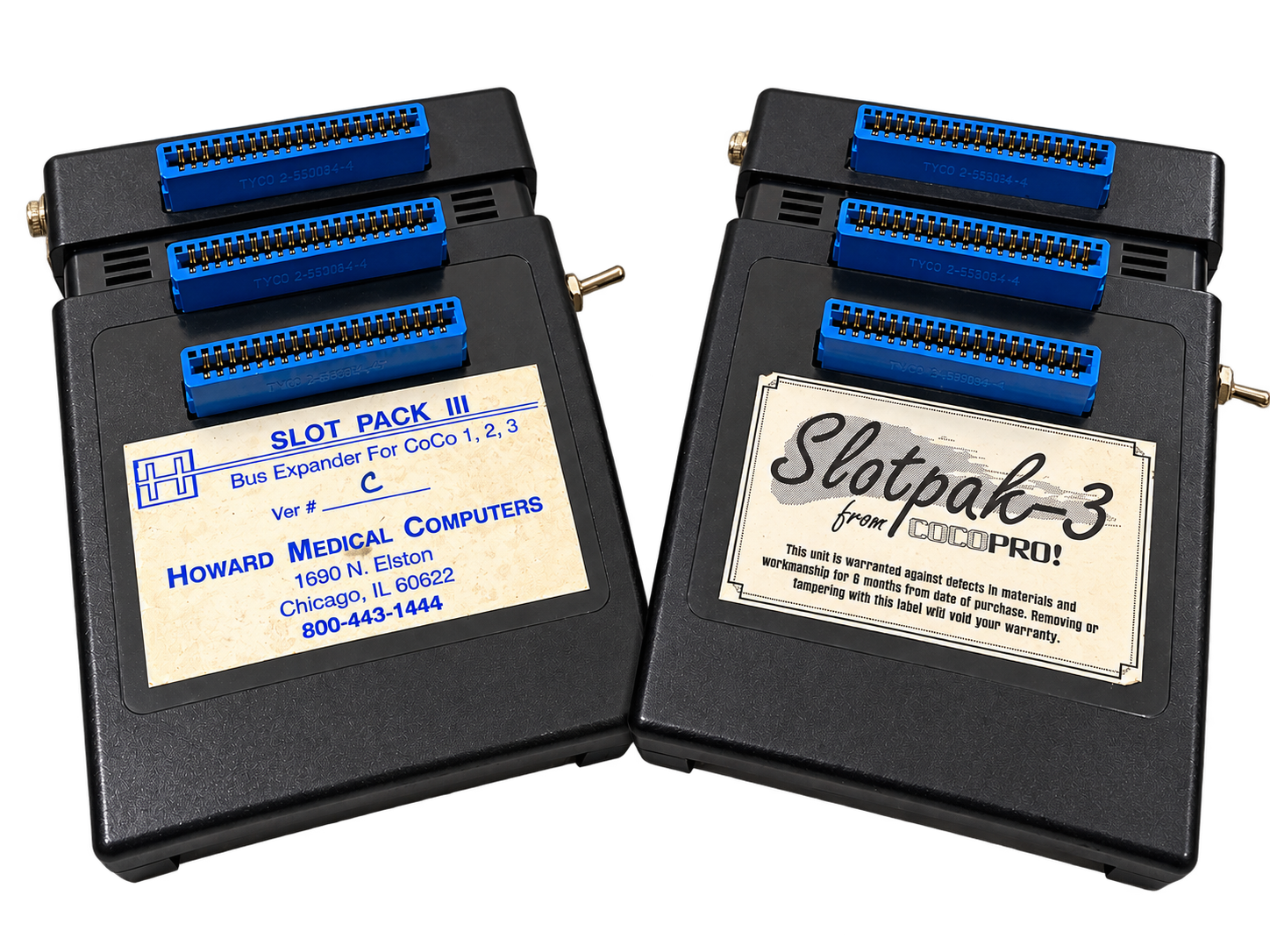
Howard Medical - Slot Pak II & III
The Slot-Pak II and Slot-Pak III were compact expansion interfaces produced by Howard Medical Computers as alternatives to the Radio Shack Multi-Pak Interface. Rather than providing four cartridge positions like the MPI, Howard's design used three expansion slots, providing a smaller and relatively straightforward way to keep several Color Computer peripherals connected.
The Slot-Pak II appeared around the end of 1989 and used three slots designated 1, 2 and X. Slots 1 and 2 could be selected under software control, while the X slot was intended for devices capable of handling their own address decoding. This allowed commonly used peripherals such as a disk controller and another cartridge to remain connected rather than continually being plugged into and removed from the CoCo's cartridge port.
Howard Medical subsequently introduced the Slot-Pak III, retaining the three-slot concept but refining the design. Its slots were designated A, B and X, with A and B switchable either manually or through software. Documentation specifically accommodated software written for the Radio Shack Multi-Pak Interface and recommended placing the disk controller in slot B when using MPI-oriented software.
The Slot-Pak III also incorporated a manual selector switch, improved buffering and provisions for external power. Howard's documentation notes that some peripherals requiring additional voltages could be accommodated with an external power supply rather than depending entirely upon the Color Computer.
Physically, the Slot-Pak III was quite different from Radio Shack's MPI. Instead of placing cartridges vertically into a broad enclosure, its three edge connectors were arranged along a relatively narrow case. Surviving examples show that the unit was produced under the Howard Medical Computers name, while later examples were sold as the Slotpak-3 by CoCoPRO!
Period documentation: Original installation manuals survive for both the Slot-Pak II and Slot-Pak III. Contemporary references also place Howard Medical's Slot-Pak products among the aftermarket expansion solutions that appeared after the original Radio Shack Multi-Pak Interface had become increasingly difficult to obtain.
Image note: The units pictured are surviving Slot-Pak III / Slotpak-3 examples. A verified period photograph of the earlier Slot-Pak II has not yet been located.
Images provided for use by Brian Wieseler
Maple Leaf Systems
Multiport
Maple Leaf Systems - Multiport
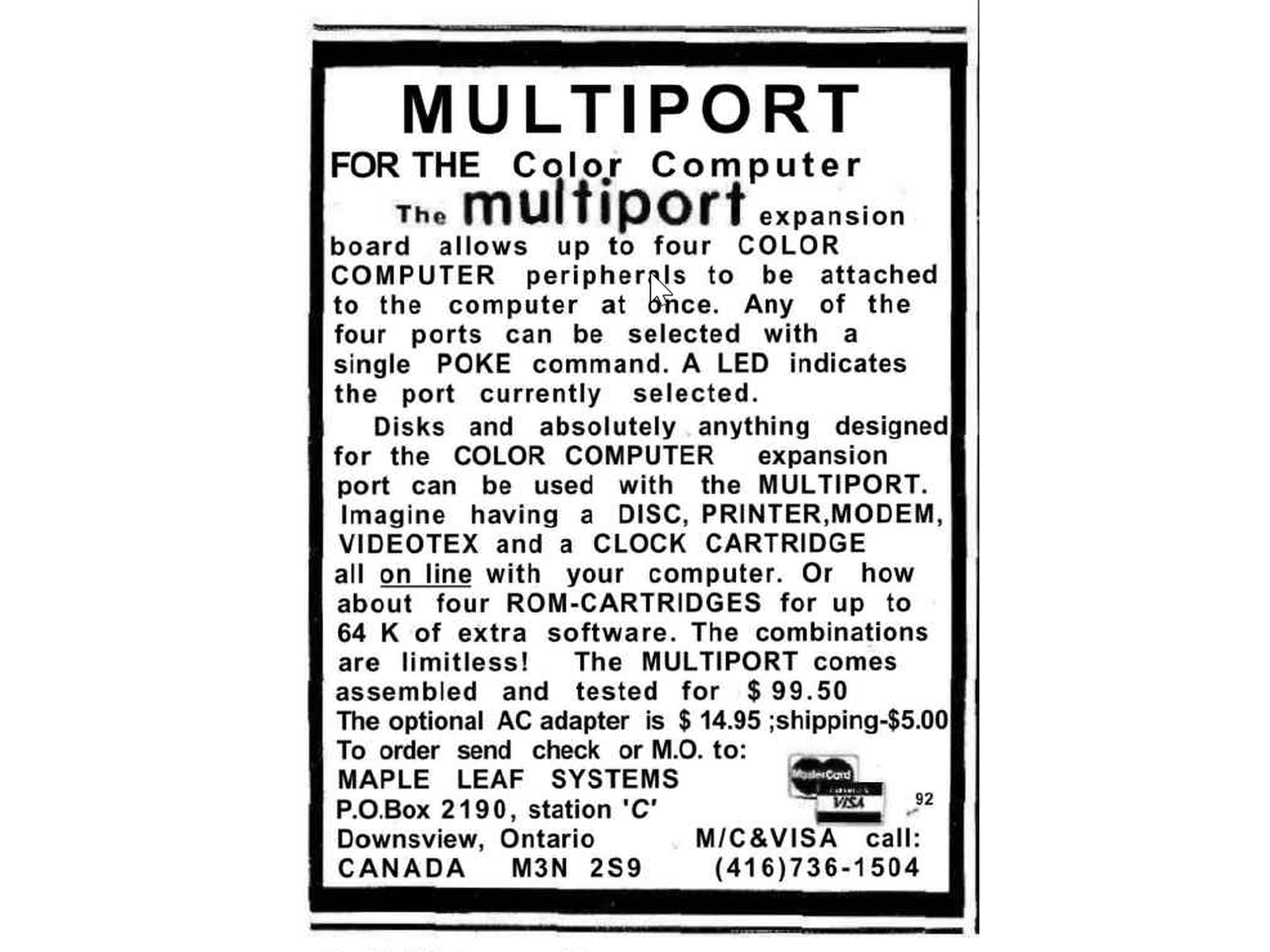
The Multiport was a four-port expansion interface produced by Maple Leaf Systems of Downsview, Ontario, Canada for the TRS-80 Color Computer. Appearing in 1983, it was designed to eliminate the constant swapping of cartridges as Color Computer owners accumulated disk controllers, printers, modems, communications hardware and ROM cartridges.
The Multiport allowed up to four Color Computer peripherals to remain connected simultaneously. Individual ports were selected under software control using a POKE command, with an LED indicating which port was currently active. Contemporary descriptions also stated that software could switch between peripherals and allow a program to access any or all of the connected devices.
Maple Leaf specifically advertised the unit for combinations such as a disk controller, printer, modem, videotex device and clock cartridge, as well as ROM cartridges providing additional software. The Multiport connected directly to the Color Computer's expansion port and required no unusual modification to the computer.
The unit was supplied fully assembled and tested for $99.50, making it considerably less expensive than some of the more elaborate expansion systems appearing during the same period. An optional AC adapter was offered for $14.95, providing external power when needed.
Period documentation: The Multiport was being promoted by early 1983, with contemporary product notices describing it as a multiple-slot expansion system for the Color Computer. Advertisements and product listings confirm its four-port design, software selection, LED status indicator and $99.50 price. While several contemporary references to the Multiport survive, no verified photograph of the actual hardware, instruction manual, or detailed hands-on review has yet been located.
USER80C
J-NOR Industries
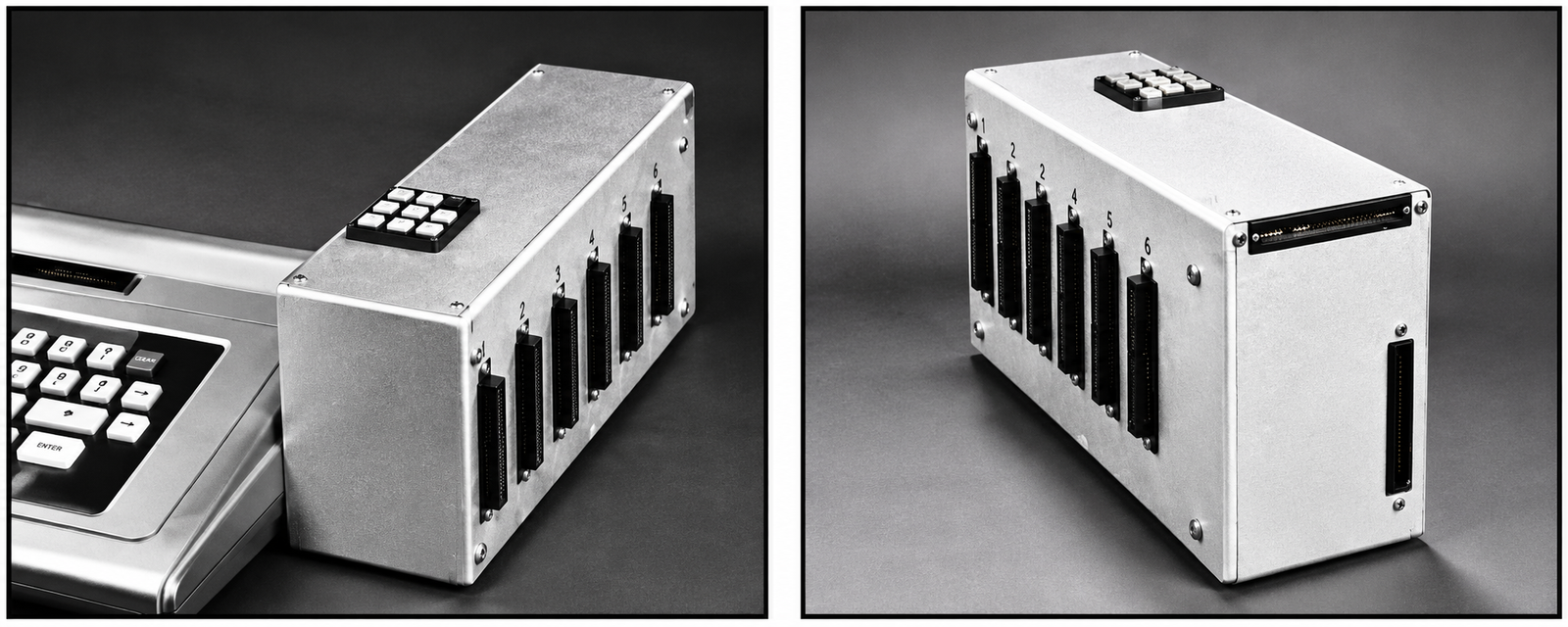
J-NOR Industries - USER80C
Manufacturer: J-NOR Industries, Inc. — Chicago, Illinois
Introduced: 1983 (advertised by June)
Original Price: $249.95
Compatibility: TRS-80 Color Computer
Six Slots and a Whole Lot of Possibilities
As the TRS-80 Color Computer gained popularity, owners quickly discovered one of its greatest limitations: a single cartridge expansion port. With disk controllers, ROM cartridges, memory expansions, and other peripherals competing for that one connection, changing devices often meant shutting down the computer and physically swapping cartridges.
In 1983, J-NOR Industries of Chicago, Illinois, offered an ambitious solution: the USER 80C, a six-slot expansion interface designed to give Color Computer owners considerably more flexibility than the computer's original single cartridge port.
Advertised for $249.95, the USER 80C was one of the more elaborate expansion interfaces available for the early Color Computer. Rather than simply providing additional cartridge connectors, J-NOR incorporated electronic slot selection, software control, independent power, and provisions for further expansion.
Six Expansion Slots with Software Control
The USER 80C provided six cartridge expansion slots, allowing owners to connect multiple peripherals without constantly unplugging and reconnecting equipment.
Individual slots could be selected using pushbutton controls mounted on top of the unit. J-NOR also advertised optional programmable control, allowing software to select or reset individual slots or groups of slots.
Included menu-driven software was advertised as supporting the operation of multiple slots at the same time, including transferring data between devices connected to different slots.
This was a particularly ambitious feature for the Color Computer, whose expansion architecture had originally been designed around a single cartridge connection.
J-NOR also advertised the ability to connect additional USER 80C units, potentially extending the system beyond its original six expansion slots.
Designed with the User in Mind
J-NOR emphasized convenience and protection as much as expandability.
The USER 80C featured gold-plated expansion connector contacts, intended to improve connection reliability, along with its own power switch and LED power indicator.
An independent reset button eliminated the need to reach behind the Color Computer to reset the system.
The unit also included a 9-volt battery eliminator (AC power adapter), allowing the expansion interface to operate from its own power supply rather than relying entirely on the Color Computer.
J-NOR promoted the USER 80C as providing protection against electrical damage associated with experimental boards and the insertion or removal of cartridges and controllers while power was applied. Although this was an advertised feature, it should not be interpreted as proof that hot-swapping every peripheral was electrically safe.
The system required no internal modifications to the Color Computer.
More Than Just a Cartridge Expander
J-NOR envisioned the USER 80C as the foundation for a broader peripheral expansion system.
Its September 1983 advertising mentioned several proposed accessories, including an analog-to-digital converter, parallel interfaces for printers and joysticks, and a four-channel oscilloscope.
The company also offered to produce experimental circuit boards based on customers' schematics.
These offerings suggest that J-NOR was targeting electronics enthusiasts, experimenters, and users interested in extending the Color Computer into instrumentation and control applications.
However, surviving documentation has not established whether all of the proposed accessories reached commercial production.
An Unusual Chapter in CoCo Expansion History
The USER 80C stood apart from many contemporary expansion interfaces because of its six-slot capacity, software-selectable connections, and provisions for chaining additional units.
Its distinctive metal enclosure, with six cartridge connectors arranged along one side and a small pushbutton control panel on top, also gave it a very different appearance from Radio Shack's later Multi-Pak Interface.
Despite its ambitious design, relatively little documentation survives. Period advertising establishes the unit's specifications and availability, but detailed technical manuals, schematics, and independent reviews remain difficult to locate.
Today, the J-NOR USER 80C represents one of the more unusual efforts by independent manufacturers to overcome the limitations of the early TRS-80 Color Computer.
It is also a reminder that long before modern expansion buses and plug-and-play peripherals, CoCo enthusiasts were already looking for ways to connect more hardware, automate peripheral selection, and turn an affordable home computer into something considerably more versatile.
Technical Specifications
Feature |
Specification |
|---|---|
| Manufacturer | J-NOR Industries, Inc. |
| Model | USER 80C |
| Year | 1983 |
| Original price | $249.95 |
| Expansion slots | Six |
| Slot selection | Pushbutton or optional software control |
| Multiple-slot operation | Advertised through included menu software |
| Additional expansion | Connection of additional USER 80C units advertised |
| Connectors | Gold-plated contacts |
| Power | Independent supply; 9V adapter included |
| Controls | Power switch, LED indicator, reset button |
| Installation | No internal computer modifications |
| Optional accessories | Programmable slot control; proposed peripheral interfaces |
Historical Sources
- The Rainbow, June 1983 — Early USER 80C advertising.
- HOT CoCo, September 1983, page 11 — J-NOR advertisement, product photographs, specifications, and original pricing.
- The Rainbow, October 1983 — Additional period advertising.
- Frank G. Swygert, Tandy's Little Wonder — Historical discussion of third-party Color Computer expansion interfaces.
MAX-SYS Electronics
Colorburst
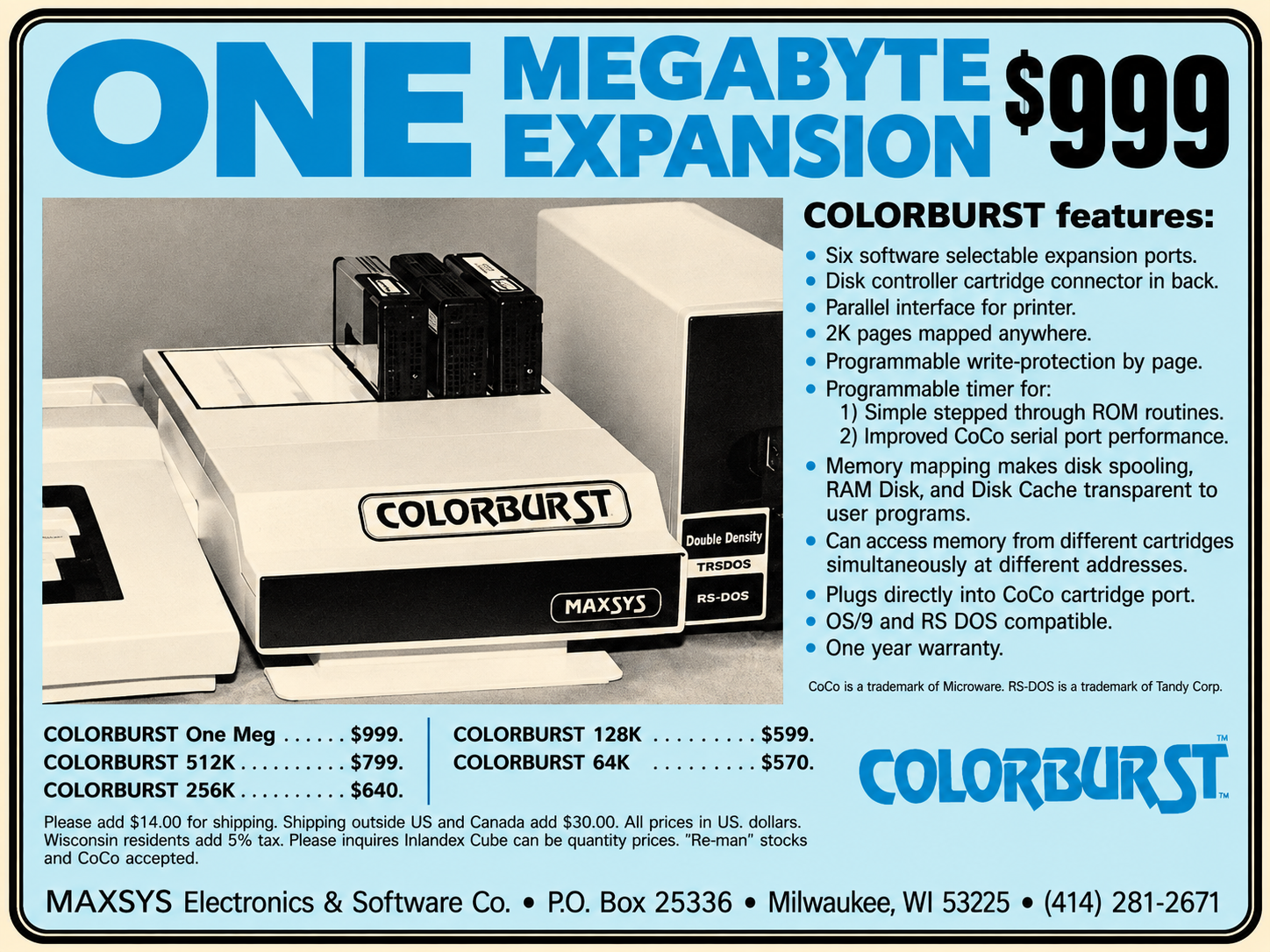
MAXSYS Electronics - Colorburst
Its six expansion ports were software selectable, allowing several Color Computer peripherals to remain connected simultaneously. A separate connector at the rear accommodated the disk-controller cartridge, while a built-in parallel printer interface provided another commonly needed connection without occupying one of the expansion slots. The Colorburst plugged directly into the CoCo's cartridge port and was advertised as compatible with both RS-DOS and OS-9.
Memory Expansion
Memory expansion was a major part of the design. MAXSYS offered the Colorburst with 64K, 128K, 256K, 512K, or a full one megabyte of RAM. Memory was organized in 2K pages that could be mapped anywhere, with programmable write protection on individual pages.
MAXSYS promoted this architecture for applications such as RAM disks, disk caching and print spooling, with the memory-mapping system intended to make these functions transparent to application software.
Contemporary coverage provides an interesting additional description of the system. In its September 1985 issue, HOT CoCo reported that Colorburst could add as much as one megabyte of contiguous memory to the Color Computer without the need for conventional bank switching. The magazine also noted ROM-based support for a print spooler, RAM spooler and disk cache, reinforcing just how much functionality MAXSYS was attempting to incorporate into the unit.
The system also included a programmable timer, advertised for such uses as single-stepping through ROM routines and improving the performance of the CoCo's serial port. MAXSYS further claimed that memory associated with different cartridges could be accessed simultaneously at different addresses, giving the Colorburst capabilities well beyond those of a conventional cartridge switcher.
Expansion and Disk Support
The Colorburst's expansion capabilities were intended to make it the center of a substantially expanded CoCo system. HOT CoCo described six software-selectable expansion ports, with one reserved for a disk controller.
Optional controller hardware and software could provide support for both floppy-disk and hard-disk systems, while the Colorburst's additional RAM could be used for disk caching. The system was designed to operate with both Radio Shack DOS and OS-9, making it useful in either of the major CoCo software environments of the period.
Pricing
All of this capability came at a substantial price.
MAXSYS advertised the Colorburst at $570 for the 64K version, with prices increasing to $599 for 128K, $640 for 256K and $799 for 512K. The fully expanded one-megabyte Colorburst sold for $999.
MAXSYS backed the system with a one-year warranty.
Period Documentation
MAXSYS was advertising the Colorburst during 1985, and contemporary Rainbowfest coverage confirms that the system was publicly demonstrated with its six expansion ports and memory expansion.
The September 1985 issue of HOT CoCo provides additional independent documentation of the Colorburst. Besides describing its memory expansion, software-selectable ports, RAM-based spooling and disk-cache capabilities, the magazine included a period photograph of the actual Colorburst hardware. The photograph shows the large external enclosure and provides valuable visual confirmation of the physical system beyond MAXSYS's own advertising.
Surviving advertising provides considerably more technical information about the Colorburst's memory architecture and expansion capabilities. A complete manual or detailed independent technical review has yet to be located.
Taken together, however, the surviving advertising, Rainbowfest reporting and HOT CoCo coverage establish the Colorburst as considerably more than another cartridge expander. With six software-selectable expansion ports, up to one megabyte of RAM, memory mapping, print spooling, disk caching, a parallel interface and optional floppy- and hard-disk support, MAXSYS was effectively attempting to turn the Color Computer into the center of a much larger computer system.
Ed Snider
Mini MPI
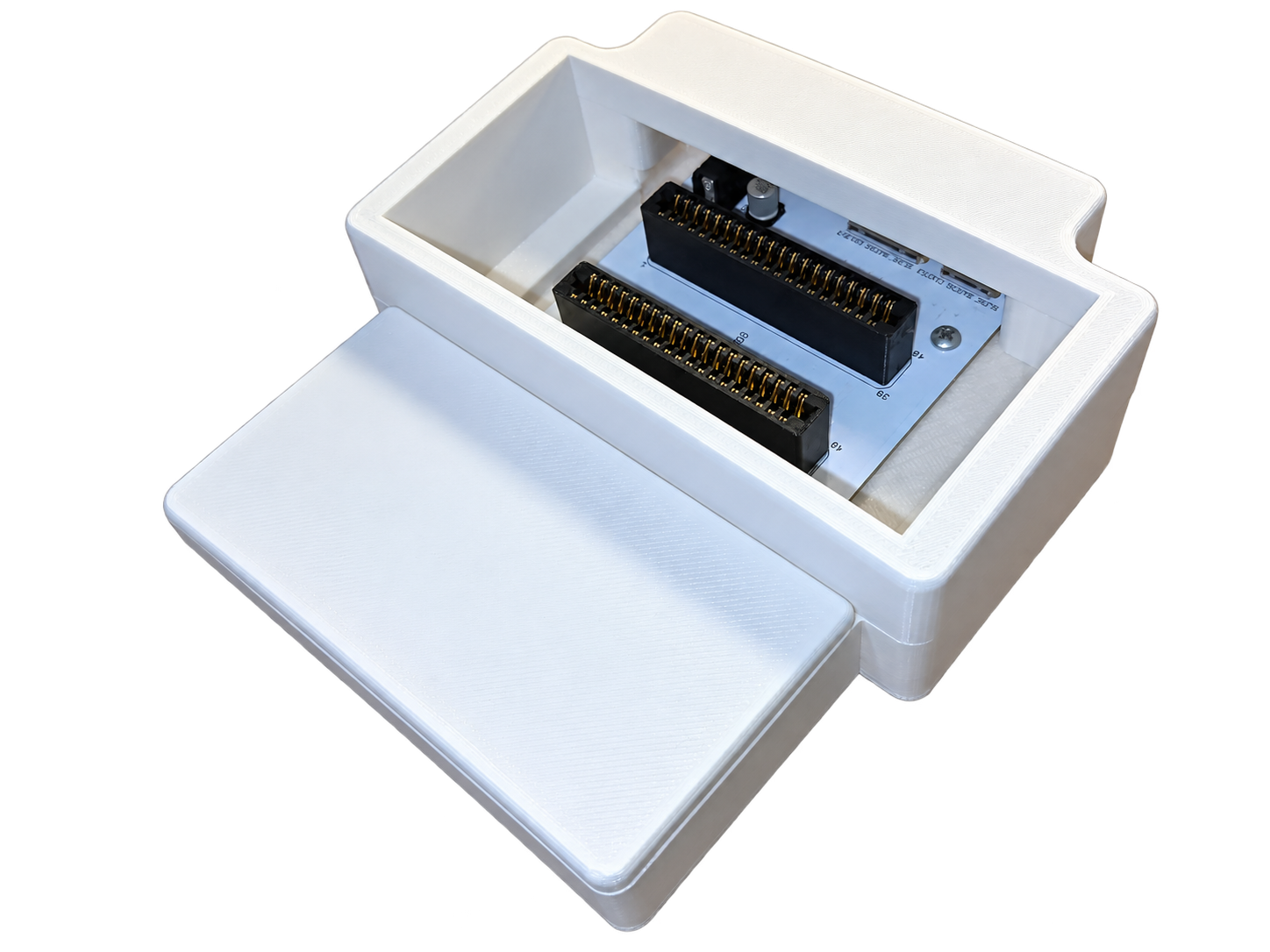
Zippster mini-MPI (2016)
Developer: Ed Snider (Zippster)
Development Period: 2016
Original Price: Not confirmed
Compatibility: Tandy TRS-80 Color Computer 1, 2, and 3; Dragon computers
Classification: Two-Slot Multi-Pak / Expansion Bus Interface
A Modern Alternative to the Original Multi-Pak
Radio Shack's original Multi-Pak Interface was one of the most useful accessories available for the TRS-80 Color Computer. By expanding the computer's single cartridge port into four independently selectable slots, it allowed owners to connect disk controllers, communications interfaces, sound cartridges, and other peripherals without constantly swapping hardware.
However, the original Multi-Pak was large, occupied considerable desk space, and had become increasingly difficult to obtain as the Color Computer entered its third decade as a vintage computing platform.
In 2016, Color Computer enthusiast and hardware developer Ed Snider, better known as Zippster, developed the mini-MPI, a compact two-slot alternative to the original Radio Shack expansion interface.
Rather than attempting to reproduce the entire four-slot Multi-Pak, Snider concentrated on a simpler objective: providing one additional cartridge connection in the smallest practical package, while retaining the essential bus-selection functions of the original hardware.
The result was a compact expansion device that combined modern programmable logic, buffered bus connections, and externally powered cartridge slots.
Two Slots Instead of Four
The mini-MPI connects directly to the Color Computer's cartridge expansion port and provides two cartridge slots in a small enclosure positioned alongside the computer.
For many users, two slots were sufficient. A typical configuration might combine a floppy disk controller or CoCo SDC storage interface with another accessory, such as an Orchestra 90 music cartridge or a communications interface.
The design retained the standard Multi-Pak's software-controlled slot-selection register at memory address $FF7F, allowing software to direct the appropriate cartridge control signals to the desired slot.
Although only two physical slots were provided, the mini-MPI preserved the addressing conventions of the original four-slot interface.
The first physical slot was always identified as slot 1, while the second could be configured to appear as slot 2, 3, or 4.
This was particularly important for software and cartridges that expected specific hardware to occupy a particular Multi-Pak slot.
Programmable Logic and Bus Buffering
Rather than duplicating the original Multi-Pak's collection of conventional logic circuitry, Snider used a Xilinx XC9572XL Complex Programmable Logic Device (CPLD) to implement the slot-selection register and associated control logic.
The CPLD controlled the routing of three important cartridge-bus signals:
- CTS (Cartridge Select): Used to select cartridge ROM and other devices responding to the cartridge-select signal.
- SCS (Spare Chip Select): Used by peripheral hardware occupying the cartridge I/O address range.
- CART: The cartridge interrupt signal, commonly associated with autostart cartridges and other interrupt-driven hardware.
The CTS and CART signals were routed together, while SCS could be directed independently to another slot.
This arrangement allowed different cartridges to respond to their respective control signals without interfering with one another.
The interface also employed 74ABT16245 16-bit bidirectional bus transceivers to buffer signals traveling between the Color Computer and the connected cartridges.
These components provided a modern implementation of the bus-interface functions required by the original Multi-Pak architecture.
Independent Cartridge Power
One of the mini-MPI's most important design considerations was power consumption.
The Color Computer's cartridge port was rated to supply approximately 300 milliamps of 5-volt power. Although simple ROM cartridges typically consumed relatively little current, peripherals such as floppy disk controllers could draw more than 200 milliamps individually.
Connecting multiple powered peripherals directly to the computer could therefore place an excessive load on its internal power supply.
Snider addressed this by providing independent 5-volt regulators for the two cartridge slots, supplied by an external 7.5-volt DC, 1-amp power adapter.
The mini-MPI itself consumed approximately 30 milliamps from the host computer during normal operation.
This arrangement substantially reduced the electrical burden placed on the Color Computer while allowing more demanding cartridge combinations to operate.
For compatibility with early Color Computer 1 accessories, the mini-MPI also passed through the host's positive and negative 12-volt cartridge power lines. These voltages were not generated internally, however, so they were unavailable when the interface was connected to a CoCo 2 or CoCo 3.
Flexible Slot Selection
The mini-MPI incorporated two small configuration switches rather than the four-position selector commonly associated with Radio Shack's original Multi-Pak.
The first switch selected which physical cartridge slot would be active when the computer was initially powered on.
The second switch determined whether the second physical slot would identify itself as logical slot 2, 3, or 4.
This flexibility was useful because some Color Computer software expected particular peripherals to occupy predetermined Multi-Pak positions.
For example, the mini-MPI manual described operating an Orchestra 90 music cartridge alongside a floppy disk controller by configuring the controller as slot 4.
Another documented arrangement paired Orchestra 90 with a CoCo SDC, allowing the music cartridge to access disk images through the modern storage interface.
Slot selection could also be changed directly through BASIC or machine-language software by writing to the standard Multi-Pak register.
The register remained compatible with the conventional four-slot numbering scheme, even though the mini-MPI provided only two physical cartridge connections.
Designed for Modern CoCo Peripherals
The mini-MPI arrived during a period of renewed hardware development within the Color Computer community.
Modern peripherals such as Darren Atkinson's CoCo SDC made it possible to use SD-card storage in place of conventional floppy disks, while reproductions and newly developed sound cartridges expanded the capabilities of surviving Color Computers.
Many of these accessories still relied on the original cartridge expansion port.
The mini-MPI provided a practical way to combine such devices without requiring the large original Radio Shack Multi-Pak Interface.
Its small enclosure, external power supply, and configurable slot assignments made it particularly attractive for owners seeking a compact, permanent expansion arrangement.
Development and Later Enclosures
Snider documented the mini-MPI's development through photographs of early prototypes, completed circuit boards, and assembled units.
Photographs from 2016 show the project progressing from prototype hardware to a completed expansion interface. The final revision pictured in the mini-MPI manual carries a June 2016 board marking.
The design was later documented on Snider's The Zippster Zone website in an article published May 7, 2018.
In February 2020, Snider updated the article to show a newly designed enclosure, demonstrating that development and refinement of the project continued after the original hardware had been completed.
These different enclosure styles are worth noting when identifying surviving examples, since the appearance of a mini-MPI may vary depending on its production period and case design.
Preserving and Extending the CoCo Expansion Bus
The mini-MPI represents an important example of modern hardware development for the Color Computer.
Unlike the ambitious expansion products of the 1980s, which often attempted to introduce entirely new processor architectures or operating systems, Snider's design concentrated on preserving and improving a familiar and essential capability.
By using a programmable logic device, modern bus transceivers, independent cartridge power regulation, and a compact enclosure, the mini-MPI reproduced the core functionality of Radio Shack's original Multi-Pak in a much smaller form.
It also demonstrated that the Color Computer's original expansion architecture remained useful decades after the machines themselves had left commercial production.
The mini-MPI would eventually be followed by Snider's more elaborate MEGA mini-MPI, which expanded the concept to four cartridge slots while incorporating additional sound, serial communications, and interrupt-management hardware.
Together, these products illustrate the continuing evolution of the Color Computer expansion bus through the efforts of its enthusiast community.
Technical Specifications
Feature |
Specification |
|---|---|
| Developer | Ed Snider (Zippster) |
| Model | mini-MPI |
| Documented development | 2016 |
| Developer article | May 7, 2018 |
| Original selling price | Not confirmed |
| Compatible computers | Color Computer 1, 2, 3; Dragon |
| Expansion interface | CoCo cartridge bus |
| Cartridge slots | 2 |
| Slot configuration | Physical slot 1 fixed; slot 2 selectable as logical slot 2, 3, or 4 |
| Logic controller | Xilinx XC9572XL CPLD |
| Bus buffering | 74ABT16245 16-bit transceivers |
| Slot selection register | $FF7F |
| Control signals | CTS, SCS, CART |
| Cartridge power | Separate regulated 5V supplies |
| External power | 7.5V DC, 1A |
| Host current consumption | Approximately 30mA |
| Legacy voltage support | CoCo 1 ±12V pass-through |
| Boot selection | Two-position switch |
| Second-slot identification | Three-position switch |
| Enclosure | Compact custom case; later enclosure revisions |
Historical Sources
- Ed Snider, "mini-MPI," The Zippster Zone, May 7, 2018; updated February 8, 2020. https://thezippsterzone.com/2018/05/07/mini-mpi/
- Ed Snider, The mini-MPI User's Manual, Revision 02b, six pages. Hardware architecture, configuration, operating instructions, and cartridge compatibility examples.
- mini-MPI circuit board photographs, including the June 2016 revision marking, reproduced in the developer's documentation.
Ed Snider
Mini MEGA MPI
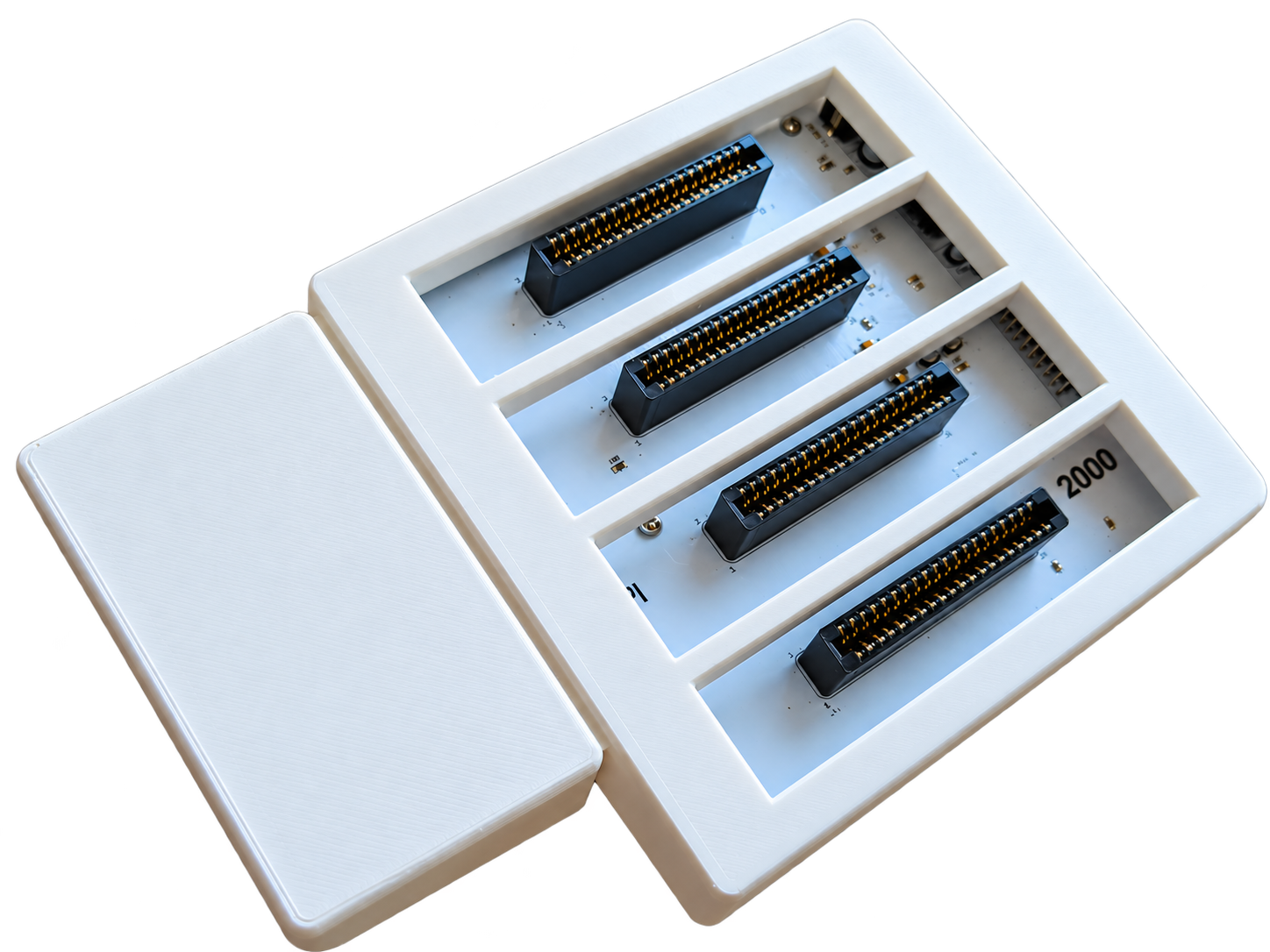
Zippster MEGA mini-MPI (2018)
Developer: Ed Snider (Zippster)
Development Period: 2018
Original Price: Not confirmed
Compatibility: Tandy TRS-80 Color Computer family
Classification: Four-Slot Multi-Pak / Multifunction Expansion Bus Interface
Taking the Multi-Pak to the Next Level
Radio Shack's original Multi-Pak Interface was one of the most important expansion accessories developed for the TRS-80 Color Computer. By providing four cartridge slots, it allowed users to connect disk controllers, communications devices, sound cartridges, and other peripherals simultaneously, greatly expanding the computer's usefulness.
Decades after Radio Shack discontinued the Color Computer, the need for multiple cartridge connections remained. Modern accessories such as the CoCo SDC, newly developed sound cartridges, and replacement disk controllers continued to rely on the machine's original expansion bus.
In 2016, hardware developer Ed Snider, better known as Zippster, introduced his compact two-slot mini-MPI, offering a modern alternative to the original Multi-Pak Interface.
Snider subsequently developed a more ambitious successor, the MEGA mini-MPI, documented on The Zippster Zone website in May 2018.
The new design restored the original four-slot arrangement while incorporating several capabilities that had never been available in Radio Shack's original expansion interface.
These included a Yamaha FM sound synthesizer, two high-speed serial communications controllers, programmable timers, enhanced interrupt handling, and software-controlled audio routing.
The result was much more than a replacement Multi-Pak. The MEGA mini-MPI combined conventional cartridge expansion with several additional peripheral functions in a single compact enclosure.
Four-Slot Cartridge Expansion
Like the original Radio Shack Multi-Pak Interface, the MEGA mini-MPI connected to the Color Computer's cartridge expansion port and provided four cartridge slots.
These slots allowed multiple peripherals to remain connected to the computer, eliminating the need to repeatedly remove and exchange cartridges.
The MEGA mini-MPI retained the standard Multi-Pak slot-selection register at memory address $FF7F, preserving compatibility with the established expansion architecture.
The Color Computer's cartridge bus provides several control signals that determine which peripheral should respond to a particular memory or I/O access.
Two especially important signals are:
- CTS (Cartridge Select): Used to select cartridge ROM and other devices responding to the cartridge-select signal.
- SCS (Spare Chip Select): Used to access peripheral hardware within the cartridge I/O address range.
The Multi-Pak selection register determines which slot receives each signal. This allows the computer to communicate with devices installed in different slots without conflicting responses.
The MEGA mini-MPI retained this familiar arrangement while extending the register's capabilities to accommodate its additional onboard hardware.
Modern Programmable Logic
The MEGA mini-MPI employed modern electronic components to implement the bus-control functions traditionally performed by the original Multi-Pak's conventional logic circuitry.
At the center of the design was a Xilinx XC95144XL Complex Programmable Logic Device (CPLD), which managed slot selection and the interface's additional control functions.
The expansion bus was buffered using 74ABT16245 bus transceivers, helping isolate the Color Computer's internal circuitry from the electrical demands of multiple connected peripherals.
By implementing much of the control circuitry in programmable logic, Snider was able to accommodate both the traditional four-slot Multi-Pak functions and the MEGA's additional hardware features without requiring a large collection of separate logic chips.
The system was housed in a custom enclosure designed to occupy considerably less desk space than Radio Shack's original Multi-Pak Interface.
Virtual Expansion Slots
One of the MEGA mini-MPI's most distinctive technical features was its use of virtual cartridge slots.
Although the interface provided four physical cartridge connectors, its internal control logic supported additional logical slot numbers for accessing the onboard hardware.
The standard Multi-Pak register at $FF7F contains separate fields for selecting the destination of the CTS and SCS signals.
Because each field contains four bits, the extended design could address as many as 16 logical slots.
Snider assigned several of these additional slot numbers to the MEGA's integrated peripherals.
Virtual Slot |
Function |
|---|---|
| 5 | Yamaha YMF262 FM sound synthesizer |
| 6 | Dual serial UART controllers |
| 16 | Extended Multi-Pak control registers |
Software could select the appropriate virtual slot through the standard Multi-Pak register before accessing the associated hardware.
This approach preserved the original expansion mechanism while extending it to devices that did not occupy physical cartridge connectors.
Yamaha OPL3 FM Sound
Perhaps the most immediately recognizable addition to the MEGA mini-MPI was its Yamaha YMF262 OPL3 sound synthesizer.
The YMF262 was widely used in IBM PC-compatible sound hardware, including Sound Blaster and AdLib-compatible sound cards.
Unlike the Color Computer's relatively simple built-in sound circuitry, the OPL3 generated audio using frequency-modulation synthesis, allowing complex musical tones, layered instruments, and multichannel compositions.
The MEGA mini-MPI provided a dedicated stereo audio output for connecting powered speakers, an amplifier, or another suitable audio device.
The sound chip could also feed a mixed mono signal into the Color Computer's cartridge audio input, allowing sound to pass through the computer's existing audio output circuitry.
This provided flexibility for users who wanted improved sound quality through external speakers or preferred to retain the computer's original audio connections.
The YMF262 was accessed through virtual slot 5, using memory-mapped registers beginning at $FF50.
The chip also incorporated two programmable timers, which could be used by software in addition to its audio-generation functions.
Dual High-Speed Serial Ports
The MEGA mini-MPI also incorporated two NXP SC16C550B UARTs, providing a substantial improvement over the Color Computer's original serial communications capabilities.
These UARTs supported conventional asynchronous serial communication and included hardware features intended to reduce the amount of processor intervention required during data transfers.
The serial controllers were clocked at 29.4912 MHz, allowing standard baud rates to be generated without the timing errors that can occur when a UART clock is not an exact multiple of the desired communication rate.
The documentation specified standard rates ranging from 600 baud to 1,843,200 baud.
The two UARTs were accessed through virtual slot 6, using memory-mapped registers in the $FF40 and $FF50 address ranges.
Their external connections were provided through a 26-pin header on the side of the enclosure.
The header exposed the serial control and data signals, along with 3.3-volt and 5-volt power connections.
These were TTL-level interfaces rather than conventional RS-232 voltage-level ports, so appropriate interface circuitry would be required when connecting equipment expecting standard RS-232 signaling.
During development, Snider reported achieving serial transfer rates exceeding 50 kilobytes per second on a standard-speed CoCo 2, demonstrating the potential of the new interface even with the Color Computer's original processor speed.
Enhanced Interrupt Management
The original Radio Shack Multi-Pak Interface provided relatively limited interrupt handling.
In a conventional Multi-Pak, the cartridge interrupt signal was associated with the slot currently selected for the CTS signal.
This arrangement worked adequately for many cartridges, but it made handling interrupts from multiple peripherals more difficult.
The MEGA mini-MPI introduced a programmable interrupt-management system that could monitor multiple sources independently.
The system supported eight interrupt sources:
- Four physical cartridge slots
- Yamaha YMF262 sound synthesizer
- UART A
- UART B
- Programmable timer
Software could enable individual interrupt sources through a control register and read a separate status register to determine which device had requested service.
This allowed peripherals to generate interrupts even when their physical cartridge slot was not currently selected for ordinary bus access.
The enhanced interrupt system was disabled at startup, preserving conventional Multi-Pak behavior until software explicitly enabled the additional features.
This approach helped maintain compatibility with existing Color Computer software while making more sophisticated interrupt-driven applications possible.
Programmable Timing Functions
In addition to the two timers incorporated into the Yamaha sound chip, the MEGA mini-MPI provided a separate programmable timer.
This timer was accessible through the extended control registers associated with virtual slot 16.
The timer could generate an interrupt, allowing software to perform operations at controlled intervals without relying entirely on the Color Computer's existing timing resources.
Such functionality was potentially useful for communications software, sound playback, background processing, and other applications requiring periodic events.
Together with the enhanced interrupt controller, the additional timer gave programmers greater flexibility when coordinating multiple peripherals.
Software-Controlled Audio Routing
Another practical improvement concerned the way sound from multiple cartridges was handled.
The Color Computer's cartridge expansion bus included an audio input connection that allowed sound-producing cartridges to feed audio into the computer.
However, when multiple cartridges attempted to drive this connection simultaneously, their outputs could interfere with one another and reduce sound quality.
During development, Snider identified this problem and incorporated an analog audio switch into the MEGA mini-MPI.
Software could select which audio source was connected to the Color Computer's cartridge audio input.
Available sources included the four physical cartridge slots and the onboard Yamaha YMF262 sound synthesizer.
Only the selected source was routed to the computer's cartridge audio connection, preventing unwanted interaction between multiple sound-producing devices.
The audio selection was controlled through the MEGA's extended features register.
This was a particularly thoughtful addition because it addressed a problem that could arise when combining several audio-capable cartridges in a conventional Multi-Pak.
A New Generation of CoCo Expansion Hardware
The MEGA mini-MPI was developed during a period of renewed interest in creating sophisticated hardware for the Color Computer.
Modern programmable logic devices, compact circuit-board manufacturing, and 3D-printed enclosures made it possible for independent developers to produce expansion hardware that would have been difficult or expensive to manufacture during the computer's original commercial lifetime.
Snider's design demonstrated how these technologies could be used not merely to reproduce existing hardware, but to extend the Color Computer's capabilities substantially.
The MEGA mini-MPI preserved the familiar four-slot expansion architecture while integrating sound synthesis, high-speed serial communications, programmable timing, and advanced interrupt management.
These additions made it possible to develop applications that could take advantage of capabilities unavailable on the original Multi-Pak Interface.
Continuing the Multi-Pak Legacy
The MEGA mini-MPI represents one of the more ambitious modern interpretations of the Color Computer's original expansion bus.
Where the earlier mini-MPI concentrated on providing a compact and convenient two-slot replacement, the MEGA mini-MPI combined a full four-slot interface with an integrated collection of additional peripherals.
Its use of virtual slots was particularly significant, allowing new hardware to coexist with the traditional cartridge-selection mechanism without requiring a fundamentally different expansion architecture.
The result demonstrated the flexibility of the Color Computer's original design and the ingenuity of the developers who continued working with it decades after its commercial production ended.
Together, the mini-MPI and MEGA mini-MPI illustrate the progression from straightforward replacement hardware to sophisticated modern expansion systems, helping preserve the Color Computer as an active platform for hardware and software experimentation.
Technical Specifications
Feature |
Specification |
|---|---|
| Developer | Ed Snider (Zippster) |
| Model | MEGA mini-MPI |
| Documented development | 2018 |
| Original selling price | Not confirmed |
| Host computers | Tandy Color Computer family |
| Expansion interface | CoCo cartridge bus |
| Physical cartridge slots | 4 |
| Logical slot addressing | Up to 16 |
| Slot selection register | $FF7F |
| Programmable logic | Xilinx XC95144XL CPLD |
| Bus transceivers | 74ABT16245 |
| Sound processor | Yamaha YMF262 OPL3 |
| Audio output | Stereo output; selectable mono cartridge audio |
| Serial controllers | 2 × NXP SC16C550B |
| UART clock | 29.4912 MHz |
| Documented baud rates | 600–1,843,200 baud |
| Serial connections | 26-pin TTL-level header |
| Programmable timers | 3 total, including 2 in YMF262 |
| Interrupt controller | 8 independently selectable sources |
| Interrupt output | CART/FIRQ |
| Audio routing | Software-controlled analog switch |
| Onboard sound virtual slot | 5 |
| UART virtual slot | 6 |
| Extended control virtual slot | 16 |
| Enclosure | Custom 3D-printed housing |
Historical Sources
- Ed Snider, "MEGA mini-MPI," The Zippster Zone, May 9, 2018. https://thezippsterzone.com/2018/05/09/mega-mini-mpi/
- Ed Snider, MEGA mini-MPI User and Programming Manual, nine pages. Technical specifications, slot arbitration, register assignments, sound interface, serial controllers, interrupt handling, and audio routing.
- Ed Snider, The mini-MPI User's Manual, Revision 02b. Documentation of the earlier two-slot design and its relationship to the original Multi-Pak architecture.
DID THIS THING ACTUALLY GET MADE?
Some Color Computer products survive today only as a name, an advertisement or a brief mention in a magazine.
Others were clearly demonstrated or documented when new, yet no surviving example is presently known.
Those mysteries are part of the history too.
Expansion Interface
F&D Systems - 1981
Among the earliest proposed expansion devices for the Color Computer was an Expansion Interface from F&D Associates of New Plymouth, Ohio. The device was being discussed in 68 Micro Journal as early as March 1981, only months after the Color Computer reached the market.
F&D was already an established microcomputer hardware manufacturer and produced a ROM/EPROM Board and Proto Board for the Color Computer. Contemporary reports indicate that the company also announced plans for an Expansion Interface intended to extend the CoCo's limited cartridge expansion capability.
Unlike F&D's EPROM board, which is documented as having reached the market, surviving information about the Expansion Interface is extremely scarce. It is presently unclear whether the interface entered regular production, was produced only in small quantities, or remained a proposed product.
HELP US DOCUMENT IT!
This is intended to be a living museum exhibit.
If you own hardware shown here — or something we've missed entirely — photographs, manuals, advertisements, schematics, packaging, software and firsthand information can help preserve a part of Color Computer history that might otherwise disappear.
Particularly useful are photographs of surviving hardware accompanied by the manufacturer, model name and any history known about the device.